Pharmacovigilance Case Processing Jobs Freshers: Complete Industry Workflow Roadmap

Pharmacovigilance Case Processor jobs for freshers involve collecting, triaging, coding, and reporting adverse event cases from clinical trials and post-marketing sources. In India, pharmacovigilance case processing jobs freshers suit BDS, BHMS, BAMS, Nursing and life science graduates; salaries usually start at ₹3.2–₹5.5 LPA.
If you are a BDS, BHMS, BAMS, Nursing, or allied health graduate stuck in an IT, BPO, or non-healthcare role, there is a structured way out. Pharmacovigilance case processing jobs freshers are built on workflows, not guesswork, so your clinical background can finally count.
The relief is simple: entry-level employers do not expect years of safety experience. They expect you to understand the case workflow, safety database discipline, and documentation standards before Day 1.
Build These Skills Now
Programs from ZANE ProEd Academy that directly address the skill gaps discussed above.
This guide breaks down the industry workflow so you can move in the next hiring cycle, not after another vague certificate.
Pharmacovigilance Case Processing Jobs Freshers: What Does a Pharmacovigilance Case Processor Do?
Picture this: a hospital sends a suspected adverse drug reaction report to a company safety team. The case processor opens the source document, checks whether it is valid, and starts turning that messy real-world event into a structured safety case.
The pharmacovigilance case processor job description is therefore part data entry, part clinical judgement, and part quality control. You are the first serious checkpoint in adverse event reporting jobs.
- Case intake: collect reports from emails, phone calls, literature, clinical trials, or partner companies.
- Triage: identify serious, non-serious, expected, and unexpected cases as per timelines.
- Data entry: enter patient, reporter, drug, event, and narrative details into a safety database.
- Coding: map medical terms using MedDRA and drugs using WHO Drug dictionaries.
- Quality check: fix inconsistencies before a senior reviewer or medical reviewer signs off.
- Submission support: prepare cases for regulatory reporting under CDSCO and global requirements.
Common tools include Oracle Argus Safety, ArisGlobal LifeSphere, and Veeva Vault Safety. Freshers are not expected to know every button, but they must understand the case lifecycle and why each field matters.
What is the salary of a PV Case Processor in India?
For PV case processor salary India expectations, freshers usually start between ₹3.2 LPA and ₹5.5 LPA. With strong ICSR workflow knowledge and a clean simulated portfolio, some candidates cross ₹5.5 LPA in their first offer itself.
- Fresher: ₹3.2 LPA to ₹5.5 LPA.
- 1 to 3 years: ₹5 LPA to ₹7.5 LPA.
- Senior processor or QC: ₹7.5 LPA to ₹8.5 LPA and above.
- Hiring hubs: Hyderabad, Bangalore, Pune, Mumbai, and Chennai.
Salary depends on the safety database you can use, your MedDRA confidence, shift flexibility, and whether you can prove quality-focused work habits. A certificate alone rarely moves salary; a verifiable workflow portfolio often does.
How to get a PV case processing job as a fresher?
Start with the end in mind: a hiring manager wants evidence that you can process a case without creating quality errors. Your ICSR processing career begins when you can demonstrate that evidence clearly.
- Learn the vocabulary: adverse event, serious adverse event, ICSR, causality, expectedness, and reporting timelines.
- Understand the workflow: intake, triage, duplicate check, data entry, coding, narrative, QC, and submission.
- Practise in a safety database: simulation on Argus Safety-style screens beats passive video watching.
- Build proof: maintain a portfolio of completed mock cases, coding logs, and QC corrections.
- Apply to the right roles: search for drug safety associate, PV case processor, safety data coordinator, and adverse event reviewer roles.
For a wider roadmap, read the pharmacovigilance case processing jobs freshers career roadmap and the pharmacovigilance jobs for freshers in India industry blueprint.
What is ICSR processing in pharmacovigilance?
An ICSR is an Individual Case Safety Report. It is the structured record of one patient who experienced one or more adverse events after exposure to one or more drugs. ICSR processing is the workflow that turns that report into a complete, coded, and review-ready safety case.
- Intake and validity check: confirm the minimum criteria of patient, reporter, drug, and event.
- Triage: classify seriousness and start the clock for regulatory timelines.
- Duplicate search: check whether the same case already exists in the database.
- Data entry: capture demographics, medical history, suspect drugs, concomitant drugs, events, and outcome.
- MedDRA and drug coding: assign accurate dictionary terms to events and medications.
- Narrative writing: summarise the story clearly without adding unsupported opinions.
- Quality review: correct missing fields, inconsistencies, and coding errors.
- Reporting: prepare expedited or periodic submissions as per ICH E2B and local rules.
This is why ICSR processing career paths are strong for medical and allied health graduates: your clinical training helps you spot seriousness, causality, and medically important details that a non-clinical fresher may miss.
What is MedDRA coding and how is it used in PV?
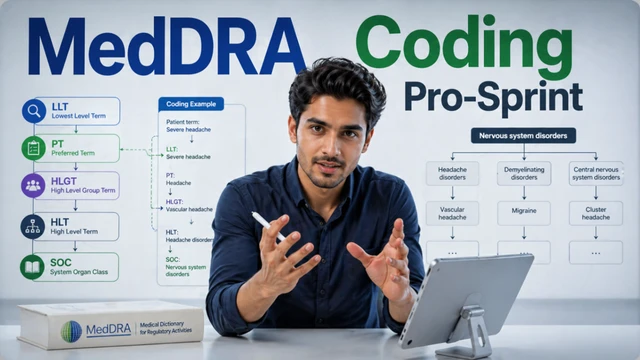
MedDRA is the Medical Dictionary for Regulatory Activities. It gives safety teams a standard language for adverse events. Instead of writing five versions of 'stomach pain', the case processor maps the event to the most accurate MedDRA term.
For MedDRA coding for freshers, understand the hierarchy:
- LLT: Lowest Level Term, closest to the reporter's words.
- PT: Preferred Term, the standard event label.
- HLT: High Level Term, groups related PTs.
- HLGT: High Level Group Term, a broader clinical group.
- SOC: System Organ Class, the top-level body system category.
Accurate coding affects signal detection, regulatory submissions, and labelling decisions. A wrong PT can hide a real safety issue. That is why employers test fresh candidates on medical term accuracy, not just database speed.
What gap do BDS, BHMS, BAMS and Nursing graduates face in PV hiring?
Your conventional education gives you anatomy, pathology, pharmacology, and patient-care exposure. That is valuable. The gap is that Indian PV employers also expect workflow-level readiness from Day 1.
- Colleges teach: clinical subjects and patient management. Employers expect: ICSR triage, Argus Safety-style data entry, and case narrative discipline.
- Colleges teach: diagnosis and treatment. Employers expect: adverse event reporting timelines, seriousness criteria, and expectedness checks.
- Colleges teach: textbook terminology. Employers expect: MedDRA coding, WHO Drug coding, and quality correction habits.
- Colleges teach: exams. Employers expect: audit-ready documentation and proof that you can follow WHO and ICH-aligned processes.
For career switchers from IT, BPO, or non-healthcare roles, the gap is even more specific: you must show clinical interpretation plus safety database discipline. Relief comes from structured simulation, not from another generic soft-skills course.
What is the step-by-step pathway into PV case processing jobs?
Use this workflow-level pathway if you want to be interview-ready in the next hiring cycle.
- Week 1 to 2: Build the foundation. Learn adverse event definitions, seriousness criteria, expectedness, causality, and reporting timelines.
- Week 3 to 4: Practise ICSR workflow. Process mock cases from intake to QC using a safety database simulation.
- Week 5: Master MedDRA basics. Code events from case narratives, compare your terms with a mentor's log, and correct errors.
- Week 6: Build a portfolio. Keep mock case files, coding rationales, QC checklists, and a short workflow summary ready for interviews.
- Week 7: Prepare job-search assets. Rewrite your CV around PV keywords, tool exposure, and case-processing outputs.
- Week 8 onward: Apply and rehearse. Target PV hubs, practise case-based interview questions, and track every application.
This pathway works for BDS, BHMS, BAMS, Nursing, BPharm, MPharm, and life science graduates because it converts your existing knowledge into an industry workflow.
How can simulation and portfolio proof close the experience gap?
Employers cannot verify what you only watched in a video. They can verify what you practised, documented, and explained clearly. Simulation-based learning gives you that bridge.
When you process mock ICSRs in an Argus Safety-style environment, you learn the invisible rules: what to check first, how to code conservatively, when to query, and how to write a clean narrative. A portfolio then turns that practice into interview evidence.
Build These Skills Now
Programs from ZANE ProEd Academy that directly address the skill gaps discussed above.
Which professional certifications build industry-ready PV case processing skills?
ZANE ProEd Academy is a professional career-certification platform built around industry-grade simulation toolkits, not passive lectures. The focus is structured preparation for real safety workflows and audit-ready output.
- ICSR Case Processing and Triage: learn intake, validity, seriousness, duplicate search, data entry, narrative writing, QC, and submission readiness using simulation-led practice.
- MedDRA Medical Coding Certification: build coding accuracy through hierarchy practice, term selection, coding rationales, and quality review.
The ROI is practical: you close the qualification gap, create a portfolio that hiring managers can review, and prepare for high-paying roles in Hyderabad, Bangalore, Pune, and Mumbai. The academy also supports professional exposure to industry systems such as Argus Safety ICSR case processing, Medidata Rave EDC, Veeva Vault eTMF, and FDA 21 CFR submissions.
Explore the broader ZANE ProEd Academy approach if you want to understand how professional certification differs from casual online learning.
What should you audit before the next hiring cycle?
Before you apply, audit your industry readiness honestly. Can you explain an ICSR workflow without notes? Can you code ten adverse events accurately? Can you show a mock case file that looks audit-ready?
Use consultative next steps instead of rushing into applications:
- Audit your industry readiness against the case processor job description.
- Review the simulation curriculum for Argus Safety-style ICSR practice.
- Explore Professional Certification Blueprints for ICSR case processing and MedDRA coding.
- Map your next 30 days to one measurable output: a completed portfolio of mock safety cases.
The structured way out is not a mystery. It is a workflow you learn, practise, document, and present with confidence.
Build These Skills Now
Programs from ZANE ProEd Academy that directly address the skill gaps discussed above.
Follow Zane ProEd on Google
Preferred SourceAdd our publication as a preferred source to get the latest clinical research guides, industry updates, and career intel directly in your Google Top Stories & AI Overviews.