Pharmacovigilance Case Processing Jobs for Freshers: Step-by-Step Roadmap

Pharmacovigilance Case Processor jobs for freshers involve analyzing and processing Individual Case Safety Reports (ICSRs) from clinical trials or post-marketing surveillance. You’ll learn to code adverse events using MedDRA, enter data into safety databases, and ensure compliance with global regulations. With practical skills, freshers can secure these roles in 3–6 months.
If you feel stuck with only college theory and no practical skills, pharmacovigilance case processing jobs freshers can feel like a locked door. BPharm and MPharm programs teach pharmacology, but they rarely cover the real-world tasks of a PV case processor. This guide will give you a clear step-by-step roadmap to land your first job fast.
What does a Pharmacovigilance Case Processor do?
A pharmacovigilance case processor is the backbone of drug safety. They review incoming adverse event reports from patients, doctors, or clinical trials. Their job is to enter this data accurately into safety databases, code medical terms using MedDRA, and ensure each case follows strict regulatory timelines.
Build These Skills Now
Programs from ZANE ProEd Academy that directly address the skill gaps discussed above.
Here is a typical pharmacovigilance case processor job description:
- Case intake and triage: Receive reports via email, phone, or E2B systems. Prioritize based on seriousness.
- Data entry: Enter all patient details, drug information, and adverse events into a safety database like Argus or ArisG.
- MedDRA coding: Assign standardized medical codes to each adverse event and medical history term.
- Narrative writing: Create a clear medical narrative summarizing the case.
- Quality review: Check for accuracy and completeness before sending to medical reviewers.
- Regulatory submission: Ensure the report is submitted to authorities like FDA or CDSCO within the required timeframe.
What is the salary of a PV Case Processor in India?
The PV case processor salary India varies by city, company, and experience. As a fresher, you can expect:
- Fresher (0-1 year): ₹2.5 - 4.5 LPA (lakhs per annum)
- After 1-3 years: ₹4.5 - 7 LPA
- Senior roles (3-5 years): ₹7 - 12 LPA
Companies like Accenture, TCS, IQVIA, and Parexel often hire fresh graduates. Getting skilled in ICSR processing and MedDRA coding can push your starting salary toward the higher end.
How to get a PV case processing job as a fresher?
Getting pharmacovigilance case processing jobs freshers might seem tough, but it’s all about the right preparation. Here’s the step-by-step plan:
- Fill the skill gap: Most colleges don’t teach ICSR processing or MedDRA coding. Enroll in targeted training programs (see Skill Gap section).
- Get hands-on practice: Work on mock cases. Practice coding adverse events using MedDRA dictionaries.
- Build a PV-focused resume: Highlight any training, projects, or certifications in pharmacovigilance.
- Apply to entry-level roles: Look for titles like “Drug Safety Associate”, “PV Case Processor”, or “Pharmacovigilance Trainee”.
- Network: Connect with PV professionals on LinkedIn. Join pharmacovigilance groups.
For a deeper dive, check out our guide on pharmacovigilance jobs for freshers in India.
What is ICSR processing in pharmacovigilance?
ICSR stands for Individual Case Safety Report. It’s a report about a single patient who experienced an adverse event after taking a drug. ICSR processing is the heart of a pharmacovigilance case processor’s job. It involves collecting, entering, and analyzing these reports to detect potential safety signals.
An ICSR processing career offers stability and growth. Every pharmaceutical company and CRO needs skilled ICSR processors. You’ll use tools like Oracle Argus or ArisGlobal’s LifeSphere to manage cases. The work follows strict guidelines from ICH (International Council for Harmonisation) and local regulators like CDSCO.
What is MedDRA coding and how is it used in PV?
MedDRA (Medical Dictionary for Regulatory Activities) is a standardized medical terminology used globally in pharmacovigilance. It’s how all adverse events are coded so that data can be analyzed consistently across countries.
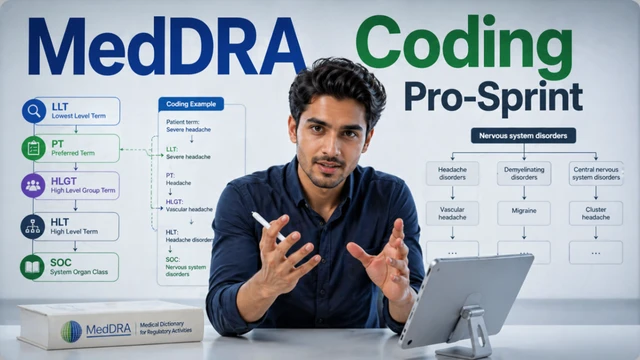
As a PV case processor, you’ll look up medical terms in MedDRA and assign the closest matching code. For example, “headache” might be coded as “Headache” (PT: 10019263). This coding is essential for adverse event reporting jobs. Freshers need to understand MedDRA’s hierarchy (SOC, HLGT, HLT, PT, LLT) and practice coding real cases. Our guide on medical coding jobs for freshers explains more about coding careers.
The Real Skill Gap: College vs. Industry
What colleges teach:
- Theory of adverse drug reactions
- Basic pharmacology
- Maybe one lecture on pharmacovigilance
What employers expect:
- Hands-on experience with a safety database
- Ability to code adverse events using MedDRA
- Understanding of ICH E2B(R3) guidelines for electronic reporting
- Knowledge of case narrative writing
- Familiarity with regulatory submission timelines
This gap is why many BPharm/MPharm graduates struggle to get hired. You need practical skills, not just a degree.
Your 5-Step Roadmap to Become a PV Case Processor
- Learn the Basics: Understand the drug development process and where PV fits. Read ICH guidelines on ICH.org.
- Get Trained in ICSR Processing: Enroll in a simulation-based course that teaches you to triage, enter, and submit cases.
- Master MedDRA Coding: Practice coding real adverse events. Learn to navigate the MedDRA browser.
- Build a Portfolio: Complete mock case projects. Show employers you can do the work.
- Apply with Confidence: Tailor your resume to PV roles. Mention tools like Argus, ArisG, and MedDRA.
The System Bridge: Simulation-Based Learning
Reading theory won’t land you a job. You need to experience the actual workflow of a case processor. Simulation-based learning platforms let you practice on real-world-like cases, making mistakes in a safe environment and learning from them. This is the fastest way to bridge the skill gap.
Build These Skills Now
Programs from ZANE ProEd Academy that directly address the skill gaps discussed above.
How ZANE ProEd’s System Helps You
ZANE ProEd doesn’t just teach theory. Our system includes comprehensive training in ICSR Case Processing & Triage and MedDRA Medical Coding. You’ll work on simulated cases, receive personalized feedback, and learn industry tools. With mentor support from professionals at top pharma companies, you gain the confidence to handle real-world PV cases. This is not a course—it’s a launchpad for your career.
Learn more about our approach to career readiness.
Are You Ready for a PV Case Processing Role?
Take the first step: check your current skill level against industry requirements. Identify gaps and build a plan. Your dream job in pharmacovigilance is closer than you think.
Build These Skills Now
Programs from ZANE ProEd Academy that directly address the skill gaps discussed above.
Follow Zane ProEd on Google
Preferred SourceAdd our publication as a preferred source to get the latest clinical research guides, industry updates, and career intel directly in your Google Top Stories & AI Overviews.