Pharmacovigilance Jobs for Freshers in India: Step-by-Step Career Guide

Pharmacovigilance Jobs for Freshers in India – Freshers with BSc/MSc in life sciences can start as Drug Safety Associates. This role focuses on monitoring drug safety, processing adverse event reports, and ensuring compliance. With right training, you can secure a job in 3–6 months.
If you have a BSc or MSc in Biotechnology, Microbiology, or Biochemistry and no job experience yet, you might worry about finding a good career. The truth is, degrees alone are no longer enough. But there is a field that welcomes life science graduates: pharmacovigilance. This guide shows you exactly how to get pharmacovigilance jobs for freshers in India in a step-by-step way.
Pharmacovigilance (PV) is the science of monitoring the safety of medicines. Every drug that reaches the market must be watched for side effects. This creates many jobs. For a fresher, the Drug Safety Associate role is the perfect entry point. You don’t need medicine knowledge, just your life science degree and the right training.
Build These Skills Now
Programs from ZANE ProEd Academy that directly address the skill gaps discussed above.
What is pharmacovigilance and why is it important?
Pharmacovigilance, often called PV, is the practice of detecting, assessing, and preventing adverse effects of drugs. When a medicine is sold, companies must collect reports from patients and doctors about any side effects. They analyze these reports to keep patients safe. This field is crucial because it directly protects public health. In India, the Central Drugs Standard Control Organization (CDSCO) regulates pharmacovigilance.
Without pharmacovigilance, dangerous drugs could stay on the market. For example, a new drug might cause liver damage in rare cases. A Drug Safety Associate (DSA) would review such cases and help decide if the drug needs a warning or recall. That’s why this career is both responsible and rewarding.
What is the salary of a Drug Safety Associate in India?
The pharmacovigilance salary in India for a fresher Drug Safety Associate typically ranges from ₹2.5 lakh to ₹4.5 lakh per year. With 1–2 years of experience, salaries rise to ₹5–7 lakh per year. Senior associates and team leads can earn over ₹10 lakh annually. These numbers vary by city and company. MNCs like Parexel, IQVIA, and Accenture often pay higher than small CROs.
- Fresher (0–1 year): ₹2.5L – ₹4.5L
- Experienced (2–5 years): ₹5L – ₹8L
- Manager level: ₹10L+
Pay also depends on your skills. Those trained in case processing and regulatory guidelines often get better offers. So investing in a good pharmacovigilance course for BPharm or life science graduates can boost your starting salary.
How to start a career in pharmacovigilance?
Starting a pharmacovigilance career as a fresher is straightforward if you follow a plan. Here is the PV career path for life science graduates:
- Understand the basics: Learn about drug safety, adverse events, and regulatory bodies like ICH and WHO.
- Get certified: Complete a hands-on pharmacovigilance course that teaches case processing and international guidelines. Look for programs with simulation-based training.
- Build practical skills: Practice on case studies, learn to use safety databases like Argus or ArisG. You can practice with mock scenarios.
- Apply strategically: Target entry-level job titles: Drug Safety Associate, PV Trainee, Junior Safety Officer. Check our guide on pharmacovigilance jobs for freshers.
- Prepare for interviews: Focus on scenario-based questions. Show you know how to handle an adverse event report from start to finish.
What are the job responsibilities of a PV Associate?
The drug safety associate job description revolves around managing safety data. Here are the typical drug safety associate roles and responsibilities:
- Case intake: Receive and log adverse event reports from various sources.
- Triage: Determine the priority and validity of each case according to regulations.
- Data entry: Enter case details into a safety database accurately.
- Coding: Use medical dictionaries like MedDRA to code adverse events and medications.
- Narrative writing: Write a clear clinical summary of the case.
- Quality check: Review processed cases for completeness and correctness.
- Reporting: Submit reports to regulatory authorities within strict timelines.
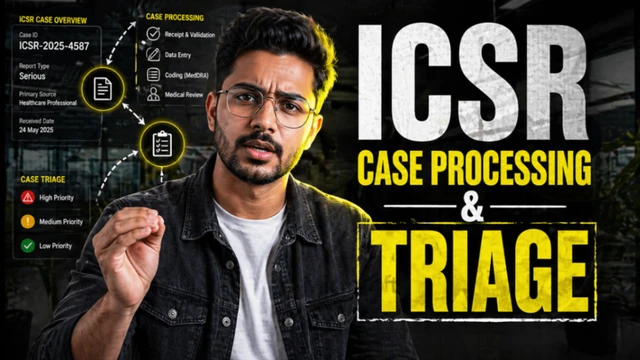
These tasks require attention to detail and a logical mindset. A good training program, like the one covering ICSR case processing and triage, will prepare you for these day-to-day activities.
Is pharmacovigilance a good career for BPharm freshers?
Yes, pharmacovigilance is an excellent career for BPharm freshers. But it’s also great for BSc and MSc graduates in Microbiology, Biotechnology, and Biochemistry. Why? Because pharma companies need people who understand biological concepts. The work is not clinical; it’s about data analysis and critical thinking. This makes it suitable for any life science background.
Additionally, the PV field is growing fast in India. Many global companies outsource drug safety work here. This means pharmacovigilance jobs for freshers in India are abundant. With a certification and practical skills, you can beat the competition and start a stable, high-growth career.
What colleges teach vs what employers actually expect
Your degree gave you theoretical knowledge: pharmacology, microbiology, maybe some drug mechanisms. But employers need you to handle real-world safety data from day one. They expect you to know:
- ICH guidelines (E2A, E2B, E2C) – never taught in college.
- MedDRA coding – not part of BPharm curriculum.
- Safety database navigation – you only learn by doing.
- Case processing workflows – purely practical.
This gap is why shortlisting is tough. Recruiters look for candidates who have already practiced these skills, even as a fresher. That’s where simulation-based learning bridges this gap perfectly.
Your 5-step roadmap to a PV job in 3–6 months
Follow this simple sequence to become job-ready:
- Step 1: Learn the theory. Understand what pharmacovigilance is, why it matters, and the global regulations. Use free resources from ICH and EMA.
- Step 2: Enroll in a hands-on certification. Pick a course that simulates real case processing, not just video lectures. Look for one that covers end-to-end pharmacovigilance.
- Step 3: Practice with case studies. Process at least 10–15 mock ICSRs. Learn to triage, code, write narratives, and perform quality checks. This builds confidence.
- Step 4: Prepare your resume and LinkedIn. Highlight your certification, practical projects, and knowledge of tools. Use keywords from the drug safety associate job description.
- Step 5: Apply and interview. Start with small CROs and IT companies with pharmacovigilance departments. Use our tips in this article: Pharmacovigilance case processing jobs for freshers.
The role of simulation-based learning
Traditional courses give you knowledge, but not skill. When you sit for an interview, the recruiter will ask: “Tell me how you would process a case.” If you have only theory, you fumble. That’s why simulation-based learning is a game-changer. You work on a software-like platform that mimics a real safety database. You process cases exactly like you would on the job. This experience sets you apart.
At ZANE ProEd, we built our programs around this principle. Our courses are not just lessons; they are job simulators. You complete modules that replicate actual tasks in a pharmacovigilance department. This bridges the gap between degree and employment.
Build These Skills Now
Programs from ZANE ProEd Academy that directly address the skill gaps discussed above.
How ZANE ProEd prepares you for the role
ZANE ProEd offers a system, not just a course. The ICSR Case Processing and Triage module focuses on the most important beginner skill: handling cases from intake to triage. You practice on multiple case scenarios, learning to apply regulation and logic.
The End-to-End Pharmacovigilance Certification covers the full lifecycle: case processing, narrative writing, quality review, and submission. It’s designed for freshers who want to show they can do the job from day one. Both programs use simulation-based exercises, so you build a portfolio even before your first job. This makes your application stand out instantly.
Check your job readiness
Ready to see where you stand? Take a moment to reflect: Do you know the difference between a valid and invalid case? Can you code using MedDRA? If not, it’s time to fill those gaps. Explore our simulation-based learning paths and see how quickly you can become job-ready. The pharmacovigilance industry is waiting for skilled freshers.
Build These Skills Now
Programs from ZANE ProEd Academy that directly address the skill gaps discussed above.
Follow Zane ProEd on Google
Preferred SourceAdd our publication as a preferred source to get the latest clinical research guides, industry updates, and career intel directly in your Google Top Stories & AI Overviews.