Pharmacovigilance Case Processing Jobs Freshers: Myth vs Reality Roadmap for Tier-2/3 & Non-Healthcare Graduates

Pharmacovigilance Case Processor Pharmacovigilance case processing jobs freshers involve reviewing adverse event reports, doing MedDRA coding, and entering ICSRs into safety databases like Argus Safety. Freshers from BSc/BCA/BTech can enter via certified simulation training, earning ₹3.2–₹5.5 LPA in Hyderabad, Bangalore, Pune, or Mumbai.
Stop applying to every random BPO or data-entry ad that says 'life sciences preferred'. If you are from a Tier-2 or Tier-3 college, or you are a BSc/BCA/BTech/non-healthcare switcher, that spray-and-pray strategy is why pharmacovigilance case processing jobs freshers feel impossible to crack. Employers are not short of resumes. They are short of candidates who can open an ICSR, read an adverse event narrative, and code it correctly without hand-holding.
The real barrier is not your degree label. It is proof. You are competing with job-ready candidates who already know the ICSR workflow, basic MedDRA coding, and safety database screens. Automation is squeezing generic back-office roles, so entry-level PV hiring is getting sharper, not softer. This checklist shows the myth vs reality of breaking in before basic roles get compressed.
Build These Skills Now
Programs from ZANE ProEd Academy that directly address the skill gaps discussed above.
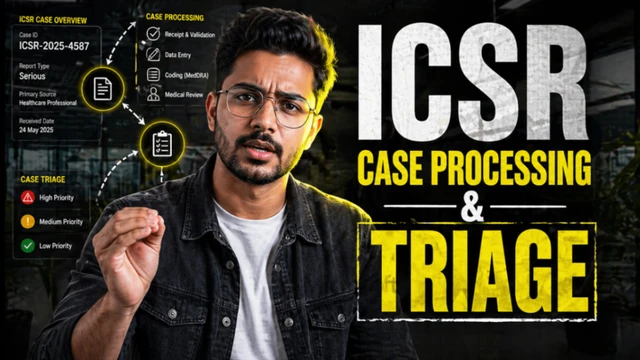
Pharmacovigilance Case Processing Jobs Freshers: What Does a Pharmacovigilance Case Processor Do?
A Pharmacovigilance Case Processor handles individual case safety reports (ICSRs) from intake to database entry. This is not a doctor role. It is a process, quality, and accuracy role inside a pharmacovigilance case processor job description.
- Case intake: Collect adverse event reports from clinical trials, call centers, literature, or consumers.
- Triage: Check seriousness, expectedness, and reporting timelines under ICH E2B standards.
- Data entry: Enter patient, reporter, drug, event, and narrative details into Argus Safety or similar safety databases.
- MedDRA coding: Map adverse events and medical history to correct dictionary terms.
- Quality check: Fix duplicates, missing fields, and inconsistencies before medical review.
- Regulatory support: Help prepare expedited reports for CDSCO and global regulators.
Daily work is screen-heavy, deadline-driven, and audit-sensitive. Your BPO/IT background can help with accuracy, ticketing tools, Excel trackers, and SLA discipline. But you still need PV-specific vocabulary and workflow proof.
What is the salary of a PV Case Processor in India?
For freshers, PV case processor salary India usually starts around ₹3.2 LPA to ₹4.8 LPA in Hyderabad, Bangalore, Pune, and Mumbai. Candidates with a strong simulation portfolio and clean ICSR processing test scores can push toward ₹4.5 LPA to ₹5.5 LPA.
- 0–1 year: ₹3.2–₹4.8 LPA for case processing/data entry.
- 1–3 years: ₹4.5–₹7.5 LPA with independent ICSR handling.
- 3–5 years: ₹7–₹12 LPA as senior processor, QC reviewer, or case manager.
- Hubs: Hyderabad and Bangalore have dense PV hiring; Pune and Mumbai are strong for CRO and sponsor roles.
Do not compare this with a random ₹15,000/month back-office job. Compare the 2–3 year trajectory: ICSR processing career growth usually moves into quality check, aggregate reporting, signal detection support, and safety science. For the long game, see this signal detection pharmacovigilance career roadmap.
How to get a PV case processing job as a fresher?
Stop waiting for a 'life sciences only' opening. Many adverse event reporting jobs accept BSc, BCA, BTech, and non-healthcare graduates if you prove trainability. Use this checklist.
- Learn the ICSR lifecycle: intake, triage, data entry, MedDRA coding, QC, and submission. Know what happens in the first 24 hours of a serious case.
- Get tool familiarity: Practice on simulated Argus Safety screens. Learn case folders, patient tabs, product tabs, event tabs, and narrative fields.
- Build a coding habit: Use MedDRA for adverse events, medical history, and indications. Start with common events like nausea, rash, dizziness, and elevated liver enzymes.
- Create proof: Complete 5–10 simulated ICSR cases with a clean audit trail. Prepare a one-page portfolio showing case intake, coding rationale, and QC checks.
- Target the right teams: Search for 'PV case processor', 'drug safety associate', 'ICSR associate', and 'safety data coordinator' in Hyderabad, Bangalore, Pune, and Mumbai.
- Prepare for the test: Expect a written assessment on seriousness, expectedness, MedDRA coding, and data entry accuracy.
For a deeper walkthrough, read the complete guide to pharmacovigilance case processing jobs for freshers.
What is ICSR processing in pharmacovigilance?
ICSR processing is the structured handling of an individual case safety report. It starts when a patient or reporter describes a possible side effect and ends when the case is entered, coded, quality-checked, and sent for medical review or regulatory reporting.
- Valid case check: Confirm an identifiable patient, reporter, suspect drug, and adverse event.
- Seriousness check: Death, hospitalization, disability, congenital anomaly, life-threatening event, or medically important event.
- Timeline check: Serious unexpected cases often need faster reporting under ICH and local rules.
- Database entry: Capture the narrative accurately in Argus Safety or another validated safety system.
- Quality control: Check for duplicates, missing dates, inconsistent drug names, and wrong coding.
In India, companies also align with CDSCO requirements and global WHO pharmacovigilance principles. Your job as a fresher is not to make clinical decisions. Your job is to process the case accurately, on time, and audit-ready.
What is MedDRA coding and how is it used in PV?
MedDRA coding is the process of translating the words in an adverse event report into standardized medical terms. It helps companies compare safety data across countries, products, and studies. MedDRA coding for freshers is a learnable skill, not a medical degree requirement.
- LLT: Lowest Level Term, closest to the reporter's words.
- PT: Preferred Term, the standard label used for analysis.
- SOC: System Organ Class, the broad body-system group.
- Example: 'Stomach pain' may map to a PT such as 'Abdominal pain' under the gastrointestinal SOC.
- Rule: Code the event, not your interpretation. Use the narrative and reporter words carefully.
- Quality: Avoid over-coding, under-coding, and mismatched medical history.
Strong MedDRA accuracy is one of the fastest ways to stand out in adverse event reporting jobs. It also supports later moves into QC, signal detection, and aggregate reporting.
Why does your Tier-2/3 degree feel invisible to PV employers?
Your college may have taught you life science theory, basic IT, or laboratory concepts. Pharma employers are not hiring you to repeat definitions. They are hiring you to work inside a regulated workflow.
- Conventional education: Generic resume, marksheet, theory notes, no case experience.
- Modern employer expectation: Simulated ICSR handling, MedDRA coding accuracy, Argus Safety familiarity, and audit-ready documentation.
- Your gap: You know the subject, but you cannot show the pharmacovigilance case processor job description in action.
- Your advantage: IT/BPO switchers often have better SLA discipline, ticket hygiene, Excel skills, and process documentation habits than fresh science graduates.
That gap is fixable. But it will not close by adding 'hardworking' to your resume.
What is the step-by-step pathway to become a PV Case Processor?
- Week 1–2: Learn PV basics, ICSR types, seriousness criteria, expectedness, and reporting timelines.
- Week 3–4: Practice MedDRA coding for events, medical history, and indications using real-style narratives.
- Week 5–6: Work on simulated Argus Safety case entry: patient, reporter, product, event, narrative, and case assessment.
- Week 7: Complete a QC checklist on your own cases and correct duplicates, missing fields, and coding errors.
- Week 8: Build a portfolio with 5–10 cases, a coding rationale sheet, and a one-page process map.
- Week 9–10: Apply to PV hubs with role-specific keywords and prepare for the ICSR written test.
How can simulation training close the experience gap?
Reading about ICSR processing is not the same as processing a case. Employers want evidence that you can work inside a validated workflow without creating quality errors. Simulation-based learning gives you that evidence safely.
A strong portfolio should show case intake, triage decision, MedDRA coding, Argus Safety-style data entry, QC correction, and a final case summary. That is verifiable portfolio proof. It turns your resume from 'willing to learn' into 'already trained on the workflow'.
Build These Skills Now
Programs from ZANE ProEd Academy that directly address the skill gaps discussed above.
Which professional certifications build an audit-ready PV portfolio?
ZANE ProEd Academy is a premier professional career-certification platform for industry-grade simulation toolkits. The focus is structured professional preparation, not passive video watching. You work with simulation environments aligned to Argus Safety ICSR case processing, Medidata Rave EDC, Veeva Vault eTMF, and FDA 21 CFR submissions.
For this career path, review two programs closely: ICSR Case Processing & Triage (icsr-case-processing-triage) and MedDRA Medical Coding Certification (meddra-medical-coding-certification). The ROI is practical: you close the qualification gap, build an audit-ready portfolio, and prepare for high-paying industry roles in Hyderabad, Bangalore, Pune, and Mumbai.
This matters more as automation takes over basic data movement. Companies still need people who can judge case quality, code accurately, and follow regulatory logic. Professional certification signals that you understand the system, not just the definition.
How should you audit your industry readiness before applying?
Use this quick audit. Can you explain seriousness and expectedness without notes? Can you code 20 common adverse events to MedDRA PTs? Can you enter a case in a simulated safety database? Can you show a QC-corrected case portfolio? If any answer is no, fix that before mass applying.
Explore the professional certification blueprints, review the simulation curriculum, and audit your industry readiness against real PV case processor expectations. Visit ZANE ProEd to understand the training philosophy and career acceleration system.
Build These Skills Now
Programs from ZANE ProEd Academy that directly address the skill gaps discussed above.
Follow Zane ProEd on Google
Preferred SourceAdd our publication as a preferred source to get the latest clinical research guides, industry updates, and career intel directly in your Google Top Stories & AI Overviews.