The Ultimate Decision Framework for Aspiring Pharmacovigilance Case Processors
Is Pharmacovigilance Case Processor the Right Career For You? A No-Nonsense Framework
You’ve finished your B.Pharm or M.Pharm. You're standing at a crossroads, bombarded with terms: 'Clinical Research', 'Regulatory Affairs', 'Medical Writing', 'Pharmacovigilance'. Each path seems promising, yet the map is blank. This paralysis is not a personal failure; it's a systemic one. You feel confused because the academic world gave you a textbook, while the industry expects you to be a pilot ready to fly a complex aircraft.
This feeling of being overwhelmed is a validation of your awareness. You sense there's a disconnect between your degree and the job market, especially in a hyper-competitive landscape like India. Everyone tells you to 'get certified', but which certification actually translates into a job offer? Which role aligns with your core strengths? Your indecision is a signal that you're looking for a strategic fit, not just any entry-level job. Let's replace that confusion with a clear, logical decision framework.
Reality Disruption: Your Degree is Not a Job Ticket
Let's be brutally honest: your university degree, while foundational, is not what gets you hired as a Pharmacovigilance Case Processor. Hiring managers at CROs and pharmaceutical companies are not impressed by your grades in pharmacology. They are looking for specific, operational skills that your college never taught. The assumption that a degree equals job-readiness is the single biggest roadblock for fresh graduates.
Build These Skills Now
Programs from ZANE ProEd Academy that directly address the skill gaps discussed above.

Your curriculum taught you the definition of an Adverse Drug Reaction (ADR). The industry expects you to take an unstructured email from a doctor, identify the four minimum criteria for a valid Individual Case Safety Report (ICSR) according to ICH E2B guidelines, and accurately enter it into a safety database like Oracle Argus Safety. See the gap? It’s not a crack; it’s a canyon.
The Industry Insider View: What We Actually Look For
When a stack of CVs lands on my desk, I spend less than 30 seconds on each. We don't read your 'Objective' statement. We scan for keywords that signal practical knowledge. We're looking for signs that you understand the operational rhythm of pharmacovigilance. Can you differentiate between 'listedness' and 'expectedness'? Do you know what MedDRA and WHO-DD coding are? Do you understand the critical regulatory timelines for reporting serious, unexpected adverse events to authorities like the FDA or the CDSCO?
Your CV needs to speak the language of the job. It needs to show that you've moved beyond textbook definitions and grappled with the processes and tools that run the department. Anything less is just academic noise.
Skill Gap Exposure: College Theory vs. Operational Reality
The disconnect is best illustrated with a direct comparison:
- College Teaches: The definition of 'causality assessment'.
- Industry Demands: Applying a causality assessment method (like the WHO-UMC system) to a real case with incomplete information and documenting the rationale for the conclusion.
- College Teaches: The names of different regulatory bodies.
- Industry Demands: Understanding the specific reporting timelines for a 15-day report versus a 7-day report and knowing what triggers each.
- College Teaches: The concept of a drug's 'safety profile'.
- Industry Demands: Performing a duplicate check in a global safety database, writing a concise and medically coherent case narrative, and ensuring data integrity for signal detection activities. This is the real day-to-day workflow of a case processor.
The Career Trajectory Filter™: A Framework for Clarity
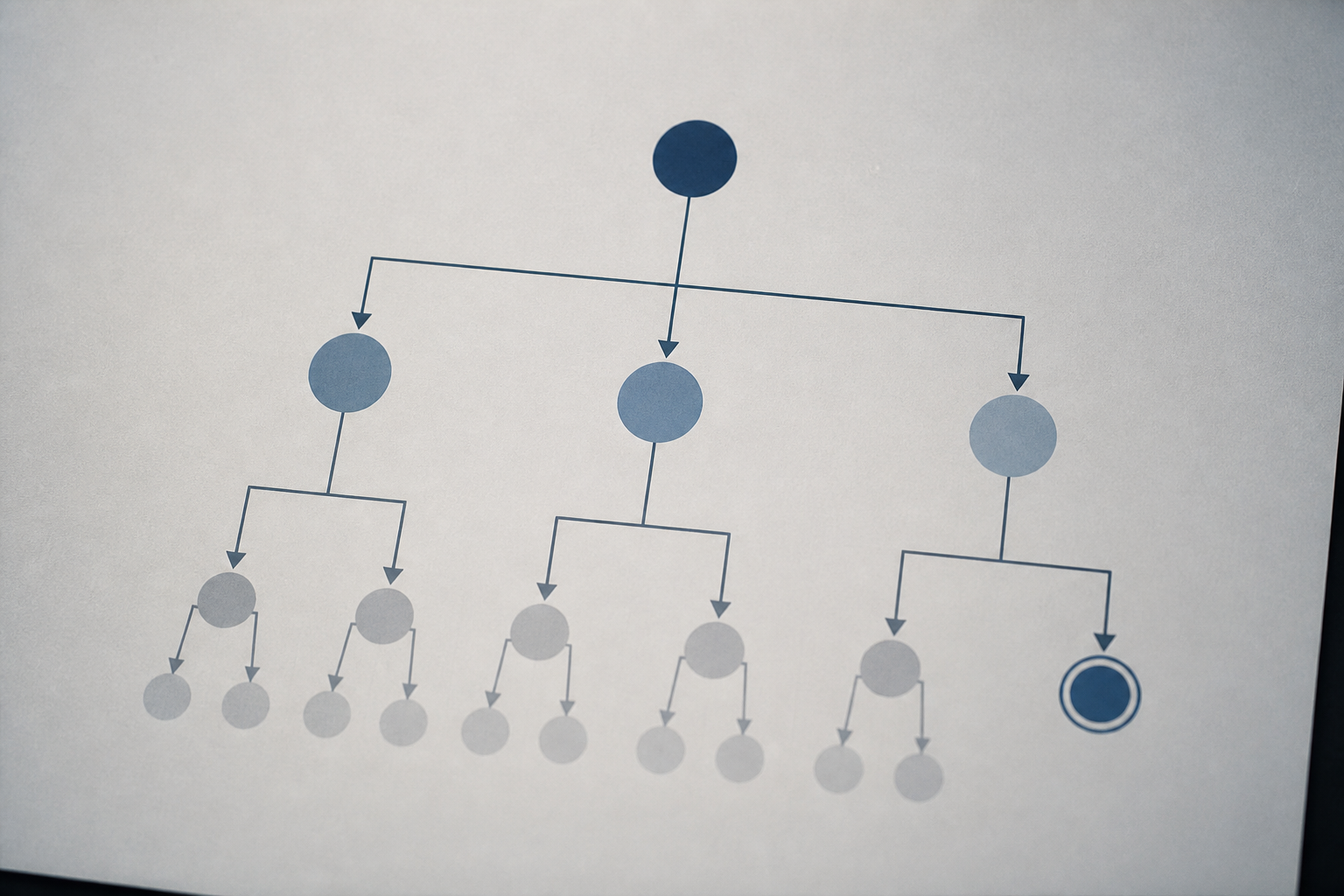
To navigate your options, you don't need more information; you need a better filtering system. We call this the 'Career Trajectory Filter'. It's a simple, three-question decision tree designed to align your innate abilities with a specific industry role. Instead of asking 'What job can I get?', ask 'Which job am I built for?'.
Your Step-by-Step Decision Pathway
Answer these questions honestly to find your starting point in the pharmaceutical industry.
Question 1: Are you driven by data and detail, or by human interaction?
Think about what energizes you. Do you enjoy meticulously analyzing information, finding patterns, and ensuring accuracy in a structured process? Or do you thrive on communication, patient engagement, and managing relationships?
- If you chose Data & Detail: Your path likely leads toward Pharmacovigilance or Regulatory Affairs. Proceed to Question 2.
- If you chose Human Interaction: You might be better suited for roles like a Clinical Research Coordinator or Medical Science Liaison. This path requires a different skill set.
Question 2: Do you prefer reactive investigation or proactive compliance?
Both PV and RA are detail-oriented, but their focus differs. Regulatory Affairs is about proactively ensuring all documentation and processes comply with health authority rules *before* a product goes to market. Pharmacovigilance is about reactively investigating and processing safety data *after* a product is on the market.
- If you chose Reactive Investigation: You are a strong candidate for Pharmacovigilance. You enjoy connecting the dots, working with case data, and contributing to the ongoing safety picture of a drug. Proceed to Question 3.
- If you chose Proactive Compliance: Your mindset aligns well with Regulatory Affairs, which involves dossier preparation, submission strategy, and ensuring all guidelines are met from the start.
Question 3: Do you thrive in a structured, high-volume, deadline-driven environment?
The role of a Pharmacovigilance Case Processor is the engine room of drug safety. It is methodical, precise, and governed by strict global timelines from agencies like the European Medicines Agency. The work is not ambiguous; it is a clear process of receiving, evaluating, and processing safety cases.
- If YES: Congratulations. The role of a Pharmacovigilance Case Processor is a powerful and strategic entry point into the industry for you. It builds a non-negotiable foundation of skills that are transferable across the entire drug safety spectrum.
- If NO: You may still be interested in PV, but perhaps in a different role like signal detection or aggregate reporting, which are typically more advanced positions. However, nearly everyone starts in case processing.
Micro-Scenario: A Day in the Life
It's 10:00 AM. An email arrives containing a scanned, handwritten form from a hospital in France. A 72-year-old male on your company's hypertension drug, 'CardiaSafe', experienced a 'dizzy spell' and was hospitalized. Your clock starts now. You must triage the case (is it serious?), check for the four validity criteria, create a new case in the safety database, perform a duplicate search, code the event 'Dizziness' and the drug 'CardiaSafe' using MedDRA and WHO-DD dictionaries, assess causality, and write a clear medical narrative. This all has to be done accurately and submitted for medical review well within the 15-day regulatory clock. This is not theory. This is your job.
The System Bridge: Moving from Knowing to Doing
How do you prepare for that micro-scenario? Reading a book won't help. Watching a video is passive. The only way to build the confidence and competence to perform that task is to do it. You need a system that doesn't just teach you the 'what' but forces you to practice the 'how' in a simulated environment that mirrors the pressure and complexity of a real job. Many freshers fail interviews not because of a lack of knowledge, but because they can't articulate how they would handle such a scenario. This is one of the key interview mistakes we've audited.
This is where simulation-based learning becomes non-negotiable. It's the bridge across the chasm between academic knowledge and professional execution.
Build These Skills Now
Programs from ZANE ProEd Academy that directly address the skill gaps discussed above.
Academy Integration: Building Your Operational Skill Stack
At ZANE ProEd, we don't sell courses; we provide an integrated system designed to build job-ready professionals. For an aspiring Pharmacovigilance Case Processor, the system focuses on two core, interconnected capabilities. The first is mastering the end-to-end ICSR Case Processing & Triage workflow. This isn't just theory; it's a deep dive into the practical steps of handling a case from receipt to submission. The second is achieving operational fluency in the industry-standard tool, which is why our Oracle Argus Safety Training simulates real-world database handling.
These are not separate 'certifications' to be listed on a resume. They are components of a single system designed to make you competent and confident. The goal is to walk into an interview and be able to explain exactly how you would handle that case from France, step-by-step, because you have already done it dozens of times in a simulated environment.
Your Next Step: From Passive Learning to Active Analysis
Stop passively collecting conflicting career advice. Your path to clarity begins with a single, focused action. Use the framework outlined above to make a definitive choice. If the role of a Pharmacovigilance Case Processor aligns with your profile, your next step is not to blindly apply for jobs. It's to deeply understand the skills required and honestly assess your current gaps. Start building the operational competence that companies are desperate to hire.
Build These Skills Now
Programs from ZANE ProEd Academy that directly address the skill gaps discussed above.
Follow Zane ProEd on Google
Preferred SourceAdd our publication as a preferred source to get the latest clinical research guides, industry updates, and career intel directly in your Google Top Stories & AI Overviews.