The Pharmacovigilance Case Processor Workflow: Why 90% of Freshers Fail
Why Your Degree Won't Make You a Pharmacovigilance Case Processor
Here’s a brutal truth: 90% of aspiring Pharmacovigilance Case Processor candidates fail their technical interviews for the exact same reason. It has nothing to do with their degree, their grades, or even the basic definitions they memorized. They fail because they can define an Individual Case Safety Report (ICSR), but they have never actually navigated the complex, high-pressure workflow required to process one. They know the 'what,' but have zero practical exposure to the 'how'.
You’ve spent years learning pharmacology, anatomy, and regulatory affairs. You believe this theoretical foundation is your ticket into a top Contract Research Organization (CRO). But the moment a hiring manager asks, "Walk me through your process for a serious, unexpected adverse event from a non-solicited report," the theory evaporates. The silence that follows is the sound of an opportunity lost.
The industry is shifting. As companies face increasing pressure from regulatory bodies like the U.S. Food and Drug Administration (FDA) and the European Medicines Agency (EMA), they aren't just looking for people who can pass a test. They need professionals who can step onto the floor and perform from day one. Your theoretical knowledge is the entry fee, not the winning prize.
Build These Skills Now
Programs from ZANE ProEd Academy that directly address the skill gaps discussed above.
Reality Disruption: Your Certificate is Just Paper Without Workflow Proficiency
Let's be clear: that online pharmacovigilance certificate you're considering? It’s probably not the silver bullet you think it is. Most programs are glorified textbook summaries. They teach you to recite definitions of causality assessment or list the seriousness criteria. But they don't simulate the pressure of a deadline, the ambiguity of a poorly written case narrative, or the intricate click-by-click process within a safety database like Argus or ArisG.
Hiring managers know this. They see dozens of resumes with the same credentials. The real differentiator isn't another certificate; it's demonstrable, workflow-level competence. Can you correctly triage a case? Can you accurately code terms using MedDRA (Medical Dictionary for Regulatory Activities)? Do you understand the nuances of generating a follow-up query? This is the language the industry speaks, and most academic programs don't even teach the alphabet.
The Insider View: What Really Happens in a CRO
Inside a fast-paced CRO, nobody is going to ask you to define pharmacovigilance. They expect you to execute it. Your Team Lead isn't interested in your knowledge of the International Council for Harmonisation (ICH) guidelines in theory; they need to see you apply the ICH E2B(R3) data fields correctly under pressure.
The expectation is immediate integration. You're handed a case, given access to the safety database, and expected to begin processing. This isn't an internship where you shadow someone for six months. This is a high-stakes environment where a single data entry error can have significant regulatory and patient safety implications. As we've discussed before, this is why simply stopping the blind application process is your first strategic move.
The Skill Gap Exposed: College Theory vs. CRO Reality
The gap between academic learning and industry expectation is a chasm. It’s the primary reason qualified candidates get rejected.
- College Teaches: The definition of 'Seriousness Criteria' (e.g., results in death, is life-threatening).
- Industry Expects: You to analyze a narrative like "patient was hospitalized for observation after feeling faint" and determine if it meets the 'hospitalization' criterion, then document your justification for the medical review team.
- College Teaches: The names of different regulatory bodies like India's CDSCO.
- Industry Expects: You to know the specific reporting timelines for a serious, unlabeled domestic case versus a non-serious foreign case and execute the submission process accordingly.
This isn't about being book-smart. It's about being workflow-smart. It's a truth that makes many traditional pharmacovigilance certificates useless in the real world.
The ZANE Framework: The Workflow Proficiency Gap™
We call this disconnect the Workflow Proficiency Gap™. It's the dangerous space between knowing regulatory rules and being able to execute tasks fluidly within industry-standard systems and timelines. The entire hiring process for a Pharmacovigilance Case Processor is designed to expose this gap. Your degree gets you to the door, but your lack of workflow proficiency keeps you outside.
The Pathway: Deconstructing the ICSR Workflow
To become a job-ready Pharmacovigilance Case Processor, you must master the end-to-end workflow. Stop thinking in terms of definitions and start thinking in terms of process stages. Here is the operational breakdown:
- Case Triage: This is the first gate. You receive a source document (e.g., an email, a call center transcript, a clinical trial form). Your job is to quickly identify the four minimum criteria for a valid ICSR: an identifiable patient, an identifiable reporter, a suspect drug, and an adverse event. You must also make an initial seriousness assessment and determine the reporting timeline. This is a high-pressure decision point that dictates the urgency of the entire process.
- Case Booking/Data Entry: Once triaged, the case is formally entered into the safety database. This is not simple typing. It involves structured data entry across dozens of tabs—patient details, drug information (dosage, dates, indication), event details, and reporter information. Every field matters for compliance and signal detection.
- Event Coding: You must translate the reporter’s narrative into standardized MedDRA terms. Is "feeling blue" coded as 'Depressed mood' or 'Depression'? Is "stomach ache" coded as 'Abdominal pain' or something more specific based on the context? Incorrect coding corrupts the entire dataset.
- Case Narrative Writing: You will write a concise, accurate, and medically coherent summary of the case. This narrative must be a standalone story that a regulator or physician can read and understand completely without referring back to the source document.
- Quality Review (QC): Before submission, another team member (or you, for a colleague's case) performs a quality check. They review every single data point against the source document to ensure accuracy, completeness, and consistency. This is a critical step to prevent regulatory findings.
Micro-Scenario: Your First Five Minutes on a New Case
Imagine this lands in your queue: A fax from a clinic. It reads: "Patient J. Doe, 55F, on our new drug [Product X] for 2 weeks. Called to say she felt very tired and had to go to the hospital last Tuesday. She's home now."
What do you do in the first five minutes? A textbook-trained fresher freezes. A workflow-proficient professional immediately executes:
- Validity Check: Patient (J. Doe), Reporter (clinic), Drug (Product X), Event (tired, hospital visit) - Yes, it's a valid case.
- Seriousness Assessment: The word "hospital" triggers the 'hospitalization' seriousness criterion. This is now a high-priority case.
- Triage Decision: Based on the seriousness, you immediately flag it for expedited processing (e.g., a 7-day or 15-day report, depending on local regulations).
- Query Generation: You know you're missing critical information. You immediately draft a follow-up query for the clinic: What was the date of hospitalization? What was the diagnosis? Was the patient discharged? Was the drug stopped?
This is the reality. It's a series of rapid, precise, and logical actions within a validated system. How can you possibly master this from a PDF or a passive video lecture?
The System Bridge: From Theory to Simulated Reality
You can't. The only way to close the Workflow Proficiency Gap™ is to bridge it with practical, hands-on experience. Reading about flying a plane is fundamentally different from being in a flight simulator. The same principle applies here. You need to build muscle memory. You need to make mistakes in a safe environment, not on a live case with regulatory consequences.
This is where simulation-based learning becomes non-negotiable. It's about moving beyond memorization and into active problem-solving within a system that mirrors the exact software and pressures of a real CRO job. It’s the only methodology that trains you to think and act like an experienced Pharmacovigilance Case Processor before you even have the job title.
Build These Skills Now
Programs from ZANE ProEd Academy that directly address the skill gaps discussed above.
The ZANE ProEd System: Building Your Workflow Competency
We built ZANE ProEd not to sell courses, but to provide a complete system that makes you job-ready. Our approach is built on high-fidelity simulation, mirroring the exact challenges you'll face.
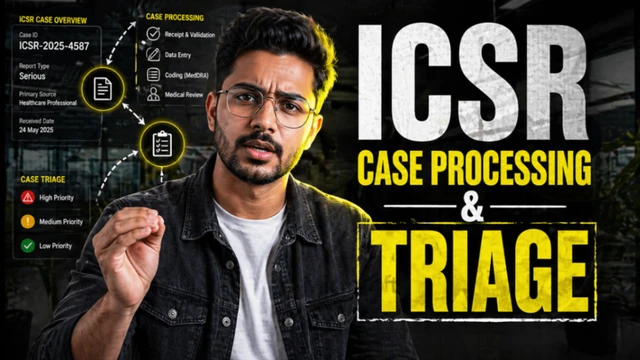
Our ICSR Case Processing & Triage performance module is designed to build foundational muscle memory. You don't just learn about triage; you perform triage on a series of realistic, ambiguous cases within our simulated environment. You learn to make the right call under pressure, a skill that's impossible to gain from theory alone.
For those seeking comprehensive mastery, our End-to-End Pharmacovigilance Certification integrates this practical skill into the full workflow. It's a complete system that takes you from triage through data entry, MedDRA coding, narrative writing, and quality control, all within a simulated database environment. This isn't a course; it's a virtual apprenticeship that builds the exact workflow proficiency hiring managers are desperate to find.
Stop Theorizing. Start Performing.
The path to becoming a successful Pharmacovigilance Case Processor isn't paved with more textbooks or passive certificates. It's built by actively engaging with the tools and processes of the industry. The choice is simple: continue accumulating theoretical knowledge that doesn't translate, or start building the practical, workflow-level skills that will get you hired and allow you to excel from day one.
Build These Skills Now
Programs from ZANE ProEd Academy that directly address the skill gaps discussed above.
Follow Zane ProEd on Google
Preferred SourceAdd our publication as a preferred source to get the latest clinical research guides, industry updates, and career intel directly in your Google Top Stories & AI Overviews.