Pharmacovigilance Jobs for Freshers in India: A Guide for Chemistry Graduates

Pharmacovigilance jobs for freshers in India involve monitoring and preventing adverse drug reactions. Companies actively hire science graduates, including BPharm and BSc/MSc Chemistry, for roles like Drug Safety Associate. Key skills needed are case processing, medical coding (MedDRA), and knowledge of global drug safety regulations.
If you have a Chemistry degree and are looking for pharmacovigilance jobs for freshers in India, you might feel a bit lost. Perhaps you've taken a career gap and now see that your degree alone isn't opening the right doors in this highly competitive market.
You are not alone. Many BSc and MSc Chemistry graduates have the analytical mindset to excel in pharmacovigilance (PV) but lack the specific, practical skills that companies demand from day one. Your degree taught you how to think, but it didn't teach you how to process an adverse event case.
Build These Skills Now
Programs from ZANE ProEd Academy that directly address the skill gaps discussed above.
This guide is your step-by-step roadmap. We will break down exactly what you need to do to go from a Chemistry graduate with a career gap to a confident, job-ready Drug Safety professional.
What is pharmacovigilance and why is it important?
Pharmacovigilance, also known as drug safety, is the science and activity related to detecting, assessing, understanding, and preventing adverse effects or any other drug-related problem. In simple terms, it's about making sure medicines are safe for patients to use.
Its importance cannot be overstated. A drug that works well in a controlled clinical trial might have different effects on a larger, more diverse population. PV helps protect public health by continuously monitoring a drug's safety profile after it has been launched in the market.
Global regulatory bodies like the U.S. Food and Drug Administration (FDA) and the European Medicines Agency (EMA) have strict rules for drug safety. In India, the Central Drugs Standard Control Organisation (CDSCO) oversees these activities. This global need for safety makes PV a stable and growing career field.
What is the salary of a Drug Safety Associate in India?
For freshers, the pharmacovigilance salary in India typically ranges from ₹2.5 Lakhs to ₹4.5 Lakhs per annum. This starting salary can vary based on the company (MNC vs. local pharma), city (like Bangalore, Mumbai, or Hyderabad), and the specific skills you bring.
Your degree is the entry ticket, but practical skills in areas like MedDRA coding or experience with safety databases can put you at the higher end of that range. This is where specialized training makes a direct financial impact.
The PV career path is very rewarding. With 2-3 years of experience, you can become a Senior Drug Safety Associate, with salaries rising to ₹5-8 LPA. Further growth can lead to roles like Team Lead, Manager, or specialist positions in signal detection or regulatory affairs, where salaries are even higher.
How to start a career in pharmacovigilance?
Starting a career in PV, especially from a Chemistry background, requires a structured approach. Your analytical skills are a huge advantage, but you need to build a bridge to the pharmaceutical world. Here’s how:
- Understand the Core Concepts: Learn the language of drug safety. This includes understanding what an Adverse Event (AE) is, the difference between seriousness and severity, and the overall lifecycle of a safety case.
- Study Global Regulations: Familiarize yourself with Good Pharmacovigilance Practices (GVP) and guidelines from the International Council for Harmonisation (ICH). Employers expect you to know these standards.
- Gain Practical Skills: This is the most critical step. You must learn the actual tasks of a Drug Safety Associate. This includes case processing, data entry, medical coding, and narrative writing. This is a topic we cover in detail for chemistry freshers looking for PV jobs.
- Get Certified with Job-Ready Training: A generic certificate is not enough. You need training that focuses on hands-on software simulation and real-world case studies to prove you can do the job from day one. For those returning after a career break, this step is non-negotiable.
- Optimize Your CV and LinkedIn: Replace generic phrases with specific PV skills. Instead of saying "detail-oriented," say "Proficient in MedDRA coding for adverse event classification."
What are the job responsibilities of a PV Associate?
The drug safety associate job description focuses on processing individual case safety reports (ICSRs). This is the foundation of all pharmacovigilance work. Your day-to-day tasks will be very specific and process-driven.
Here are the core drug safety associate roles and responsibilities:
- Case Triage & Intake: Receiving and prioritizing incoming adverse event reports from sources like patients, doctors, or clinical trials.
- Data Entry: Accurately entering all case information into a safety database. Common databases include Oracle Argus and ArisG.
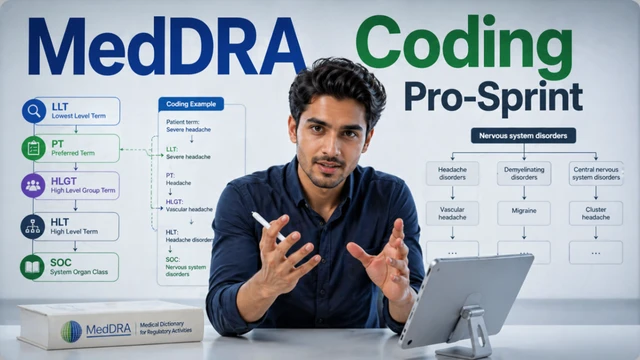
- Medical Coding: Assigning standardized codes to medical terms using dictionaries like MedDRA (for adverse events) and WHO-DD (for drugs). This ensures data consistency.
- Narrative Writing: Writing a clear, concise, and medically accurate summary of the adverse event case. This is a critical skill.
- Follow-up: Contacting the person who reported the event to gather any missing information.
- Quality Check: Reviewing cases for accuracy and completeness before they are submitted to regulatory authorities.
The Skill Gap for Chemistry Graduates
There's often a big gap between what you learn in college and what pharmacovigilance employers need.
What Your BSc/MSc Chemistry Degree Taught You:
- Strong analytical and problem-solving skills.
- Attention to detail and accuracy.
- Experience with documentation and data recording.
What Pharmacovigilance Employers Actually Expect:
- Practical knowledge of GVP and ICH guidelines.
- Hands-on experience with safety databases like Oracle Argus.
- Proficiency in medical coding with MedDRA.
- Ability to write a clear, compliant case narrative.
- Understanding of regulatory submission timelines.
Your degree proves you are smart. Practical training proves you are ready for the job.
Is pharmacovigilance a good career choice?
Absolutely. For science graduates, including those from a Chemistry background, pharmacovigilance is an excellent career choice for several reasons:
- High Demand: As more drugs are developed, the need for safety monitoring grows. It's a stable and recession-proof industry.
- Global Opportunities: PV is a global function. The skills you learn in India are applicable in the US, Europe, and other major markets.
- Meaningful Work: You play a direct role in protecting patient health and ensuring medicines are safe.
- Strong Career Growth: The PV career path is well-defined, allowing for significant professional and financial growth over time.
Your 4-Step Roadmap to a Drug Safety Job
Let's turn this knowledge into an actionable plan. Here is your roadmap to stand out from other applicants.
- Step 1: Build a Strong Foundation. Don't just read about PV. Understand the 'why' behind each step of case processing, from first report to regulatory submission.
- Step 2: Master the Core Tools. Focus on learning the two most important tools: a safety database (like Argus) and the MedDRA medical dictionary. Proficiency here is non-negotiable.
- Step 3: Gain Simulated 'Work Experience'. The best way to become job-ready is to practice on real-world case studies. This builds confidence and gives you concrete examples to discuss in interviews.
- Step 4: Rebrand Your Professional Profile. Update your CV and LinkedIn to highlight these new, specific PV skills. Position yourself as a Drug Safety professional, not just a Chemistry graduate.
The Bridge from Theory to Job-Ready Skills
Reading about pharmacovigilance is not enough. Watching videos is not enough. To compete in the Indian job market, you need to prove you can perform the tasks of a Drug Safety Associate before you even get your first interview. How do you do that?
The answer is simulation-based learning. This approach puts you in a virtual work environment, allowing you to process cases, perform medical coding, and use software just like you would on the job. It’s the fastest way to build practical confidence and become a candidate employers want to hire.
Build These Skills Now
Programs from ZANE ProEd Academy that directly address the skill gaps discussed above.
A System for Career Success
At ZANE ProEd, we don't just offer courses; we provide a complete system designed to make you job-ready. Our training is built on a foundation of practical, hands-on learning that mirrors the real work environment.
Our End-to-End Pharmacovigilance Certification is the core of this system. It guides you through every single step of case processing, from intake to submission, using simulated software and real-world scenarios. It's designed to build muscle memory and true competence.
To complement this, our MedDRA Medical Coding Certification provides specialized, in-depth training on the most critical coding skills. Mastering MedDRA ensures you are accurate, efficient, and compliant—qualities that make you a valuable asset to any PV team.
Take the First Step
Feeling stuck is temporary. Taking action is what creates change. Your Chemistry degree gave you a strong foundation; now it's time to build the specialized skills that will launch your career in pharmacovigilance.
Ready to see how your current skills compare to what top pharmaceutical companies are looking for? Learn more about how our system prepares you for the real world of drug safety by exploring our approach to practical learning at ZANE ProEd.
Build These Skills Now
Programs from ZANE ProEd Academy that directly address the skill gaps discussed above.
Follow Zane ProEd on Google
Preferred SourceAdd our publication as a preferred source to get the latest clinical research guides, industry updates, and career intel directly in your Google Top Stories & AI Overviews.