Pharmacovigilance Jobs for Freshers in India: A Recruiter's Clear Guide

Pharmacovigilance / Drug Safety Associate Pharmacovigilance jobs for freshers in India are entry-level roles where you collect, assess, and report adverse drug reactions. A Drug Safety Associate earns ₹3-6 LPA, works with tools like Argus and MedDRA, and needs ICSR case processing know-how. Chemistry graduates can enter after targeted training.
If you have a BSc or MSc in Chemistry, you may feel stuck between lab jobs, teaching, or IT. But there is a hidden demand for science graduates who can protect patient safety. Pharmacovigilance jobs for freshers in India are growing fast, and recruiters are actively looking for Chemistry graduates who understand chemical structures and drug safety data.
\nConfusion is normal. You see ten career options and none feel perfect. The truth is, the pharmaceutical industry needs people who can read case reports, code medical terms, and spot safety signals. You do not need a medical degree to start. You need the right workflow knowledge.
Build These Skills Now
Programs from ZANE ProEd Academy that directly address the skill gaps discussed above.
Here is what recruiters actually want, and how you can move from confusion to clarity in 90 days.
\nWhat is pharmacovigilance and why is it important?
\nPharmacovigilance (PV) is the science of detecting, assessing, and preventing adverse effects of medicines. In simple terms, it keeps patients safe after a drug is on the market. The World Health Organization calls it a core public health function. The International Council for Harmonisation sets global safety reporting standards.
\nIn India, pharmacovigilance jobs for freshers in India exist because the CDSCO requires companies to monitor drug safety. Every pharmaceutical company, CRO, and IT vendor needs PV associates to process individual case safety reports (ICSRs).
\nFor Chemistry graduates, this field is a natural fit. You already understand molecular structures, drug interactions, and analytical thinking. PV gives you a non-lab, high-growth career path.
\nWhat is the salary of a Drug Safety Associate in India?
\nThe pharmacovigilance salary in India for a fresher Drug Safety Associate (DSA) is typically ₹3.0 to ₹4.5 LPA. With 1-3 years of experience, you can earn ₹4.5 to ₹7 LPA. In top MNCs or CROs like IQVIA, Parexel, or Accenture, freshers may start at ₹4 to ₹6 LPA with the right certifications.
\n- \n
- Fresher DSA: ₹3.0 - 4.5 LPA \n
- Junior PV Associate: ₹2.5 - 3.5 LPA \n
- After 2 years (Senior DSA): ₹5 - 8 LPA \n
- Drug Safety Scientist: ₹8 - 15 LPA \n
Your salary depends on city, company type, and tool proficiency. Knowing Argus Safety, ArisG, and MedDRA coding can push you to the higher end even as a fresher.
\nHow to start a career in pharmacovigilance?
\nThe PV career path is clear. First, build foundational knowledge. Second, learn the workflow. Third, get certified. Fourth, apply with a strong resume.
\n- \n
- Learn the basics of drug safety and regulatory guidelines (ICH E2E, GVP). \n
- Master ICSR case processing — intake, triage, data entry, narrative writing. \n
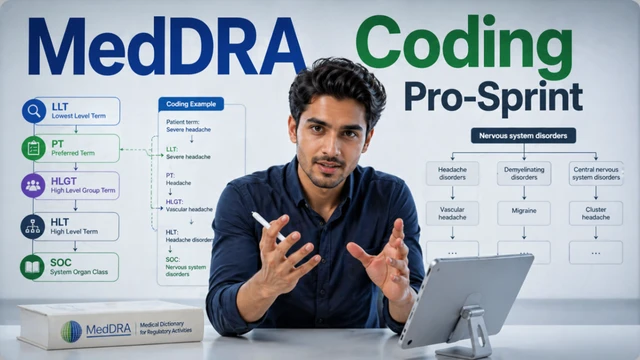
- Learn MedDRA medical coding — mapping adverse events to standard terms. \n
- Practice on real-world case scenarios using simulation tools. \n
- Apply to entry-level pharmacovigilance jobs for freshers in India at CROs and pharma companies. \n
A pharmacovigilance course for BPharm is common, but Chemistry graduates can also do a focused certification. Check our guide on pharmacovigilance case processing jobs for freshers.
\nWhat are the job responsibilities of a PV Associate?
\nThe drug safety associate job description is specific. You are not a clinician. You are a data processor and safety screener. Daily tasks include:
\n- \n
- Receiving and logging adverse event reports from patients, doctors, or literature. \n
- Triaging ICSRs based on seriousness and expectedness. \n
- Entering data into safety databases like Argus, ArisG, or Veeva Vault. \n
- Writing concise, factual case narratives. \n
- Coding adverse events and medications using MedDRA and WHODrug. \n
- Performing quality checks and duplicate searches. \n
- Submitting reports to regulatory authorities within deadlines. \n
The drug safety associate roles and responsibilities require attention to detail, speed, and zero tolerance for errors. Recruiters test these skills before hiring.
\nIs pharmacovigilance a good career for BPharm freshers?
\nYes, but let's be honest for Chemistry graduates too. Pharmacovigilance is a stable, office-based, global career. It offers fixed shifts, remote work options, and clear growth. The demand for pharmacovigilance jobs for freshers in India is rising because drug safety is regulated worldwide.
\nHowever, there is a catch. Many colleges do not teach PV workflows. You may know organic chemistry but not how to triage an ICSR. That is why recruiters often reject graduates who only have a degree. You need to demonstrate practical readiness.
\nThe PV career path can lead to roles in signal detection, risk management, or regulatory affairs. For a Chemistry graduate, it is a smart pivot away from low-paying lab jobs. Read our article on signal detection pharmacovigilance career for chemistry graduates.
\nWhat skills do recruiters expect that colleges don't teach?
\nThis is the skill gap. In college, you learn theory. In industry, you need workflow execution. Here is the comparison:
\nWhat colleges teach
\n- \n
- Drug chemistry and pharmacology basics \n
- Lab techniques and analytical methods \n
- Regulatory guidelines as theory \n
- No hands-on safety database practice \n
What recruiters expect
\n- \n
- End-to-end ICSR processing (intake to submission) \n
- MedDRA coding accuracy \n
- Narrative writing following ICH E2B format \n
- Tool fluency: Argus, ArisG, or Veeva \n
- Knowledge of triage rules and seriousness criteria \n
As a BSc or MSc Chemistry graduate, you have the science base, but you lack the workflow layer. That gap is why freshers get stuck. The FDA and EMA expect companies to train, but companies want job-ready hires.
\nHow can you build a clear pharmacovigilance career path?
\nStop waiting for direction. Follow these six steps.
\n- \n
- Confirm your interest — read three PV job descriptions. If safety data work feels okay, move forward. \n
- Learn the regulatory backbone — ICH E2E, GVP modules, and India's PvPI. \n
- Get simulation-based training — practice ICSR case triage and MedDRA coding on real-world scenarios. \n
- Build a portfolio — show sample case narratives and coded terms to recruiters. \n
- Apply strategically — target CROs, IT vendors, and pharma companies with high fresher intake. \n
- Prepare for interviews — know seriousness criteria, expectedness, and data entry fields. \n
Your goal is not to learn everything. Your goal is to prove you can process a case without hand-holding.
\nWhy does industry expect tools and workflow knowledge before hiring?
\nIn today's AI-driven healthcare industry, recruiters have no time to train basic workflows. A hiring manager at a CRO sees 300 resumes for one PV opening. Candidates who can show workflow familiarity get shortlisted. Candidates who only have a degree get filtered out.
\nThe solution is simulation-based learning. Instead of memorizing slides, you work on mock cases in a safe environment. You make mistakes, learn triage rules, and build speed. That is what ZANE ProEd calls a 'system for job readiness'.
\nThis system teaches you exactly what a fresher PV associate does daily. It closes the gap between your Chemistry degree and employer expectations.
\nBuild These Skills Now
Programs from ZANE ProEd Academy that directly address the skill gaps discussed above.
How can simulation-based training bridge the gap for chemistry graduates?
\nZANE ProEd does not sell courses. It runs a system that mimics a PV department. For Chemistry graduates, two core modules matter most.
\nThe ICSR Case Processing & Triage module (course slug: icsr-case-processing-triage) trains you to receive, validate, triage, and enter adverse event reports. You learn seriousness criteria, expectedness, and timelines. You also write narratives in the correct format.
\nThe MedDRA Medical Coding Certification module (course slug: meddra-medical-coding-certification) teaches you to code adverse events and medications accurately. MedDRA is the global medical dictionary. Coding errors can delay drug safety submissions. Employers test coding speed and accuracy.
\nBy practicing on simulated cases, you build a portfolio that speaks louder than a degree. You show recruiters you can handle the desk on day one.
\nAre you ready to test your pharmacovigilance job readiness?
\nYou can stay confused, or you can take a small step today. Check your current skill level against what recruiters expect. If you cannot explain ICSR triage or list three MedDRA benefits, you have a clear gap to fill.
\nSee how your skills compare with the ZANE ProEd job readiness benchmark. You do not need to buy anything. Just measure where you stand.
\nPharmacovigilance jobs for freshers in India are waiting for people who prepare. Your Chemistry background is an asset. Add the right workflow skills, and you become the candidate recruiters call first.
Build These Skills Now
Programs from ZANE ProEd Academy that directly address the skill gaps discussed above.
Follow Zane ProEd on Google
Preferred SourceAdd our publication as a preferred source to get the latest clinical research guides, industry updates, and career intel directly in your Google Top Stories & AI Overviews.