Pharmacovigilance Jobs for Freshers in India: A Step-by-Step Career Guide

Pharmacovigilance jobs for freshers in India are entry-level roles in drug safety monitoring. With the right training in ICSR case processing and medical coding, life science graduates can start as Drug Safety Associates earning ₹3.5–6 LPA. No experience is required, but practical skills are a must.
Are you a BSc or MSc life science graduate in India wondering how to land pharmacovigilance jobs for freshers in India? You are not alone. Thousands of biotechnology, microbiology, and biochemistry students leave college with strong theory but zero hands-on experience.
\nCompanies like Cognizant, Accenture, and TCS are hiring Drug Safety Associates right now. But they are not waiting for you to learn on the job. They want freshers who can hit the ground running with practical knowledge of ICSR case processing, MedDRA coding, and safety database navigation.
Build These Skills Now
Programs from ZANE ProEd Academy that directly address the skill gaps discussed above.
This is your 6-month roadmap. Act now before the hiring wave passes. Let's break down exactly what you need to do to secure your first pharmacovigilance role.
\n\nWhat is pharmacovigilance and why is it important?
\nPharmacovigilance (PV) is the science of detecting, assessing, understanding, and preventing adverse effects of medicines. It ensures that the drugs we take are safe. According to the World Health Organization, robust PV systems are essential for public health. In India, the Central Drugs Standard Control Organization (CDSCO) runs the Pharmacovigilance Programme of India (PvPI) to monitor drug safety.
\nEvery pharmaceutical company must have a PV department to comply with global regulations from bodies like the International Council for Harmonisation (ICH), the US FDA, and the European Medicines Agency (EMA). This creates a constant demand for trained pharmacovigilance professionals.
\n\nWhat is the salary of a Drug Safety Associate in India?
\nThe pharmacovigilance salary in India for a fresh Drug Safety Associate (DSA) typically ranges from ₹3.5 to ₹6 Lakhs per annum. With 2–3 years of experience, you can earn ₹8–10 LPA. Senior roles like PV Scientist or Team Lead can command ₹12–20 LPA or more. The exact figure depends on the company, location, and your skill level.
\nTop recruiters like IQVIA, Accenture, TCS, and Wipro regularly hire freshers. They value practical skills over just a degree. So investing in the right training early can boost your starting salary.
\n\nHow to start a career in pharmacovigilance?
\nIf you hold a BSc or MSc in Biotechnology, Microbiology, Biochemistry, or related life sciences, you are eligible for entry-level PV roles. Here is your PV career path roadmap:
\n- \n
- Build foundational knowledge: Learn ICH and GVP guidelines, and the basics of adverse event reporting. \n
- Get practical training: Enroll in a program that offers hands-on practice in ICSR case processing and medical coding using MedDRA. \n
- Create a portfolio: Process sample cases and build a project portfolio that shows your skills. \n
- Apply smartly: Tailor your resume with keywords from the drug safety associate job description and start applying on LinkedIn, Naukri, and company websites. \n
What are the job responsibilities of a PV Associate?
\nUnderstanding the drug safety associate roles and responsibilities helps you prepare better. A typical day involves:
\n- \n
- Triage and prioritize incoming adverse event reports from various sources (literature, clinical trials, social media). \n
- Enter case data into safety databases like Argus Safety, ArisG, or Veeva Vault. \n
- Perform medical coding of adverse events and medications using MedDRA. \n
- Write medical narratives summarizing the case. \n
- Conduct quality checks to ensure data accuracy and compliance. \n
- Assist in regulatory submission of individual case safety reports (ICSRs). \n
Employers expect you to handle these tasks with minimal supervision. That's why practical exposure is non-negotiable.
\n\nIs pharmacovigilance a good career for BPharm freshers?
\nAbsolutely. Although we are focusing on life science graduates, the PV field welcomes BPharm as well as BSc/MSc graduates. The PV career path offers stability, global opportunities, and a clear growth trajectory. Many pharmacovigilance course for BPharm options are available, but the same training benefits life science graduates equally. It is a good career for anyone passionate about drug safety and patient health.
\n\nThe Skill Gap: What College Didn't Teach You
\nYour college curriculum covered drug pharmacology, molecular biology, and biochemistry. But it almost never includes the practical tools used daily in PV jobs:
\n- \n
- ICSR triage and data entry forms \n
- MedDRA coding hierarchies \n
- Safety database navigation (Argus, ArisG) \n
- Narrative writing as per ICH E2B guidelines \n
Employers expect freshers to know these before joining. That's the painful gap that keeps many capable graduates out.
\n\nYour 6-Step Roadmap to a Pharmacovigilance Job
\n- \n
- Understand PV fundamentals (1–2 weeks): Study ICH E2E and GVP Modules I–VI. Free resources are available on the ICH website. \n
- Master ICSR case processing (2–3 weeks): Learn how to triage, data enter, and quality check a case. Simulate real reports. \n
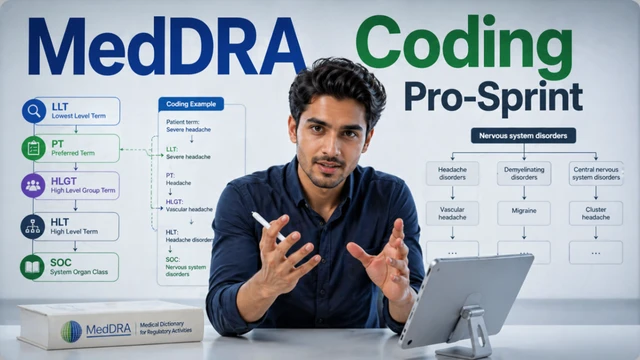
- Learn medical coding with MedDRA (2–3 weeks): Understand MedDRA structure (SOC, HLGT, HLT, PT, LLT) and code adverse events and medications. \n
- Get comfortable with a safety database (1–2 weeks): Practice on a training version of Oracle Argus or similar. This is a non-negotiable skill. \n
- Build a project portfolio (1 week): Complete a few end-to-end case processing projects and document them. Show employers you can do the work. \n
- Start applying (ongoing): Prepare a resume highlighting your practical skills and portfolio. Apply to 10-15 jobs per day. \n
Bridge the Gap with Simulation-Based Practice
\nReading about PV is not enough. You need to actually process cases, code adverse events, and navigate a database. The best way to do this without a job is through a simulated real-world environment. That's where a system designed for hands-on practice changes everything.
\nBuild These Skills Now
Programs from ZANE ProEd Academy that directly address the skill gaps discussed above.
Programs like the ICSR Case Processing & Triage simulation and the MedDRA Medical Coding Certification go beyond theory. They provide a secure sandbox where you can work on mock cases, receive instant feedback, and build the confidence of a 6-month experienced associate. This system mirrors the actual workflow of CROs and pharma companies, so interviewers recognize your readiness.
\n\nReady to Start Your PV Career?
\nYou now have a clear roadmap. The demand for pharmacovigilance jobs for freshers in India is real, but so is the competition. Don't let your theoretical degree hold you back. Check your job readiness today and see how your skills compare to industry requirements. Your first role as a Drug Safety Associate is closer than you think.
Build These Skills Now
Programs from ZANE ProEd Academy that directly address the skill gaps discussed above.
Follow Zane ProEd on Google
Preferred SourceAdd our publication as a preferred source to get the latest clinical research guides, industry updates, and career intel directly in your Google Top Stories & AI Overviews.