Signal Detection Pharmacovigilance Career: Insider Guide for Medical Graduates

Signal Detection Pharmacovigilance Career: It is the process of analyzing drug safety databases to find unknown or changing health hazards. Specialists combine medical knowledge with statistical methods to spot patterns. For BDS, BHMS, BAMS, and nursing graduates, this career offers a stable, high-paying, office-based role without patient contact.
Are you a BDS, BHMS, BAMS, or nursing graduate who has tried multiple pharmacovigilance courses but still feels stuck? You are not alone. Many medical graduates face the same wall: certificates without job offers. The truth is, employers want job-ready talent, not just paper qualifications. A signal detection pharmacovigilance career can be your breakthrough—but only if you build the real skills that companies demand.
This guide cuts through the noise. It gives you an insider's view of what signal detection really is, how much you can earn, and the exact steps to land a job. No fluff. No jargon.
Build These Skills Now
Programs from ZANE ProEd Academy that directly address the skill gaps discussed above.
What is signal detection in pharmacovigilance?
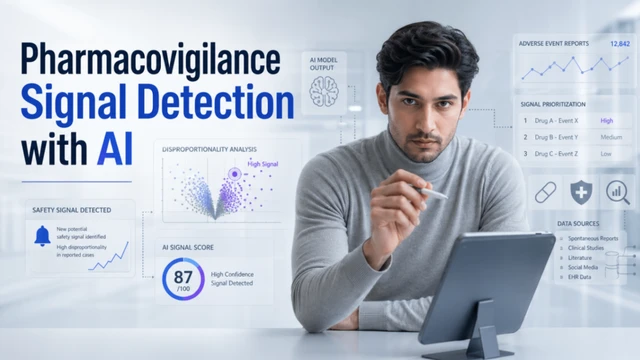
Imagine thousands of patient safety reports coming in from doctors, hospitals, and patients every day. Hidden in that data are potential new side effects—signals. Signal detection is the systematic search for these hidden risks. It is the backbone of pharmacovigilance signal management. As a Signal Detection Specialist, you don't just run software; you use medical judgment to decide if a pattern is real or just noise. The job description includes reviewing case reports, performing statistical analysis, writing safety assessments, and collaborating with global teams. Organizations like the WHO and ICH set the global standards, and regulators like FDA and EMA depend on these signals to keep drugs safe.
What is the salary of a Signal Detection Specialist in India?
Let's talk numbers. The signal detection specialist salary in India varies by experience and company type. As a fresher with the right practical skills, you can expect:
- Entry-level (0-2 years): ₹3.5 to ₹5.5 lakhs per annum
- Mid-level (3-5 years): ₹6 to ₹10 lakhs per annum
- Senior/Manager (6+ years): ₹12 to ₹20 lakhs per annum
Top CROs and global pharma companies pay even more, especially if you have hands-on experience with modern signal detection tools and methods. This is not a call-center job; it's a high-skill role that rewards clinical insight.
How to become a Signal Detection Specialist?
Many courses teach theory but skip the practice. To become a signal detection specialist, follow these steps:
- Build Your Base: Your BDS/BHMS/BAMS/Nursing degree gives you the medical foundation. Next, understand the basics of pharmacovigilance—check out this guide on PV jobs for freshers.
- Learn the Science: Study signal detection principles: disproportionality analysis, Bayesian methods, and medical review of signals. Read guidelines from CDSCO for the Indian context.
- Master the Tools: Employers use Oracle Argus, ArisGlobal, and even AI-driven platforms. You must go beyond textbooks—learn by working on real-case simulations.
- Get Practical Experience: This is the missing link. Sign up for a program that provides hands-on practice, not just video lectures. Our in-depth career guide explains why simulations beat traditional courses.
- Apply with Confidence: Tailor your resume to highlight data review and tool skills. Network on LinkedIn, and target companies like IQVIA, Labcorp, and Syneos Health.
What tools are used for signal detection?
The days of Excel sheets are gone. Modern signal detection tools and methods include:
- Pharmacovigilance databases: Oracle Argus Safety, ArisGlobal LifeSphere.
- Statistical engines: Empirical Bayesian Data Mining, PRR, ROR—often built into platforms like SAS or R.
- AI and machine learning: New tools use natural language processing to scan unstructured data. The ZANE ProEd system integrates AI-driven simulations to mimic real industry workflows.
- Visualization: Tableau or Spotfire to create dashboards that make signal patterns clear to medical reviewers.
If you only know theory, you'll struggle in interviews. Employers test practical knowledge: 'Given this output table, what would you recommend?'
What qualifications are needed for signal detection roles?
You don't need a PhD. The must-have qualifications are:
- Medical/pharmacy degree: BDS, BHMS, BAMS, BPharm, or nursing registration.
- Understanding of pharmacovigilance signal management and regulatory guidelines (ICH E2E).
- Hands-on skill with at least one safety database and one analysis method.
- Soft skills: Attention to detail, communication with global teams, and the ability to write clear safety narratives.
Note: No certification alone will convince a recruiter. The market is flooded with certificate holders who cannot perform basic tasks. Companies now demand job-ready talent from day one.
The Hidden Gap: What Colleges Don't Teach
Your BDS or BHMS curriculum covered diseases, drugs, and patient care. But did it teach you to analyze a data table with 10,000 cases? No. Did it show you how to use Oracle Argus to flag a potential liver toxicity signal? Probably not. Traditional pharmacovigilance courses often stop at the theory, leaving you in the 'certification limbo'—qualified on paper but unskilled in practice.
Employers don't care about your course completion certificate. They care if you can log into a system, run a query, and write a convincing assessment within a deadline. The real world is fast-paced and messy. Textbooks won't prepare you for ambiguous data sets. That's why simulations and projects are now the gold standard in hiring.
Your Step-by-Step Pathway to a Job
Stop circling. Follow this roadmap:
- Week 1-2: Foundations. Refresh pharmacovigilance principles using free resources from ICH and WHO. Read the CIOMS VIII report on signal detection.
- Week 3-6: Tool immersion. Get your hands dirty. Use a sandbox environment to create case series, run disproportionality analyses, and generate reports. Focus on one tool deeply.
- Week 7-8: Case practice. Work through 5-10 real-world signal scenarios. Write safety assessments. Get feedback from industry mentors.
- Week 9-10: Resume and interview prep. Build a portfolio of your practice reports. Network with PV professionals on LinkedIn.
- Week 11: Apply. Start sending applications. You are no longer a certificate holder; you are a candidate with demonstrable skills.
Why Simulation-Based Learning Changes Everything
The difference between getting hired and staying stuck often comes down to one thing: practice. Reading about signal detection will not build muscle memory. You need a system that lets you make mistakes safely—where you can detect a false signal and learn why it was wrong without risking patient safety. This is where simulation-based platforms bridge the gap between theory and job-readiness. They replicate the exact tools and data environments used in top pharma companies, so your first day on the job feels like your tenth.
Build These Skills Now
Programs from ZANE ProEd Academy that directly address the skill gaps discussed above.
How the Right System Makes You Job-Ready
Courses like the pharmacovigilance-signal-detection-with-ai program don't just teach concepts—they place you inside a simulated safety department. You work with anonymized real-world data, use industry-standard dashboards, and make decisions under time pressure. This is a system designed around the 80/20 rule: 80% hands-on, 20% explanation. It's the closest you can get to on-the-job experience without a job. When you finally walk into an interview, you can talk about concrete problems you solved, not just definitions you memorized.
Ready to stop feeling stuck? Check your job readiness—compare what you know now against the skills employers actually test. Or read more about signal detection career strategies for medical graduates to see how others made the leap.
Build These Skills Now
Programs from ZANE ProEd Academy that directly address the skill gaps discussed above.
Follow Zane ProEd on Google
Preferred SourceAdd our publication as a preferred source to get the latest clinical research guides, industry updates, and career intel directly in your Google Top Stories & AI Overviews.