How to Build a Signal Detection Pharmacovigilance Career in India: Step-by-Step Roadmap for Chemistry Graduates

Signal Detection Specialist A signal detection pharmacovigilance career involves analyzing drug safety data to identify new or changing risks. In India, Chemistry graduates can enter this field by mastering pharmacovigilance signal management, signal detection tools, and regulatory workflows—no medical degree required.
As a BSc or MSc Chemistry graduate in India, you might think a career in pharmacovigilance is only for pharmacists or doctors. But here is the truth: the demand for signal detection specialists is growing fast, and your chemistry background gives you a unique analytical edge. A signal detection pharmacovigilance career is not just possible—it is one of the most rewarding paths in the life sciences industry.
Without industry connections, breaking in can feel impossible. However, the modern pharmaceutical industry runs on tools, workflows, and regulatory knowledge—not just personal networks. This guide gives you a step-by-step roadmap to enter this field, even with zero experience.
Build These Skills Now
Programs from ZANE ProEd Academy that directly address the skill gaps discussed above.
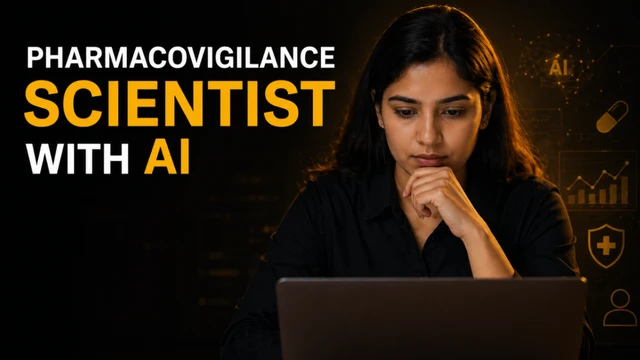
In today's AI-driven healthcare industry, the ability to detect safety signals from massive datasets is a superpower. You can learn it.
What is signal detection in pharmacovigilance? (Signal Detection Pharmacovigilance Career Guide)
Signal detection is the process of analyzing safety data from clinical trials, spontaneous reports, and real-world evidence to identify new or changing risks associated with a drug or vaccine. It sits at the heart of pharmacovigilance signal management, which includes signal validation, prioritization, and assessment.
As a Signal Detection Specialist, you scan large datasets from global safety databases to spot patterns that may indicate a safety signal. Your work directly protects patients and ensures regulatory compliance with agencies like the World Health Organization and ICH.
- Signal detection uses statistical and non-statistical methods to find potential safety issues.
- Signal management covers the entire lifecycle from detection to action.
- You work closely with safety physicians, data scientists, and regulatory affairs teams.
- No direct patient contact—it is a data-driven, analytical role ideal for Chemistry graduates.
What is the salary of a Signal Detection Specialist in India?
The signal detection specialist salary in India varies by experience, location, and company type. Entry-level roles typically start at ₹3.5 LPA, while mid-level professionals with 3-5 years of experience can earn ₹6-8.5 LPA or more.
Top pharma hubs like Hyderabad, Bangalore, Pune, and Mumbai offer the highest pay due to concentration of global pharmacovigilance centers.
- Fresher (0-2 years): ₹3.5 - ₹5 LPA
- Mid-level (3-5 years): ₹6 - ₹8.5 LPA
- Senior (5+ years): ₹10 - ₹15 LPA or more
- Additional benefits often include health insurance, performance bonuses, and shift allowances.
Companies like Accenture, Cognizant, Parexel, and IQVIA frequently hire signal detection specialists in India.
How to become a Signal Detection Specialist?
You do not need a medical degree to enter this field. A BSc or MSc in Chemistry provides the analytical foundation. Here is a high-level view of how to become a signal detection specialist:
- Learn pharmacovigilance fundamentals – ICH guidelines, GVP modules, and safety reporting basics.
- Master signal detection tools – Get hands-on with industry-standard software (details below).
- Build practical projects – Use free datasets or simulations to create a portfolio.
- Earn a certification – A recognized pharmacovigilance signal detection course adds credibility.
- Apply for internships – Even remote or short-term roles help you break in.
For a detailed roadmap, explore our guide on pharmacovigilance case processing jobs for freshers.
What tools are used for signal detection?
Modern signal detection relies on specialized software and quantitative methods. Familiarity with these signal detection tools and methods is a must-have skill.
- Oracle Argus – The most widely used safety database for case processing and signal detection.
- ArisGlobal LifeSphere – Cloud-based signal management platform.
- VigiBase / VigiLyze – WHO's global database of individual case safety reports.
- Empirica Signal – Advanced analytics for disproportionality analysis.
- Statistical methods – Proportional reporting ratio (PRR), Bayesian data mining, and time-to-onset algorithms.
You do not need to be a programmer, but basic Excel skills and an analytical mindset are essential.
What qualifications are needed for signal detection roles?
Employers in India typically require a bachelor's or master's degree in life sciences, chemistry, pharmacy, or a related field. For Chemistry graduates, a BSc or MSc in Chemistry is accepted if you demonstrate relevant pharmacovigilance knowledge.
- Degree: BSc/MSc Chemistry, BPharm, MPharm, or BSc/MSc Life Sciences.
- Certification: A pharmacovigilance signal detection course (such as those offered by ZANE ProEd) can bridge the gap.
- Skills: Attention to detail, data interpretation, and understanding of CDSCO regulations.
- Language: Strong written English for safety reports and regulatory submissions.
Qualifications aside, the signal detection job description typically includes monitoring safety data, performing statistical analysis, and preparing signal validation reports. You can start with a free pharmacovigilance course to test the waters; see our list of free pharmacovigilance courses with certificates.
Skill Gap: What Employers Actually Expect vs. What College Teaches
Your Chemistry degree teaches you molecular structures, reaction mechanisms, and analytical techniques. But a signal detection role demands a different toolset.
| Conventional Education | Modern Employer Expectations |
|---|---|
| Organic and inorganic chemistry theory | Pharmacovigilance signal management workflows |
| Laboratory experiments and titrations | Hands-on with Oracle Argus or similar safety databases |
| Academic research reports | Regulatory compliance documentation (ICH E2B, GVP) |
| No exposure to drug safety data | Ability to interpret aggregate safety reports and detect signals |
That is why practical, simulation-based training is no longer optional—it is the fastest way to prove your readiness to Indian employers.
Structured Pathway: Your 5-Step Roadmap to Enter Signal Detection
- Build foundational pharmacovigilance knowledge – Study ICH guidelines (E2A, E2B, E2C) and GVP modules. Focus on signal detection concepts.
- Learn a safety database – Get certified in Oracle Argus or ArisGlobal through online courses or simulations.
- Complete a signal detection project – Use publicly available FAERS or VigiBase data to create a mini signal detection report.
- Create a portfolio – Showcase your case processing examples, signal detection analyses, and tool proficiency.
- Apply to entry-level roles – Target pharmacovigilance service providers in Hyderabad, Bangalore, Pune, and Mumbai. Highlight your simulation experience.
Bridge the Gap with Simulation-Based Learning
Reading theory is not enough. Employers want proof that you can work in a real pharmacovigilance system. That is where structured, simulation-based training gives you an edge.
Look for programs that offer hands-on practice with safety databases, mock signal detection exercises, and portfolio-ready projects. These simulate the daily work of a Signal Detection Specialist, so you walk into interviews with confidence.
Build These Skills Now
Programs from ZANE ProEd Academy that directly address the skill gaps discussed above.
ZANE ProEd: Your Industry Training System
ZANE ProEd offers two specialized programs tailored for Chemistry graduates who want to enter signal detection:
- Pharmacovigilance Signal Detection with AI – Covers signal detection methods, AI-driven analytics, and ICH-GCP compliance.
- AI-Powered Pharmacovigilance Specialist – Deep-dives into automation, safety databases, and audit-ready documentation.
Both courses emphasize practical trial simulation, international regulatory alignment, and building a verifiable portfolio. You learn by doing, not just watching videos.
Your Next Step
Do not let a lack of connections hold you back. The signal detection field is growing, and the tools are learnable. Start by auditing your current skills against the job description above, then explore simulation workflows to fill the gaps.
Your signal detection pharmacovigilance career is waiting. Take the first step today.
Build These Skills Now
Programs from ZANE ProEd Academy that directly address the skill gaps discussed above.
Follow Zane ProEd on Google
Preferred SourceAdd our publication as a preferred source to get the latest clinical research guides, industry updates, and career intel directly in your Google Top Stories & AI Overviews.