Signal Detection Pharmacovigilance Career: Tool-Based Roadmap for BSc/MSc Chemistry Freshers

Signal Detection Specialist A signal detection pharmacovigilance career involves identifying and evaluating safety signals from adverse event data to ensure drug safety. It requires knowledge of tools like Argus Safety, MedDRA coding, and signal management workflows. Freshers in India can enter via structured training and portfolio-building.
No one tells you this: as a BSc or MSc Chemistry graduate, you already have the analytical mindset for a signal detection pharmacovigilance career. But the industry won't hire you just for your degree. They want proof you can use the tools and follow the workflow. That's the insider secret.
You're a fresher in India, maybe from a non-medical background. You see pharmacovigilance jobs on LinkedIn but they all ask for 'experience with Argus' or 'knowledge of signal management'. How do you get that experience without a job? This blog gives you the exact tool-based roadmap to get your first job in 3–6 months.
Build These Skills Now
Programs from ZANE ProEd Academy that directly address the skill gaps discussed above.
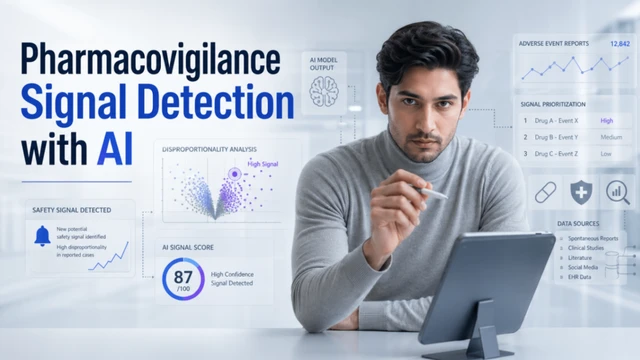
What is signal detection in pharmacovigilance and why does it matter for a signal detection pharmacovigilance career?
Signal detection is the process of identifying new safety concerns (signals) from adverse event data. In a signal detection pharmacovigilance career, you'll use statistical and clinical methods to spot patterns that might indicate a drug safety issue. It's the core of post-marketing surveillance.
Why it matters: regulators like CDSCO and global bodies like WHO require companies to continuously monitor drug safety. Without signal detection, unsafe drugs stay on the market. Your role directly protects patients.
- Daily tasks: Reviewing individual case safety reports (ICSRs), running disproportionality analysis, evaluating literature, and documenting signal evaluations.
- Key output: A validated signal that may lead to label changes, risk management plans, or regulatory action.
- Workflow: Data collection → case processing → signal detection → signal evaluation → risk minimization.
What is the salary of a Signal Detection Specialist in India?
For freshers in India, the signal detection specialist salary starts at ₹3.5 LPA to ₹6 LPA. With 2–4 years of experience, it rises to ₹6 LPA to ₹12 LPA. Senior specialists or leads can earn ₹12 LPA to ₹20 LPA+ in hubs like Hyderabad, Bangalore, Pune, and Mumbai.
Here's a realistic breakdown:
- Entry-level (0–1 year): ₹3.5 – ₹6 LPA
- Mid-level (2–4 years): ₹6 – ₹12 LPA
- Senior (5+ years): ₹12 – ₹20 LPA
- Contract/CRO roles: Often start at ₹4 – ₹7 LPA with faster growth.
Your signal detection job description will usually include: performing signal detection activities, preparing signal evaluation reports, using tools like Argus or ArisG, and collaborating with medical reviewers. Top companies include IQVIA, Parexel, Cognizant, Accenture, and Syneos Health.
How to become a Signal Detection Specialist?
Here's the step-by-step pathway to launch your signal detection pharmacovigilance career:
- Learn the core concepts: Understand pharmacovigilance signal management, MedDRA coding, and basic statistics (disproportionality analysis). Free resources from ICH can help.
- Get hands-on with tools: Practice on Argus Safety (ICSR case processing) and signal detection modules. Build a portfolio of mock signal evaluations.
- Master the workflow: Learn how a signal moves from detection to evaluation to regulatory reporting. Understand the role of PSURs and RMPs.
- Build a verifiable portfolio: Create case studies showing how you detected a signal from a dataset. Document your methodology.
- Network and apply: Target entry-level roles at CROs and pharma companies in Hyderabad, Bangalore, Pune, and Mumbai. Use LinkedIn to connect with PV managers.
- Consider professional certification: A structured program with simulation toolkits can close the experience gap. See ZANE ProEd's signal detection career roadmap for details.
What tools are used for signal detection?
Employers expect you to know specific signal detection tools and methods. Here are the key ones:
- Argus Safety: The most common safety database for ICSR processing and signal management. You must know how to run signal detection reports.
- ArisG / ARISg: Another popular safety database, especially in Indian CROs.
- MedDRA: The medical dictionary for regulatory activities. You'll use it for coding adverse events and grouping signals.
- Statistical methods: Proportional Reporting Ratio (PRR), Reporting Odds Ratio (ROR), Bayesian approaches (e.g., EBGM). These are used in disproportionality analysis.
- Signal management platforms: Tools like Empirica Signal, or custom dashboards in Veeva Vault Safety.
In 2026, companies also look for AI-assisted signal detection skills. Familiarity with machine learning for signal triage is a bonus. ZANE ProEd's pharmacovigilance jobs playbook covers this in detail.
What qualifications are needed for signal detection roles?
For a signal detection pharmacovigilance career, you need:
- Education: BSc/MSc in Chemistry, Life Sciences, Pharmacy, or related fields. Your chemical sciences background is an asset.
- Certification: A professional certification in pharmacovigilance with signal detection focus is highly valued. It proves you've practiced the workflow.
- Technical skills: Knowledge of Argus, MedDRA, and disproportionality analysis. Basic understanding of GVP (Good Pharmacovigilance Practices).
- Soft skills: Attention to detail, critical thinking, and clear documentation. You'll write signal evaluation reports, so English proficiency matters.
Many freshers from non-medical backgrounds succeed in this field. Your degree doesn't limit you—your portfolio does.
What is the skill gap for BSc/MSc Chemistry graduates in signal detection?
Your BSc/MSc Chemistry education teaches you lab techniques, chemical analysis, and research methodology. But it doesn't teach you the signal detection job description in practice. Employers want:
- Hands-on experience with Argus Safety (not just theory).
- Ability to run a signal detection report and interpret the results.
- Familiarity with regulatory timelines and reporting requirements.
- And a portfolio that proves you can do the job from day one.
That's the gap. A conventional degree gives you the foundation, but not the tools. You need simulation-based learning to bridge it.
System Bridge: This is where simulation-based learning and verifiable portfolio proof come in. Instead of waiting for a job to teach you Argus, you can practice on industry-grade simulation toolkits. Build a portfolio of signal evaluations that you can show recruiters. That's how you turn your chemistry degree into a signal detection pharmacovigilance career.
Build These Skills Now
Programs from ZANE ProEd Academy that directly address the skill gaps discussed above.
ZANE ProEd Academy offers premier professional certification programs designed for this exact gap. The Pharmacovigilance Signal Detection with AI program and the AI-Powered Pharmacovigilance Specialist program give you hands-on experience with Argus Safety ICSR case processing, Medidata Rave EDC, Veeva Vault eTMF, and FDA 21 CFR submissions. You don't just learn theory—you build an audit-ready portfolio.
Professional certification closes the qualification gap. It shows employers you've already practiced the workflow. It creates verifiable proof of your skills. And it prepares you for high-paying roles in Hyderabad, Bangalore, Pune, and Mumbai. The ROI is clear: a 3–6 month structured preparation can lead to a ₹3.5–8.5 LPA starting salary.
Soft CTA: Explore Professional Certification Blueprints to see which program fits your background. Audit your industry readiness by reviewing the simulation curriculum. Or simply review the course structure and compare it to your current skills. Take the first step toward your signal detection pharmacovigilance career.
Learn more about ZANE ProEd and our mission to build industry-ready professionals.
Build These Skills Now
Programs from ZANE ProEd Academy that directly address the skill gaps discussed above.
Follow Zane ProEd on Google
Preferred SourceAdd our publication as a preferred source to get the latest clinical research guides, industry updates, and career intel directly in your Google Top Stories & AI Overviews.