Stop Memorizing GMP: The Real Workflow of a Pharma QA/QC Executive

Stop Chasing Theory. Master the QA/QC Executive (Pharma) Workflow.
Let’s be direct. Stop memorizing the chapters of Schedule M or the annexes of EU GMP guidelines. Stop making flashcards for definitions you’ll never use in an interview. This purely academic approach is the single biggest reason why bright B.Pharm and M.Pharm graduates with excellent grades fail to secure a role as a QA/QC Executive (Pharma).
You believe that accumulating theoretical knowledge is the path to a job. You’ve been told that more certificates equal more value. This is a fundamental misunderstanding of how the pharmaceutical industry operates. A hiring manager at a top pharma company doesn’t care if you can recite the definition of a Corrective and Preventive Action (CAPA). They care if you can execute the workflow when a 200-liter batch shows an out-of-specification (OOS) result at 3 AM.
The Great Disruption: Your Degree Didn't Prepare You For The Job
The gap between what you learned in college and what is expected on Day 1 of your job is not a gap; it’s a chasm. Your curriculum taught you the 'what'—the regulations, the definitions, the ideal scenarios. It never taught you the 'how'—the messy, high-pressure, decision-making reality of a live manufacturing environment.
Build These Skills Now
Programs from ZANE ProEd Academy that directly address the skill gaps discussed above.
Companies are no longer willing to invest 6-12 months training freshers on the absolute basics of industry operations. The market demands job-ready talent. They expect you to understand not just the principles of Good Manufacturing Practices (GMP), but how to defend those principles during a regulatory audit when a batch record is incomplete.
An Industry Insider's View: What We Actually Look For
As people who have built and managed quality systems in major pharmaceutical companies, let us tell you what we screen for. We don't look for a perfect GPA. We look for evidence of execution capability.
Can you look at a Batch Manufacturing Record (BMR) and instantly spot three compliance gaps? Do you know the precise sequence of documents to initiate when a deviation is reported from the production line? Do you understand the difference between a simple correction and a full-blown CAPA, and the business implications of that choice? This isn't textbook knowledge; it's operational intelligence. It's the language of the industry, governed by guidelines from bodies like the FDA and the EMA.
The Skill Gap Exposed: College Theory vs. Factory Floor Reality
Let's make this brutally clear. Here is the difference between the candidate we ignore and the candidate we hire:
- The College Graduate Knows: The definition of 'Deviation' as per internal SOPs and regulatory guidance.
- The Industry Professional Executes: The end-to-end workflow of logging a deviation, performing an impact assessment, classifying it as critical/major/minor, and initiating the investigation—all within the Quality Management System (QMS).
- The College Graduate Knows: The importance of data integrity as a concept.
- The Industry Professional Executes: A review of HPLC audit trails to ensure compliance with CDSCO and other regulatory expectations, spotting anomalies that could trigger an audit finding.
The Workflow Execution Gap™: ZANE's Core Insight
We call this chasm the Workflow Execution Gap™. It’s the space between knowing a rule and being able to apply it under pressure to protect product quality and patient safety. Your entire academic career has focused on the 'knowing' side. But your entire professional value lies in the 'execution' side.
Every action in a pharma QA/QC role is part of a predefined, interconnected workflow. Releasing a batch isn't a single 'yes/no' decision. It's the successful completion of a 50-step workflow involving multiple documents, data points, and approvals. Your inability to navigate these workflows is your single biggest career risk.
The Batch Release Playbook: A Simplified Workflow
To bridge this gap, you need to stop thinking in terms of isolated facts and start thinking in terms of structured playbooks. Here is a simplified version of a real-world Batch Release workflow that every QA/QC executive must master:
- Documentation Assembly: Gather the executed Batch Manufacturing Record (BMR), Batch Packaging Record (BPR), and all associated QC analytical data (e.g., CoA).
- Compliance Review (Stage 1 - BMR/BPR): Scrutinize every page of the batch records. Are all signatures and dates present? Were all in-process checks performed and are they within limits? Are there any unexplained entries or overwrites?
- Compliance Review (Stage 2 - QC Data): Correlate the analytical data with the batch. Do the results meet all pre-approved specifications? Are there any Out-of-Specification (OOS) or Out-of-Trend (OOT) results? This step is critical, following strict guidelines like those from ICH.
- Discrepancy Management: If any deviation, OOS, or other discrepancy is found, halt the workflow. The appropriate investigation and documentation protocol (e.g., initiating a CAPA) must be executed and closed *before* proceeding. This is where most freshers are completely lost.
- Final QA Disposition: If all checks are passed and all discrepancies are resolved, the final QA officer provides the disposition: Release, Reject, or Quarantine. This is a legally binding decision.
Micro-Scenario: The 4 PM Friday Dilemma
It's Friday, 4 PM. A batch of a critical antibiotic is pending release. The Head of Production is at your desk, telling you they need to ship it tonight to meet a client deadline. As you review the QC data, you notice one analytical test result is borderline, technically within spec but trending upwards over the last five batches (an OOT). Your textbook gives you zero guidance. What do you do? Do you release it? Do you hold the batch and initiate a formal trend investigation? Who do you escalate this to? Your answer determines if you're just an employee or a true quality professional.
Bridging the Gap with Simulated Experience
How do you learn to make these decisions without risking millions of dollars or patient lives? Reading more books won't help. The only way is through practice in a controlled environment. You need to run through these workflows again and again, facing realistic scenarios and making decisions in a system that mirrors a real company's QMS. This is the power of simulation-based learning—it builds the muscle memory for professional execution that companies are desperate to hire. You move beyond just collecting certifications and start building demonstrable skills.
Build These Skills Now
Programs from ZANE ProEd Academy that directly address the skill gaps discussed above.
Integrating into the ZANE ProEd System
This is precisely why we built the ZANE ProEd system. It's an ecosystem designed to close the Workflow Execution Gap™. Our certification programs are not passive video courses; they are interactive, simulation-based environments where you perform the exact tasks of a QA/QC professional.
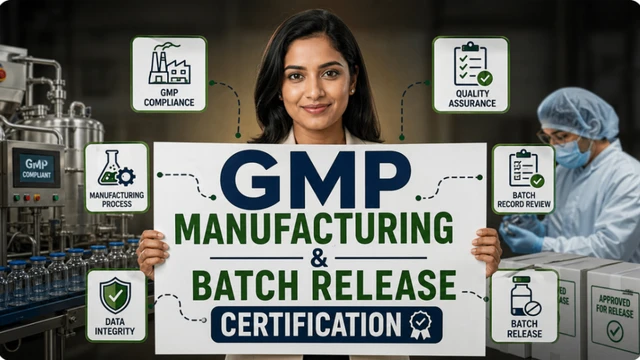
For instance, in the GMP Manufacturing Batch Release Certification, you don't just learn about batch records; you are given complex, realistic BMRs and QC data sets and must perform a full review, identify hidden errors, and make the final disposition decision. You execute the playbook you just read about.
When you encounter a deviation in that simulation, you then need the skills taught in our CAPA Management Certification. This is where you learn the rigorous, structured methodology for root cause analysis and implementing effective corrective actions. You learn the unwritten rules that govern how quality issues are managed, documented, and closed out to satisfy auditors.
Take the First Step Towards Execution
Your pharma career won't be defined by the knowledge you accumulate, but by the decisions you can confidently execute. Stop being a passive learner. It's time to step into the role and start performing the job before you even have it.
Explore the workflows. Master the protocols. Build the skills that industry leaders are searching for right now.
Build These Skills Now
Programs from ZANE ProEd Academy that directly address the skill gaps discussed above.
Follow Zane ProEd on Google
Preferred SourceAdd our publication as a preferred source to get the latest clinical research guides, industry updates, and career intel directly in your Google Top Stories & AI Overviews.