Stop Memorizing Textbooks: The Real Clinical Operations Workflow You Weren't Taught in College
Stop Chasing Useless Certificates. Start Mastering Workflow.
Let’s be brutally honest. You finished your BSc, BPharm, or Life Sciences degree, and now you’re collecting certificates like they’re Pokémon cards. You’ve memorized the stages of a clinical trial, you can recite the definition of an SAE, and you think this makes you “job-ready” for a Clinical Operations role. It doesn’t.
The single biggest mistake fresh graduates make is believing that more academic knowledge is the answer. It’s not. The industry isn’t hiring a walking textbook. They are hiring an operator—someone who can execute a complex, regulated workflow from day one. Your degree gave you the dictionary; the job requires you to write the novel.
The Great Disruption: Why Your Degree is Just the Entry Ticket
That piece of paper you worked so hard for? It gets your resume past the first automated filter. That’s it. It proves you have foundational knowledge. It does not prove you have operational capability. Hiring managers at top CROs and Pharma companies know this. They see hundreds of resumes with identical qualifications, and they’re looking for one thing: evidence that you understand the *process*, not just the principles.
Build These Skills Now
Programs from ZANE ProEd Academy that directly address the skill gaps discussed above.
The gap between academic theory and industry reality is no longer a gap; it’s a canyon. College teaches you about the ICH GCP guidelines in a sanitized, theoretical environment. The industry expects you to apply those guidelines when a Principal Investigator is pushing back on a protocol amendment and your site activation timeline is already three weeks behind schedule. See the difference?
An Insider’s View: What a Clinical Operations Executive Actually Looks For
As someone who builds and leads these teams, I can tell you we don’t have time for a six-month learning curve. When we hire a Clinical Trial Assistant (CTA) or a junior CRA, we expect them to understand the flow of information and documents. We need them to grasp the dependencies between site selection, ethics committee approvals, and drug shipment logistics.
We aren’t impressed by your grades in pharmacology. We are impressed when you can intelligently discuss the challenges of activating a pediatric oncology site versus a cardiovascular site. We care if you understand why a delay in receiving a signed Form FDA 1572 can derail an entire project startup. This is the language of the industry. It's a language of process, risk, and execution.
Skill Gap Exposed: The University vs. The Real World
The disconnect is staggering. Your curriculum was designed for academic rigor, not operational readiness. Here’s a clear breakdown:
- University Teaches: The definition of Informed Consent.
- Industry Expects: You to perform quality control on a submitted Informed Consent Form (ICF) to ensure it meets both CDSCO and sponsor requirements, identifying version control errors before an auditor does.
- University Teaches: The different phases of clinical trials (Phase I, II, III, IV).
- Industry Expects: You to manage the Trial Master File (TMF) for a Phase III global study, ensuring all site-level documents are filed, complete, and inspection-ready according to the DIA TMF Reference Model.
- University Teaches: The role of a Contract Research Organization (CRO).
- Industry Expects: You to navigate the communication matrix between the sponsor, the CRO, the site staff, and central vendors, ensuring timelines are met and data is clean. For a deeper dive into career paths, understand why your BPharm degree isn't enough.
The ZANE Framework: Achieving Clinical Workflow Acuity™
To bridge this canyon, you need a new mental model. At ZANE ProEd, we call it Clinical Workflow Acuity™. It’s a three-stage progression from academic knowledge to professional execution.
- Level 1: Academic Foundation. This is where your degree places you. You know the definitions, the concepts, and the general landscape. You can answer 'what' questions.
- Level 2: Procedural Fluency. This is about process. You understand the sequence of tasks, the documents involved, and the dependencies between steps. You can answer 'how' questions. This is the level where you become hirable.
- Level 3: Strategic Execution. This is about context and problem-solving. You can anticipate bottlenecks, manage risks, and make decisions under pressure. You can answer 'why' questions. This is where you become a leader, like a Clinical Operations Executive.
The entire industry operates at Levels 2 and 3. Your entire education was at Level 1.
The Pathway: Deconstructing the Site Activation Workflow
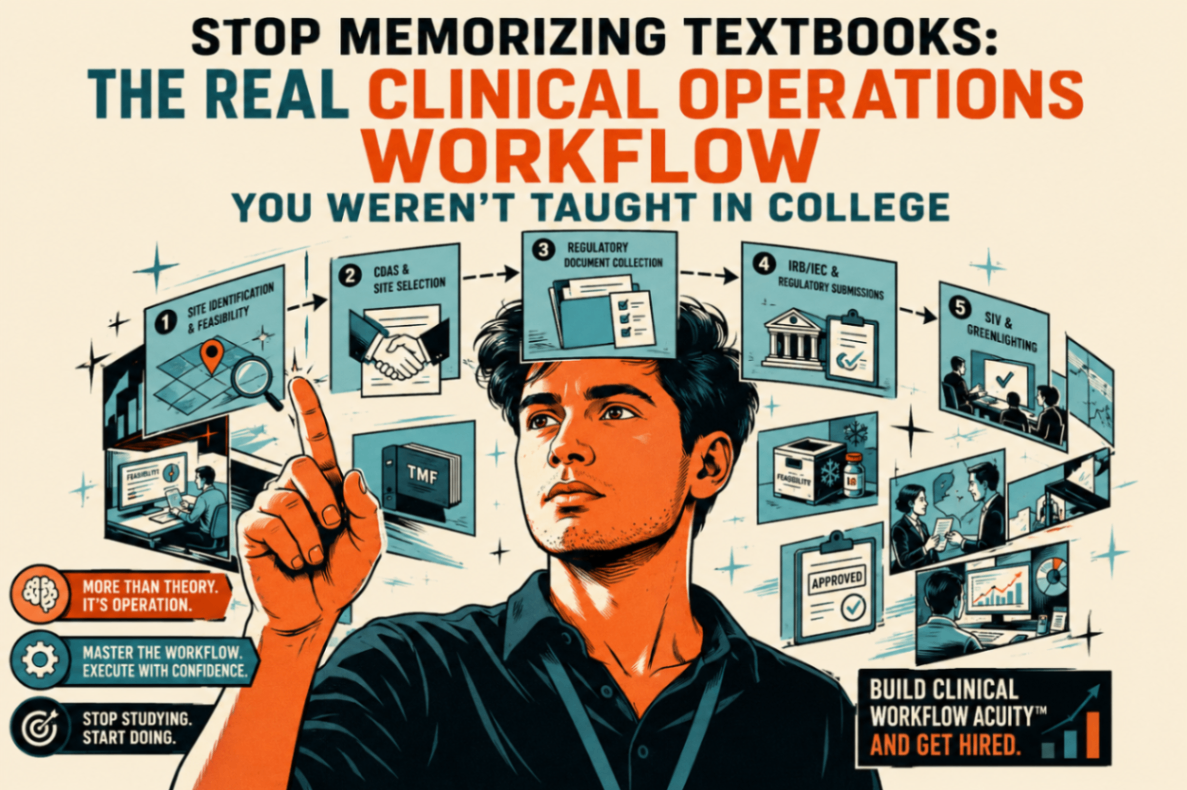
Let's move you to Level 2 right now. Forget theory. Here is a simplified, real-world workflow for one of the most critical phases in any trial: Site Activation. This is what your first job will actually look like.
Step 1: Site Identification & Feasibility
A list of potential hospitals or clinics (sites) is created. You, as a CTA, will be tasked with sending out Feasibility Questionnaires. This isn't just sending an email. You're tracking responses, flagging incomplete answers, and consolidating data for the Clinical Research Associate (CRA) to review. You're the first line of defense against selecting a non-performing site.
Step 2: Confidential Disclosure Agreements (CDAs) & Site Selection
Before you can share the confidential study protocol, each potential site must sign a CDA. You will track these legal documents meticulously. Delays here are common. Once CDAs are in place and feasibility is confirmed, the final sites are selected. You'll be updating trackers and communicating with dozens of people.
Step 3: Regulatory Document Collection
This is the core of the job. You will be responsible for collecting, reviewing, and filing essential documents like the PI’s CV, medical license, financial disclosure forms, and the signed FDA 1572. Each document has specific requirements dictated by regulators like the European Medicines Agency (EMA). An error here can halt the entire trial.
Step 4: IRB/IEC and Regulatory Submissions
Once the essential document package is complete, it’s submitted to the Institutional Review Board (IRB) or Independent Ethics Committee (IEC) for approval. You will prepare and QC this submission package. A single missing signature can lead to rejection, costing weeks of delay. Parallelly, submissions are made to national regulatory authorities.
Step 5: Site Initiation Visit (SIV) and Greenlighting
After all approvals are received, the CRA conducts the Site Initiation Visit to train the site staff. You will support this by ensuring all training logs are completed and filed, the investigational product is ready to be shipped, and the site has access to the Electronic Data Capture (EDC) system. Only then is the site “greenlit” to start enrolling patients.
Micro-Scenario: The Red Flag Review
Imagine this: It’s 4 PM on a Tuesday. Your manager drops a completed Feasibility Questionnaire from a high-priority site on your desk. She says, “Give me a red flag summary in 30 minutes.” You scan the document. The PI has listed 5 competing trials in the same therapeutic area. The pharmacy states they only have a -20°C freezer, but the protocol requires -80°C storage for the drug. The patient recruitment estimate seems wildly optimistic based on the clinic's stated patient population. These are not textbook problems; they are real-world operational risks. Your ability to spot them is your value.
The System Bridge: From Theory to Simulated Reality
How do you gain the experience of spotting those red flags without having the job first? Reading more books won't help. Attending another webinar on GCP is a waste of time. The only way to bridge the gap is by immersing yourself in the workflow.
This is where simulation-based learning becomes non-negotiable. It’s about entering a controlled environment that mirrors the pressures, documents, and decisions of a real Clinical Operations role. You're not just learning *about* the TMF; you're actively managing a simulated one. You're not just reading about feasibility; you're analyzing real-world (anonymized) questionnaire data and making recommendations.
Build These Skills Now
Programs from ZANE ProEd Academy that directly address the skill gaps discussed above.
Academy Integration: Building Your Operational Engine
At ZANE ProEd, we don't sell courses; we provide access to an operational training system. Our programs are built to move you from Level 1 to Level 2 of Clinical Workflow Acuity™ with ruthless efficiency.
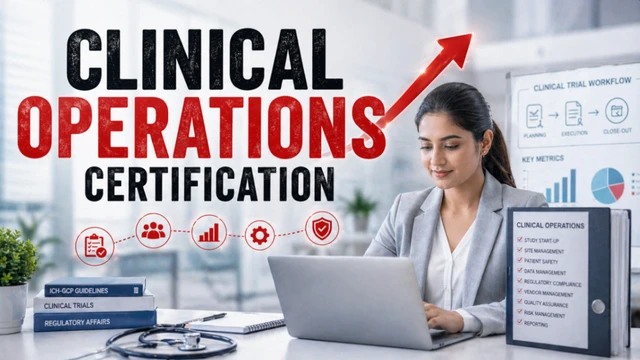
Our Clinical Operations Certification is a comprehensive simulation of the entire end-to-end trial management process. You'll manage a project from protocol development through to site closeout, dealing with the exact documents, challenges, and decisions you'd face at a top CRO.
For those looking to master the most critical and challenging phase first, the Clinical Trial Site Activation Fast-Track is a hyper-focused deep dive. It’s an intense simulation dedicated solely to the workflow we just broke down, turning you into a site activation specialist that hiring managers are desperate to find.
This isn't about getting another piece of paper. It's about building muscle memory for the job, so when you sit in that interview, you talk like an operator, not a student. You can learn more about our philosophy at ZANE ProEd.
Your Next Move: Stop Studying, Start Doing
The path to a successful career as a Clinical Operations Executive doesn't start with another textbook. It starts with a deliberate shift from accumulating knowledge to building capability. The opportunities are massive—just look at the salary potential in related clinical research roles.
Review the site activation workflow we outlined. Identify the step where you feel the least confident. That's your starting point. Your career is a series of processes to be mastered. Begin with the first one.
Build These Skills Now
Programs from ZANE ProEd Academy that directly address the skill gaps discussed above.
Follow Zane ProEd on Google
Preferred SourceAdd our publication as a preferred source to get the latest clinical research guides, industry updates, and career intel directly in your Google Top Stories & AI Overviews.