The 5 Mistakes That Block 90% of BSc/BPharm Grads From Medical Coder Jobs

Why Your Degree Won't Make You a Medical Coder
Let's be brutally honest. You finished your BSc, BPharm, or another Life Sciences degree, and you've set your sights on becoming a Medical Coder. You believe your knowledge of anatomy and pharmacology gives you an edge. The hard truth? In the hyper-competitive Indian job market, that degree is merely the price of admission. It doesn't get you the job.
Over 90% of fresh graduates who apply for medical coding positions fail their initial assessments and interviews. They possess the academic knowledge but lack the one thing companies actually hire for: the ability to translate complex medical information into precise, globally recognized codes. Your degree taught you the 'what'; the industry pays for the 'how'. This gap is where careers stall before they even begin.
Reality Disruption: The Uselessness of Theory Alone
Your university certificate is proof of academic discipline, not job-readiness. Hiring managers are not impressed by your GPA. They are looking for evidence that you can navigate the intricate rule-based systems that govern medical coding, such as the ICD-10-CM and MedDRA. These are not just lists of terms to memorize; they are complex hierarchical languages with strict guidelines enforced by regulatory bodies like the FDA.
Build These Skills Now
Programs from ZANE ProEd Academy that directly address the skill gaps discussed above.
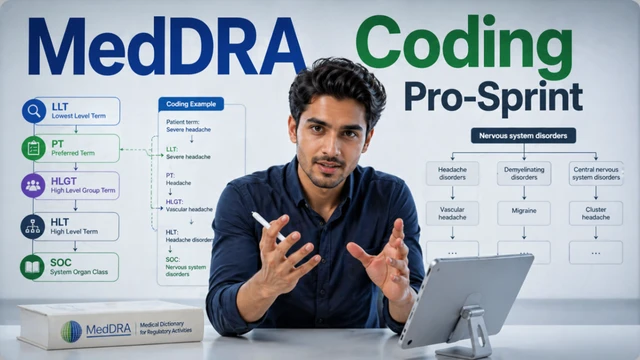
The assumption that reading a textbook on coding is sufficient is the single biggest fallacy holding freshers back. It’s like reading a book about swimming and then expecting to win a race. The real work involves applying guidelines to ambiguous, incomplete, and often confusing real-world medical reports. This is a skill, not a piece of trivia.
The Industry Insider View: What We Actually Look For
As industry practitioners who build and vet talent, we can tell you what happens behind closed doors. When a resume from a fresher lands on our desk, we aren't looking for a list of subjects they studied. We are looking for a signal—any signal—that they understand the operational reality of the job.
We need to know: Can you differentiate between a primary diagnosis and a secondary one? Do you understand the System Organ Class (SOC) hierarchy within MedDRA? Can you apply coding conventions and guidelines without constant supervision? Your degree certificate answers none of these questions. It's practical, demonstrable skill that gets you hired, not theoretical knowledge.
Skill Gap Exposure: College vs. The Coding Floor
The disconnect between academia and industry is a chasm. Let's map it out:
- College teaches you: The definition of 'hypertension'.
- Industry expects you to know: How to correctly code for 'hypertensive heart disease with heart failure', distinguishing it from 'essential (primary) hypertension', and understanding the sequencing rules that govern these codes.
- College teaches you: The names of different drug classes.
- Industry expects you to know: How to accurately code an adverse event using MedDRA, selecting the most specific Lowest Level Term (LLT) that maps to the correct Preferred Term (PT), a critical task in pharmacovigilance.
This isn't an upgrade in knowledge; it's a completely different skillset. Your college education is the foundation, but the industry requires you to build a specific, highly structured skyscraper on top of it. Most freshers show up with just the foundation and wonder why they aren't allowed in the building.
The 'Code-Clarity Chasm': ZANE's Signature Framework
We call this gap the "Code-Clarity Chasm." It's the void between knowing a medical term and being able to assign a precise, compliant, and defensible code. On one side of the chasm is your academic vocabulary. On the other is the ability to generate clean data that regulatory bodies like the CDSCO in India and the EMA in Europe can rely on. Crossing this chasm isn't about studying more; it's about training differently.
The 5 Critical Mistakes: A Fresher's Failure Checklist
To secure a job as a Medical Coder in the next 3-6 months, you must actively avoid these five common failures. This is your pathway.
- Mistake #1: Leading with Your Degree. You mention your BSc or BPharm in the first line of your cover letter and resume summary. Correction: Lead with the specific coding systems you have practical experience with (e.g., "Proficient in MedDRA and ICD-10-CM coding for adverse event reporting").
- Mistake #2: Generic, Useless Certifications. You completed a cheap online course that just gave you video lectures and a PDF certificate. This is a red flag for recruiters. It's the same problem plaguing other domains; many find their pharmacovigilance certificate is useless for the exact same reason—no real-world application.
- Mistake #3: Memorizing Codes, Not Guidelines. You try to rote learn lists of codes. This is impossible and ineffective. Correction: Focus on mastering the official coding guidelines. The guidelines are the 'operating system' that allows you to find the right code every single time, even for a condition you've never seen before.
- Mistake #4: No Demonstrable Workflow Experience. You can't explain the step-by-step process of receiving a source document, abstracting the diagnoses, querying for clarification, and assigning the final codes. This is a failure to understand the actual job, a problem we also detail in our analysis of the PV case processor workflow.
- Mistake #5: Failing the Scenario-Based Interview. The interview isn't a quiz. You will be given a short medical scenario and asked to code it, explaining your logic. This is where 90% of candidates are eliminated. They can't articulate *why* they chose a specific code over another, referencing the guidelines.
Micro-Scenario: The Million-Dollar Difference
An interviewer gives you this summary: "55-year-old male presents to the ED with 'crushing chest pain'. EKG shows ST-segment elevation. Troponin levels are elevated."
- The Untrained Fresher codes: R07.9 - Chest pain, unspecified.
- The Industry-Ready Coder codes: I21.3 - ST elevation (STEMI) myocardial infarction of unspecified site.
The first code is technically not wrong, but it's vague and financially worthless to the healthcare provider. The second code is precise, reflects the severity and specifics of the diagnosis, and is essential for proper billing and data quality. Answering this correctly demonstrates you are an asset, not a trainee.
The System Bridge: From Theory to Application
How do you gain the experience of making these decisions without having a job? You can't. Not with traditional learning. The only way to bridge the Code-Clarity Chasm is through a system that forces you to practice the job in a simulated environment. It's about building cognitive muscle memory by performing hundreds of coding tasks on realistic, complex medical records. It's this high-volume, realistic practice that separates the top 10% from the rest.
Build These Skills Now
Programs from ZANE ProEd Academy that directly address the skill gaps discussed above.
Academy Integration: Building Your Operational Skillset
This is why ZANE ProEd doesn't operate like a college. We are not a course provider; we are a career incubator. Our entire system, particularly the MedDRA Medical Coding Certification, is engineered to solve the five mistakes listed above. It's a simulated work environment designed to build the operational skills hiring managers are desperate for.
Instead of just watching videos about the ICH guidelines, you are placed in scenarios where you must apply them. You are forced to navigate the MedDRA hierarchy, make coding decisions under pressure, and justify your logic. This system builds the demonstrable proof that you are ready for the job from day one. It's about transforming you from a Life Sciences graduate into a functional Medical Coder.
Your Next Step: Stop Studying, Start Simulating
The path to your first Medical Coder job is not through another textbook or a cheap certificate. It's through deliberate, systematic practice that mirrors the real world. Stop hoping your degree will be enough. It's time to build the skills that make you undeniable.
Explore the system designed to make you interview-ready and job-ready. Understand how simulation bridges the gap between what you learned in college and what the industry demands.
Build These Skills Now
Programs from ZANE ProEd Academy that directly address the skill gaps discussed above.
Follow Zane ProEd on Google
Preferred SourceAdd our publication as a preferred source to get the latest clinical research guides, industry updates, and career intel directly in your Google Top Stories & AI Overviews.