The BSc/BPharm Graduate's Roadmap to a Clinical Trial Coordinator Job in 2024 (Stop Applying Blindly)
Stop Sending That Resume. It’s Not Working.
Let’s be direct. If you are a recent BSc, BPharm, or Life Sciences graduate, your current strategy for landing a Clinical Trial Coordinator (CTC) job is likely failing. You’ve polished your resume, highlighted your academic projects, maybe even memorized the phases of a clinical trial. You’re applying to dozens of openings on LinkedIn and Naukri, and all you hear back is silence.
This isn't because you're not smart or qualified in an academic sense. It's because you're playing a game without knowing the rules. The belief that your degree is a direct ticket to a clinical research role is a dangerous assumption. The industry isn't looking for another student who can recite textbook definitions; it’s desperate for an operator who can execute tasks from day one. The next hiring cycle is already starting, and every failed application pushes you further behind.
Reality Disruption: Your Degree Got You to the Door, Not Inside the Room
The gap between your final year syllabus and the first day as a CTC is not a gap; it's a canyon. Your professors taught you the 'what'—what is an Informed Consent Form, what are the principles of Good Clinical Practice (GCP). They never taught you the 'how'—how to review an ICF against a protocol, how to track submissions to an Ethics Committee using a specific CTMS, or how to resolve a site query about patient stipend payments.
Build These Skills Now
Programs from ZANE ProEd Academy that directly address the skill gaps discussed above.
Hiring managers know this. They see hundreds of resumes from bright graduates who list "Knowledge of ICH-GCP" as a skill. This phrase has become meaningless. It doesn’t prove you can do anything. It just proves you attended a lecture. This is why entry-level roles feel impossible to get; they aren't truly entry-level. They are 'entry-to-the-industry' roles that require a baseline of operational competence your university never provided. As we've detailed before, your BPharm degree isn't enough to land a job in this competitive landscape.
The Industry Insider View: We Hire for Execution, Not Theory
As insiders who design training for top CROs and Pharma companies, we can tell you what happens behind the scenes. When a hiring manager gets a project to start a new Phase III trial for a cardiology drug, they don't have six months to train a fresher on the basics. They need a CTC who can immediately begin the site activation process. This means someone who understands the practical steps of collecting essential documents like the Form FDA 1572, investigator CVs, and financial disclosures, and knows how to file them correctly in a Trial Master File (TMF).
They are looking for candidates who can talk about workflows, not just concepts. Can you explain the lifecycle of an essential document? Do you know the difference between a site-level and a country-level document? Do you understand the role of central labs and the logistics of sample collection kits? This is the language of the job, and it’s not taught in college.
Skill Gap Exposure: College Output vs. Day 1 CTC Expectations
Let's make this brutally clear. Here is the difference between what your education prepared you for and what the job demands:
- College Teaches: The definition of an Ethics Committee (EC) / Institutional Review Board (IRB).
- Industry Expects: The ability to prepare and track an entire EC submission package, including the protocol, investigator's brochure, ICF, and all required local forms, and manage the version control of these documents post-approval.
- College Teaches: The names of essential documents in a clinical trial.
- Industry Expects: The ability to perform a quality check (QC) on a Site Feasibility Questionnaire, a signed protocol signature page, and a Financial Disclosure Form, identifying common errors that would delay a regulatory submission.
- College Teaches: The theoretical flow of a clinical trial from Phase I to IV.
- Industry Expects: A clear understanding of the operational workflow from Site Identification to Site Close-Out, and your specific role in it. If you can't articulate this, you can't do the job. You need to understand the real clinical operations workflow you weren't taught in college.
The ZANE Framework: Escaping the "Industry-Academic Gap™"
The problem is what we call the "Industry-Academic Gap™". It's the void between possessing academic knowledge and demonstrating operational capability. Every fresher exists in this gap. The goal is not to learn more theory; it is to build a bridge of demonstrable skills across this gap so a hiring manager can confidently choose you, knowing you won’t be a training burden.
Your resume filled with academic credentials keeps you on one side of the gap. A portfolio of executed, real-world tasks (even in a simulated environment) gets you across. You must shift your focus from 'learning about' the job to 'learning to do' the job.
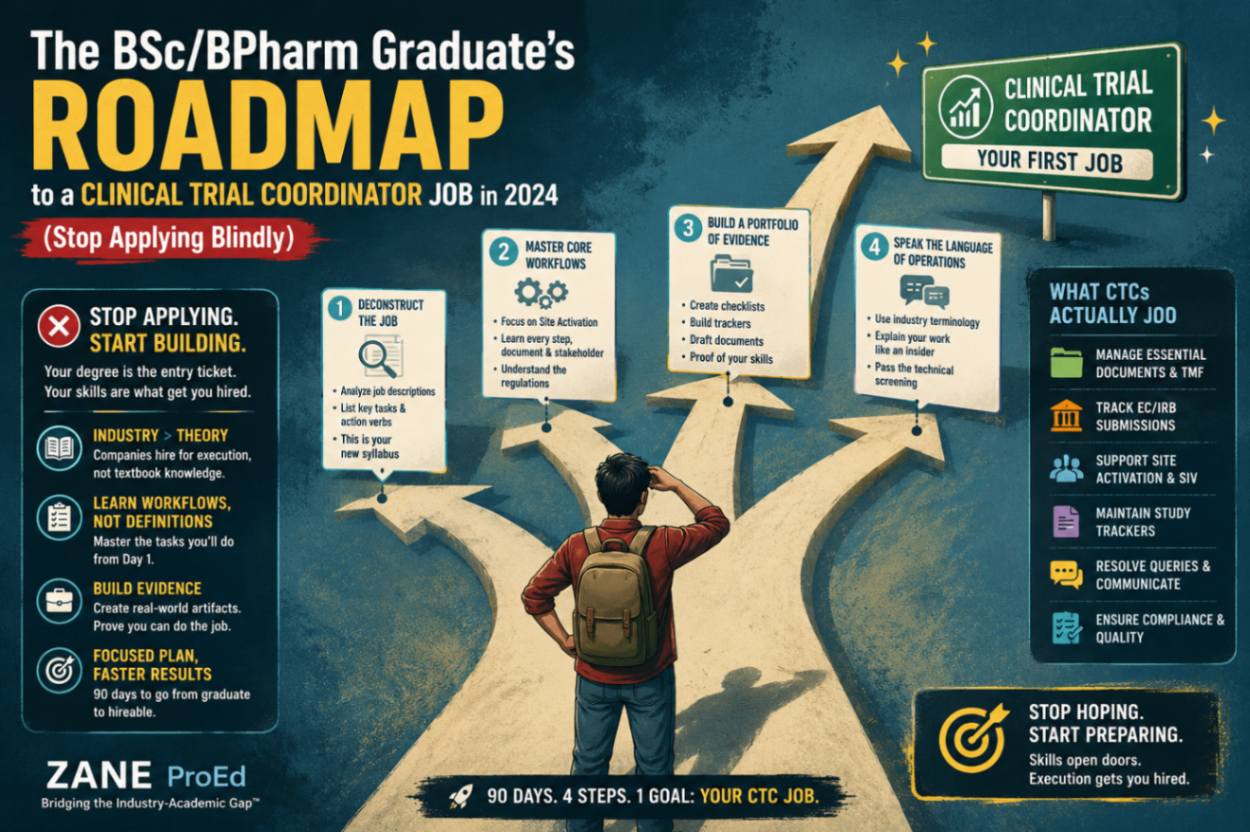
Your 4-Step Roadmap to Becoming a Clinical Trial Coordinator
Stop the random applications. Start a focused, 90-day execution plan. This is your new strategy.
- Step 1: Deconstruct the Job, Not the Subject (Weeks 1-2). Take 5 job descriptions for a CTC role from major CROs (IQVIA, PPD, Syneos Health). Ignore the generic requirements. List out every single *action verb* and *task* mentioned. Examples: "track submissions," "maintain TMF," "prepare site-facing documents," "resolve queries." This is your new syllabus.
- Step 2: Master the Core Workflows (Weeks 3-6). Focus on the most critical and hireable workflow for a new CTC: Site Activation. This is the process of getting a hospital or clinic ready to enroll patients. It involves document collection, EC/IRB submissions, and budget/contract negotiations. Learn every single step, document, and stakeholder involved. Understand the regulations that govern this process as laid out by bodies like the CDSCO in India or the European Medicines Agency.
- Step 3: Build a Portfolio of Evidence (Weeks 7-10). This is the most critical step. You need to create tangible proof of your skills. Draft a sample Informed Consent Form based on a template. Create a checklist for a Site Initiation Visit (SIV). Build an Excel tracker for essential documents. These artifacts become your proof. You can talk about them in an interview, demonstrating capability, not just knowledge.
- Step 4: Learn to Speak the Language of Operations (Weeks 11-12). Practice explaining your portfolio. Instead of saying "I know GCP," say "I created a TMF index for a hypothetical Phase II oncology trial, ensuring all site activation documents were filed according to the DIA TMF Reference Model." This is how you sound like an insider and pass the technical screening.
Micro Scenario: The Reality of a CTC's Tuesday Morning
Imagine this: It’s 10 AM. You receive an email from your Clinical Research Associate (CRA) with the subject line "URGENT: Site 104 - Dr. Sharma FDF Expired." Attached is a new Financial Disclosure Form. Your protocol mandates that all FDFs must be current before a patient can be randomized. What do you do? The textbook has no answer.
An operationally-ready CTC knows the drill: 1) Acknowledge receipt to the CRA. 2) Download and save the new FDF with the correct naming convention. 3) Perform a QC check: Is it the correct version? Is it signed and dated? Are all fields complete? 4) Upload the new FDF to the eTMF in the correct sub-folder. 5) Update the master site document tracker with the new expiry date. 6) Notify the data management team if this impacts system access. This entire workflow takes 15 minutes, and it's what separates the hireable from the hopeful.
The System Bridge: From Passive Learning to Active Doing
How do you practice a workflow like this without having the job? Reading about it in a book is useless. This is where the bridge across the "Industry-Academic Gap™" is built. You need a system that doesn't just teach you concepts but forces you to execute tasks in a simulated, high-fidelity environment that mirrors the real software and pressures of a clinical operations role. You need to perform the QC, upload the document, and update the tracker yourself.
This active, simulation-based learning is the only way to build the muscle memory and confidence to walk into an interview and demonstrate your value beyond your degree certificate. It's about moving from a passive student to an active operator.
Build These Skills Now
Programs from ZANE ProEd Academy that directly address the skill gaps discussed above.
Academy Integration: Building Your Operational Toolkit
At ZANE ProEd, we don't sell courses; we provide an integrated system designed to bridge this exact gap. Our programs are built as career entry systems, starting with the end goal—your first job—and working backward.
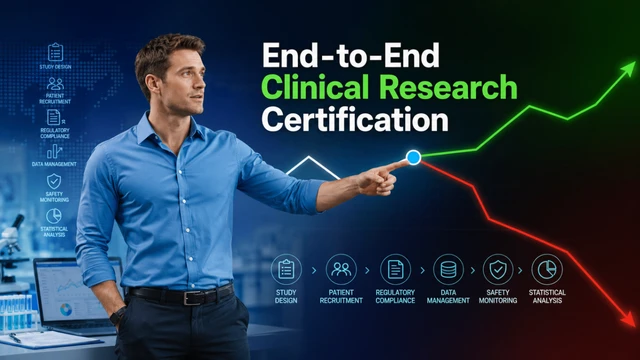
The system begins with the End-to-End Clinical Research Certification, which lays the complete operational foundation. It builds your understanding of the entire clinical trial lifecycle, not as academic phases, but as a series of interconnected, industry-standard workflows. This is where you learn the language and the map of the entire territory.
From there, you move to targeted execution. The Clinical Trial Site Activation Fast-Track is a deep-dive simulation. It doesn't just teach you *about* site activation; you will *perform* the tasks. You will manage document checklists, review mock ICFs, and prepare submission packages inside a simulated environment. This builds your portfolio of evidence, giving you verifiable skills and projects to discuss in an interview. This is how you transform from a graduate into a genuine CTC candidate.
Your Next Move: Start Building, Not Applying
Stop the cycle of blind applications. The definition of insanity is doing the same thing and expecting a different result. Your resume and cover letter are not the problem; the lack of demonstrable, operational skill is.
Your next step isn't to apply to another 10 jobs. It's to take one step on the roadmap. Deconstruct a job description. Identify one workflow you don't understand. Start building your bridge across the gap. The companies are hiring; you just need to show them an operator, not another student.
Build These Skills Now
Programs from ZANE ProEd Academy that directly address the skill gaps discussed above.
Follow Zane ProEd on Google
Preferred SourceAdd our publication as a preferred source to get the latest clinical research guides, industry updates, and career intel directly in your Google Top Stories & AI Overviews.