Hospital Quality Assurance Jobs India: Complete Career Guide for Freshers

Hospital quality assurance jobs India require managing patient safety, monitoring protocols, and ensuring NABH standards. Freshers with a pharmacy degree can apply, but most employers expect practical knowledge of accreditation audits and incident management, not just theoretical concepts.
If you are a BPharm or MPharm graduate trying to switch from IT or BPO into hospital quality assurance jobs India, you are not alone. Many pharmacy graduates feel stuck in non-healthcare roles. But the hospital QA field is growing fast, and with the right preparation, you can make the switch.
Behind the scenes, recruiters look for more than just a degree. They want someone who understands NABH accreditation and can handle real-world quality audits. In this guide, we explain what you need to know to become interview-ready.
Build These Skills Now
Programs from ZANE ProEd Academy that directly address the skill gaps discussed above.
What is NABH accreditation and why does it matter?
NABH stands for National Accreditation Board for Hospitals & Healthcare Providers. It is a standard that ensures hospitals deliver safe and high-quality care. For you, a career in NABH accreditation career means working on audits, improving processes, and reducing patient risks.
Hospitals use NABH standards to get accredited. Your job as a quality executive will involve checking if departments follow these rules. The World Health Organization (WHO) promotes similar patient safety guidelines globally.
How to become a Quality Officer in a hospital?
The role of a quality officer involves daily tasks like reviewing incident reports, conducting internal audits, and training staff. To become one, you need a mix of education and practical skills.
- Complete a BPharm or MPharm degree from a recognized university.
- Gain knowledge of healthcare quality management practices and NABH standards.
- Learn to use tools like Plan-Do-Study-Act (PDSA) cycles and root cause analysis (RCA).
- Consider a certification in hospital quality management to stand out.
- Build a sample audit checklist or a mock incident report for your portfolio.
Many freshers start as trainees and grow into the quality officer hospital job description within a year.
What is the salary of a hospital QA executive in India?
Hospital QA executive salary in India varies by city and experience. Here are typical ranges:
- Fresher (0–2 years): ₹2.5 lakh to ₹4 lakh per annum
- Mid-level (3–5 years): ₹4.5 lakh to ₹7 lakh per annum
- Senior/Manager: ₹8 lakh to ₹12 lakh per annum
Salaries are higher in metro cities like Mumbai, Delhi, and Bangalore. Certifications and NABH audit experience can boost your pay by 15–20%.
What are the key NABH standards a fresher should know?
As a fresher, you don't need to memorize all 600+ NABH elements. Focus on these core NABH standards for freshers:
- Patient Rights and Education (PRE): Explain treatment plans and get informed consent.
- Infection Control (IC): Follow hand hygiene and waste disposal rules.
- Continuous Quality Improvement (CQI): Use data to improve processes.
- Facility Management and Safety (FMS): Ensure the physical environment is safe.
- Medication Management (MM): Handle drugs correctly, from storage to administration.
These are covered in detail in the ICH guidelines and India's CDSCO regulations.
What skills are needed for hospital quality assurance?
Employers look for both hard and soft skills. Here is what you need:
- Audit skills: Be able to check documents and observe processes.
- Root cause analysis: Find why an error happened using tools like fishbone diagrams.
- Data analysis: Use Excel to track infection rates or incident trends.
- Communication: Train nurses and doctors on quality protocols.
- Attention to detail: Spot non-compliance in patient files or medication labels.
Most BPharm courses only touch on theory, but real jobs need practical application.
Why freshers struggle in hospital QA interviews
The gap between college learning and job needs is wide. Here is what colleges typically teach, versus what recruiters expect:
| What colleges teach | What employers want |
|---|---|
| Definitions of quality control | How to create an audit checklist |
| Theory of NABH chapters | Simulation of a mock NABH audit |
| Basic microbiology | Infection control data analysis |
| General SOP writing | Corrective and preventive action (CAPA) plans |
Simply having a degree is no longer enough. You need to demonstrate you can handle real incidents.
Step-by-step roadmap to hospital QA jobs for career switchers
If you are switching from IT or BPO, follow this 5-step pathway:
- Learn NABH fundamentals: Spend one month studying the 10 NABH chapters and key quality indicators.
- Get hands-on training: Enroll in a simulation-based program that lets you practice audit scenarios and incident reporting.
- Build a portfolio: Create sample documents like an audit report, a CAPA form, and an infection control checklist.
- Network: Connect with hospital QA professionals on LinkedIn and attend webinars by FDA or EMA.
- Apply strategically: Target hospitals that are preparing for or have recently received NABH accreditation. They often need extra hands.
From theory to practice: bridging the skill gap
Reading NABH standards is not the same as applying them. Simulation-based learning helps you gain experience without risk. Think of it like a flight simulator for pilots. You practice audits, handle mock emergencies, and learn from mistakes before you join a real hospital.
This method is especially useful for healthcare quality management because you get to see the entire workflow—from incident reporting to closing a CAPA loop.
Build These Skills Now
Programs from ZANE ProEd Academy that directly address the skill gaps discussed above.
How ZANE ProEd prepares you for the real job
ZANE ProEd is not a typical course provider. It is a system that uses real-world simulations to build your confidence. The hospital-quality-management-certification program walks you through setting up a quality management system. You create documents, run mock audits, and receive feedback from industry mentors.
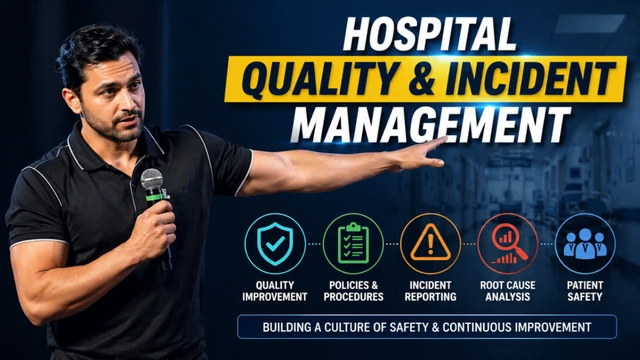
The hospital-quality-incident-management simulation puts you in charge of an incident. You learn how to investigate root causes, implement changes, and report to stakeholders. These are the exact tasks a hospital QA executive does daily.
You will also learn how to align your work with NABH standards for freshers, making you a strong candidate from day one. Many learners who complete these simulations find it easier to answer interview questions about CAPA and RCA.
To see how the system works, explore our approach.
Check your job readiness today
Are you truly ready for a hospital QA role? Compare your current skills against what recruiters demand. Identify your gaps in NABH knowledge, audit experience, and incident management. Then, take the necessary steps to fill them.
Read our detailed hospital QA fresher guide or the QA/QC pharma jobs guide for more insights.
Build These Skills Now
Programs from ZANE ProEd Academy that directly address the skill gaps discussed above.
Follow Zane ProEd on Google
Preferred SourceAdd our publication as a preferred source to get the latest clinical research guides, industry updates, and career intel directly in your Google Top Stories & AI Overviews.