Hospital Quality Assurance Jobs India: Step-by-Step Guide for Freshers

Hospital Quality Assurance Jobs India offer a stable career path for BSc, BCA, BTech graduates and non-healthcare switchers. As a QA Executive, you ensure hospitals comply with NABH accreditation, earn ₹2.5 to ₹6 LPA, and grow into leadership roles. Learn core skills to become interview-ready in 4 weeks.
You got your degree—maybe BSc, BCA, or BTech. But job rejections pile up. Every listing wants 'experience' you don't have. You're overqualified on paper but under-skilled for hospital quality roles. And while you wait, hospital quality assurance jobs India fill up with candidates who simply prepared better. The gap between college and job is massive. But you can close it.
Hospitals are hiring freshers for quality assurance roles right now. They need people who understand NABH and can handle real-world challenges. This guide shows you the exact steps to land your first hospital QA job.
Build These Skills Now
Programs from ZANE ProEd Academy that directly address the skill gaps discussed above.
What is NABH accreditation and why does it matter?
NABH stands for National Accreditation Board for Hospitals & Healthcare Providers. It is a board under the Quality Council of India that sets benchmarks for hospital quality and patient safety. Hospitals that meet these standards get 'accredited', which boosts their reputation and trust. For you, understanding NABH opens doors to entry-level hospital quality jobs because every accredited hospital needs QA staff to maintain compliance.
Without NABH, a hospital cannot claim international-level quality. So as a fresher, knowing NABH basics makes you valuable instantly. Learn more from the World Health Organization on patient safety and quality.
How to become a Quality Officer in a hospital?
You don't need a medical degree to start. Many BCA and BPO professionals have successfully moved into hospital quality management jobs. Here is a step-by-step path:
- Learn NABH standards – Study the 10 chapters of NABH, especially patient rights, infection control, and continuous quality improvement.
- Get certified – A certification like a healthcare quality management program gives you practical knowledge that colleges skip.
- Build soft skills – Hospitals need QA executives who can train staff, conduct audits, and write reports. Practice communication and observation skills.
- Create a strong resume – Highlight any project, internship, or certification related to hospital quality assurance. Even relevant offline courses count.
- Apply smart – Target small to mid-size hospitals first, as they often hire freshers. Use keywords like 'NABH accreditation career' in your job search.
Remember, the role is not just about checking boxes. A quality officer job description includes tracking incidents, preparing for audits, and improving patient care processes. You'll learn quickly on the job if you have a strong foundation.
What is the salary of a hospital QA executive in India?
Salaries vary by city and hospital size. Here's what you can expect as a fresher:
- Small hospitals & nursing homes: ₹2.5 – ₹3.5 Lakhs per year.
- Mid-size hospitals: ₹3.5 – ₹4.5 LPA.
- Large corporate hospitals: ₹4.5 – ₹6 LPA, sometimes with additional benefits.
After 2–3 years of experience and NABH internal auditor training, you can earn ₹6–8 LPA or more. The hospital QA executive salary grows fast when you upgrade your skills regularly.
What are the key NABH standards a fresher should know?
NABH has 10 chapters and over 100 standards. As a beginner, focus on these five areas that interviewers ask about:
- AAC (Access, Assessment and Continuity of Care) – How patients enter and move through the hospital.
- COP (Care of Patients) – Standard procedures for treatment and nursing care.
- MOM (Management of Medication) – Safe storage, prescription and administration of drugs.
- PCI (Patient Rights and Education) – Informed consent, privacy, and patient communication.
- QPI (Quality Improvement and Patient Safety) – Incident reporting, root cause analysis, and audits.
You don't need to memorize all, but knowing these terms will help you answer interview questions. For detailed guidelines, check the CDSCO for medical regulations and WHO for global patient safety standards.
What skills are needed for hospital quality assurance?
Employers rarely list 'degree in healthcare quality' because it doesn't exist in most colleges. They look for these skills instead:
- Documentation & Reporting – You'll maintain incident logs and audit checklists. Accuracy matters.
- Basic Audit Skills – Observing wards, checking expiry dates, and verifying protocols.
- Communication – Training nurses and staff on quality standards without conflict.
- Data Analysis – Tracking infection rates or patient complaints using Excel.
- Problem-Solving – When a quality gap appears, you must find the root cause and fix it fast.
Surprisingly, many hospital quality jobs for freshers look for healthcare quality management knowledge from short courses rather than a full degree.
What colleges teach vs What hospitals need
The biggest shock for BSc and BTech grads is how different job reality is from classroom theory.
- College teaches: Microbiology, chemistry, engineering principles – mostly textbook concepts.
- Hospitals need: Someone who can conduct a mock drill for fire safety, know how to handle a medication error, or prepare a presentation for an NABH assessment.
That's why even science graduates feel lost. The good part? These are skills you can learn fast with the right guidance. At ZANE ProEd, we have seen IT and BPO professionals move into quality jobs within months by focusing on practical training that fills this exact gap.
Your 5-step roadmap to a hospital QA job
Follow this clear path to become job-ready in weeks, not years.
- Step 1: Master NABH fundamentals – Spend 2 weeks reading the free NABH guidebook and watching explainer videos. Focus on the 5 chapters listed above.
- Step 2: Enroll in a quality management program – Choose a certification that uses real-life scenarios, not just theory. Look for systems that simulate hospital environments.
- Step 3: Practice with incident management tools – Learn how to log an incident, perform root cause analysis, and create corrective actions. This is 80% of daily QA work.
- Step 4: Build a project portfolio – Even a mock audit report or a sample quality improvement plan can prove you can do the job.
- Step 5: Apply with confidence – Use job portals and hospital career pages. Mention your certifications and practical skills. You'll stand out from other freshers.
The simulation difference — Learn by doing, not watching
Reading about NABH is not enough. Hospitals want proof you can handle a quality incident. That's why forward-thinking freshers practice on simulation-based platforms that replicate real hospital situations. Instead of memorizing standards, you learn to audit wards, manage mock drills, and create quality reports—exactly like on day one of your job.
Build These Skills Now
Programs from ZANE ProEd Academy that directly address the skill gaps discussed above.
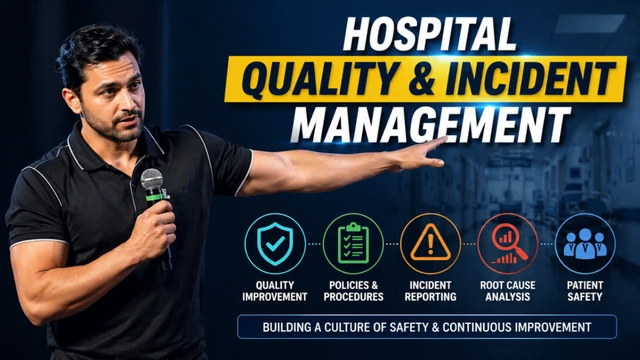
ZANE ProEd offers a Hospital Quality Management Certification that walks you through NABH accreditation step by step using interactive simulations. You'll get hands-on with checklists, incident reports, and audit trails. The Hospital Quality Incident Management program takes you deeper—showing how to investigate medication errors, patient falls, and near-misses. These are not ordinary online courses; they are skill-building experiences designed by quality experts.
Thousands of non-medical graduates have used this pathway to break into QA QC jobs in pharma and hospitals. You don't need to go back to college. You just need a system that bridges the gap between your degree and employer expectations.
Ready to see where you stand? Check your job readiness against real hospital QA requirements. Compare your current skills with what top employers in India demand. It only takes 2 minutes.
Build These Skills Now
Programs from ZANE ProEd Academy that directly address the skill gaps discussed above.
Follow Zane ProEd on Google
Preferred SourceAdd our publication as a preferred source to get the latest clinical research guides, industry updates, and career intel directly in your Google Top Stories & AI Overviews.