Medical Coding Jobs for Freshers in India: A Guide for Chemistry Graduates

Medical Coding Jobs for Freshers in India involve translating complex medical reports, diagnoses, and procedures into universal alphanumeric codes. For freshers, including BSc/MSc Chemistry graduates, this is a growing field that requires strong analytical skills, a life science background, and specific training in coding systems like ICD-10 and CPT.
If you have a BSc or MSc in Chemistry and are looking for medical coding jobs for freshers in India, you might feel stuck. You've completed your degree, maybe even taken a few online courses, but the job offers are not coming. This is a common and frustrating situation.
The truth is, your degree in chemical sciences gave you a strong foundation, but the healthcare industry speaks a different language. It's a language of codes, regulations, and specific medical terminologies. Many graduates feel lost because their college education didn't connect directly to these job requirements.
Build These Skills Now
Programs from ZANE ProEd Academy that directly address the skill gaps discussed above.
This guide is your step-by-step roadmap. We will break down exactly what you need to do to go from a confused Chemistry graduate to a confident, job-ready Medical Coder in a highly competitive Indian market. No jargon, just a clear plan.
What is medical coding and how does it work?
Medical coding is the process of converting healthcare information into universal codes. Think of it as being a translator. A doctor writes a detailed report about a patient's visit, diagnosis, and treatment. A medical coder reads that report and translates it into specific codes.
These codes come from official classification systems. The most common ones are:
- ICD-10-CM: International Classification of Diseases, 10th Revision, Clinical Modification. This is used for diagnosing diseases and health problems. This is the foundation of an ICD-10 coding career.
- CPT: Current Procedural Terminology. These codes describe medical, surgical, and diagnostic services performed by healthcare providers.
- HCPCS: Healthcare Common Procedure Coding System. This is a set of codes based on CPT that includes services not covered in CPT, like ambulance rides and medical equipment.
Why is this important? These codes are used by insurance companies to process claims for payment. Without correct coding, hospitals and doctors don't get paid properly. It ensures a standard way of reporting and tracking diseases, which is vital for health data analysis worldwide, a process overseen by organizations like the World Health Organization.
What is the salary of a medical coder in India?
The medical coder salary in India is a key reason many freshers are attracted to this field. While the exact amount can vary based on the city, company, and your certification, here is a general idea.
- Fresher (Trainee): As a fresher just starting out, you can expect a starting salary between ₹2.5 Lakhs to ₹4.0 Lakhs per year. Companies often hire freshers as trainees and provide on-the-job training.
- Certified Coder (1-3 years experience): Once you have a certification like CPC and a couple of years of experience, your salary can increase significantly to ₹4.5 Lakhs to ₹7.0 Lakhs per year.
- Senior Coder / Team Lead (5+ years experience): With deep expertise and leadership skills, senior coders can earn ₹8.0 Lakhs or more annually.
Your ability to learn quickly, your accuracy, and the type of certifications you hold will directly impact your salary growth. The demand for skilled coders is high, making it a stable and rewarding career path.
How to start a career in medical coding as a fresher?
Starting a new career can feel overwhelming, especially when you come from a non-medical background like Chemistry. Here is a simple, step-by-step plan to guide you.
- Bridge Your Knowledge Gap: Your Chemistry degree is valuable, but you need to build a foundation in Human Anatomy and Physiology. You don't need to be a doctor, but you must understand the basics of the human body and medical terms.
- Choose the Right Training Program: Do not just pick any online course. Look for a program that focuses on practical skills, uses real-world case studies, and prepares you for certification exams. A good medical coding course should teach you ICD-10, CPT, and HCPCS coding guidelines.
- Get Certified: A certification is proof of your skills. The CPC certification is the most recognized one in India and globally. Passing this exam shows employers you are serious and have the required knowledge.
- Create a Skills-Based Resume: Your resume should highlight your analytical skills from your Chemistry degree and the new medical coding skills you have learned. Mention any projects or case studies from your training.
- Prepare for Interviews: Medical coding interviews often include practical tests. You may be given a sample medical report and asked to code it. Practice is key to clearing these interviews.
What certifications are needed for medical coding?
While a degree is a good start, certifications are what make you truly job-ready in the medical coding field. They are the industry standard for measuring your skills. In India, the most important certification is the CPC.
- CPC (Certified Professional Coder): This is the gold standard, offered by the AAPC (American Academy of Professional Coders). A CPC certification in India shows employers you have a strong understanding of coding for services performed by physicians.
- CCS (Certified Coding Specialist): Offered by AHIMA (American Health Information Management Association), this is another highly respected certification, often focused on hospital-based coding.
- CIC (Certified Inpatient Coder): This is for professionals who code in hospital inpatient settings. It's usually pursued after gaining some experience.
For a fresher, the clear choice is to aim for the CPC certification. It opens the most doors for entry-level jobs and is what most Indian employers look for.
Is medical coding a good career for life science graduates?
Yes, medical coding is an excellent career for life science graduates, including those with a BSc or MSc in Chemistry. Here’s why:
1. Utilizes Your Analytical Skills: Your science degree trained you to be detailed, analytical, and systematic. Medical coding requires the exact same skills. You need to read complex information and apply a strict set of rules (the coding guidelines).
2. Strong Industry Growth: The healthcare sector in India is booming. With more hospitals, clinics, and insurance coverage, the demand for skilled medical coders is constantly increasing.
3. Non-Patient Facing Role: If you love healthcare but don't want a patient-facing role like a nurse or doctor, coding is a perfect fit. You get to be a crucial part of the healthcare system from behind the scenes.
When comparing medical coding vs clinical research or clinical data management, medical coding offers a faster entry point. While clinical research often requires higher degrees and more extensive training, you can become a certified medical coder in a matter of months and start your career.
The Skill Gap: What Your Chemistry Degree Didn't Teach You
The biggest challenge for Chemistry graduates is the gap between academic knowledge and industry needs. Here’s a simple breakdown:
- What Your BSc/MSc Taught You: Strong analytical thinking, understanding complex systems, attention to detail, and a foundation in science.
- What Employers Need for Medical Coding: Deep knowledge of medical terminology, anatomy, physiology, expertise in ICD-10-CM and CPT coding guidelines, and familiarity with healthcare regulations like HIPAA.
Your degree proves you are smart. Now, you need to prove you have the specific job skills. This is where targeted, practical training becomes critical.
Your 5-Step Roadmap from Chemistry Graduate to Medical Coder
Follow this structured pathway to ensure you become job-ready, not just certified.
- Step 1: Master Medical Fundamentals (1 Month): Dedicate one month to learning the language of medicine. Focus on Anatomy, Physiology, and common medical terms. Use online resources and textbooks.
- Step 2: Enroll in a Practical Coding Program (3-4 Months): Choose a training program that is built around real-world examples. You need to practice coding hundreds of mock patient charts to build confidence.
- Step 3: Prepare and Pass the CPC Exam (1 Month): After your training, dedicate a full month to preparing for the CPC exam. Take as many practice tests as possible.
- Step 4: Build Your Professional Profile: Update your LinkedIn profile and resume. Highlight your CPC certification and the practical skills you learned. Emphasize your analytical abilities from your Chemistry background.
- Step 5: Targeted Job Applications: Don't just apply everywhere. Target companies known for hiring freshers. Prepare for technical interview rounds by practicing coding exercises.
The Bridge from Theory to a Real Job
Simply watching videos or reading books about medical coding is not enough. The Indian job market is too competitive. Employers need to know that on day one, you can open a medical chart, understand it, and assign the correct codes accurately.
This is why simulation-based learning is the only way forward. You need a system that puts you in the exact situations you will face on the job. A system that lets you practice, make mistakes, and learn in a safe environment before you face a real interview.
Build These Skills Now
Programs from ZANE ProEd Academy that directly address the skill gaps discussed above.
Why a System is Better Than Just Another Course
At ZANE ProEd, we don't just sell courses. We provide a complete system designed to make you job-ready. For a career like medical coding, this involves understanding related fields governed by global standards, like those from the ICH.
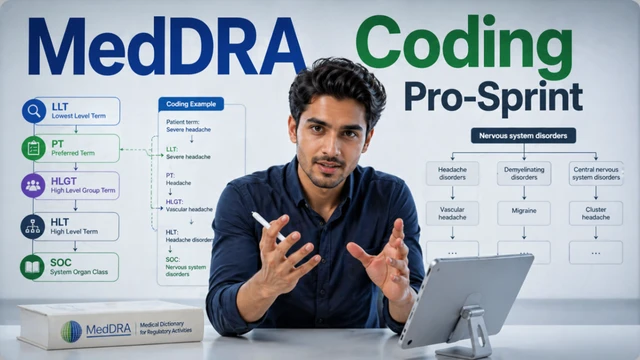
Our training, like the MedDRA Medical Coding Certification, is built on a 'Perform-And-Learn' model. It’s not about memorizing facts; it’s about doing the job. You work on simulated projects that mirror the tasks you will perform in a real company. This approach builds practical skills and the confidence to prove you can handle the role from your very first day.
This system bridges the gap left by your university degree. It connects your strong analytical foundation from Chemistry to the specific, practical skills that the healthcare industry demands.
Are You Ready to Become Job-Ready?
Feeling stuck is temporary. Taking action is what changes your career. You have the intelligence and the degree. Now it's time to add the specific skills that employers are desperately searching for.
Instead of wondering if you are good enough, find out exactly where you stand. See how your current skills compare to what hiring managers are looking for in a top medical coder candidate.
Build These Skills Now
Programs from ZANE ProEd Academy that directly address the skill gaps discussed above.
Follow Zane ProEd on Google
Preferred SourceAdd our publication as a preferred source to get the latest clinical research guides, industry updates, and career intel directly in your Google Top Stories & AI Overviews.