Medical Coding Jobs for Freshers in India: A Complete 2024 Guide

Medical Coding Jobs for Freshers in India are an excellent career path for life science graduates. The role involves translating medical reports into universal codes for billing and data analysis. A BPharm or BSc degree is required, along with a mandatory certification like CPC to secure entry-level positions.
If you have a life science degree but feel stuck in an IT or BPO job, you are not alone. Many graduates wonder how to use their specific knowledge. The good news is there is a growing demand for medical coding jobs for freshers in India, a field that directly uses your understanding of biology and medicine.
This is not a typical lab job. It's a data-focused career that forms the backbone of the healthcare industry. It’s a hidden opportunity for BSc, MSc, and BPharm graduates to build a stable, high-growth career away from sales or research roles.
Build These Skills Now
Programs from ZANE ProEd Academy that directly address the skill gaps discussed above.
This guide provides a clear, step-by-step roadmap to start your journey into medical coding, even with no prior experience.
What is medical coding and how does it work?
Medical coding is the process of translating important medical information into simple, universal codes. Think of it as being a language translator for the healthcare industry. Coders read patient records, doctor’s notes, and lab results, and convert every diagnosis, procedure, and prescription into a specific alphanumeric code.
This system is crucial for the entire healthcare ecosystem. These codes are used for:
- Billing and Insurance: To create claims so that doctors and hospitals get paid correctly.
- Data Analysis: To track diseases, study treatment effectiveness, and manage public health trends.
- Research: To group patients for clinical studies and analyze outcomes.
The main codebooks you will use in your ICD-10 coding career are:
- ICD-10-CM: International Classification of Diseases, 10th Revision, Clinical Modification. Used for coding diagnoses.
- CPT: Current Procedural Terminology. Used for coding medical procedures and services.
- HCPCS: Healthcare Common Procedure Coding System. Used for supplies, equipment, and other services.
What is the salary of a medical coder in India?
The medical coder salary in India is competitive, especially for a role that doesn't require years of specialized experience to enter. For a fresher with the right certification, the starting salary typically ranges from ₹2.5 Lakhs to ₹4.0 Lakhs per annum.
Your salary can grow quickly with experience and expertise. An experienced medical coder with 3-5 years of experience can earn between ₹5 Lakhs and ₹8 Lakhs per annum. Senior coders, auditors, and managers can earn even more.
Factors that influence your salary include:
- Certification: A CPC certification is the gold standard and can significantly boost your starting pay.
- Location: Major cities like Bengaluru, Chennai, Hyderabad, and Pune often offer higher salaries.
- Company: Large multi-national corporations (MNCs) and major hospital chains generally pay more than smaller organizations.
How to start a career in medical coding as a fresher?
Starting a career in medical coding is straightforward if you follow a clear path. You don't need a specific 'medical coding' degree. Your life science background is your biggest asset. Here is a simple 5-step process:
- Confirm Your Eligibility: You need a degree in a life science field. This includes BPharm, BSc/MSc in Biotechnology, Microbiology, Biochemistry, or Zoology.
- Strengthen Your Foundation: Refresh your knowledge of Human Anatomy, Physiology, and Medical Terminology. This is the base upon which all coding is built.
- Get Professional Training: Join a structured training program that teaches you the fundamentals of ICD-10, CPT, and HCPCS coding guidelines.
- Earn Your Certification: This is the most critical step. Pass the CPC certification India exam from the AAPC (American Academy of Professional Coders). Most employers will not hire you without it.
- Build a Professional Resume: Highlight your life science degree, your CPC certification, and any training projects. Emphasize skills like attention to detail, analytical thinking, and ethical conduct.
What certifications are needed for medical coding?
While your degree gets your foot in the door, a certification proves you have the specific skills for the job. In the world of medical coding, certification is not optional—it's essential.
The most respected and widely required certification is the CPC (Certified Professional Coder) offered by the AAPC. Holding a CPC certification tells employers that you understand the complexities of coding and are committed to the profession. It is the key that unlocks the best job opportunities.
Other certifications exist, like the CCS (Certified Coding Specialist) from AHIMA, but the CPC is the most common requirement for fresher jobs in India. Your entire focus as a beginner should be on clearing the CPC exam.
Is medical coding a good career for life science graduates?
Yes, absolutely. Medical coding is one of the best non-lab careers for life science graduates for several reasons:
- Directly Uses Your Knowledge: Your understanding of anatomy, diseases, and medical procedures gives you a huge advantage in understanding clinical documentation.
- Stable and Growing Industry: The healthcare industry is always growing. As long as there are patients, there will be a need for medical coders. The process cannot be fully automated due to its complexity.
- Clear Career Growth: You can grow from a Coder to a Senior Coder, a Quality Analyst, a Team Lead, or a Coding Manager. The path is well-defined.
- Work-Life Balance: Most coding jobs are desk-based and offer standard working hours, providing a good balance compared to demanding lab or sales roles.
When considering medical coding vs clinical research, medical coding offers a faster entry into the industry. Clinical research often requires higher degrees (like a PhD) and can involve longer, more uncertain project timelines. Medical coding is a skills-based profession where you can become job-ready in a matter of months. A related field, Clinical Data Management, also offers great opportunities for life science graduates.
The Gap Between Your Degree and The Job
Your BSc or MSc taught you the science—what a cell is, how diseases progress. However, it didn't teach you the business of healthcare. Employers expect you to know how to apply that knowledge in a commercial setting. They need you to understand coding guidelines from organizations like the World Health Organization (WHO), navigate complex insurance rules, and maintain high accuracy under deadlines.
This is the gap. You know the 'what' (e.g., Myocardial Infarction), but you need to learn the 'how' (e.g., how to code it accurately using ICD-10-CM based on specific documentation).
Your Step-by-Step Pathway to Becoming a Medical Coder
Here is a simple roadmap to bridge that gap and become job-ready:
- Master the Basics: Go beyond college-level knowledge. Deep-dive into medical terminology and anatomy specifically for coding.
- Learn the Coding Languages: Systematically learn the rules and guidelines for ICD-10-CM, CPT, and HCPCS. This is like learning a new language.
- Prepare for the CPC Exam: Don't just study; practice. Use mock exams and case studies to prepare for the rigorous CPC certification test.
- Understand the Revenue Cycle: Learn how your work as a coder impacts hospital and clinic finances. This business context is crucial.
- Develop Professional Skills: Focus on attention to detail, ethics, and communication. A single coding error can have major consequences.
The ZANE ProEd System: From Theory to Practical Skill
Reading books and watching videos is not enough. To succeed in a detail-oriented job like medical coding, you need to practice in a way that mimics the real work environment. This is where simulation-based learning becomes critical.
Instead of just memorizing codes, you need a system that teaches you to think like a coder—analyzing real (anonymized) medical reports, making decisions, and applying the correct codes according to industry standards.
Build These Skills Now
Programs from ZANE ProEd Academy that directly address the skill gaps discussed above.
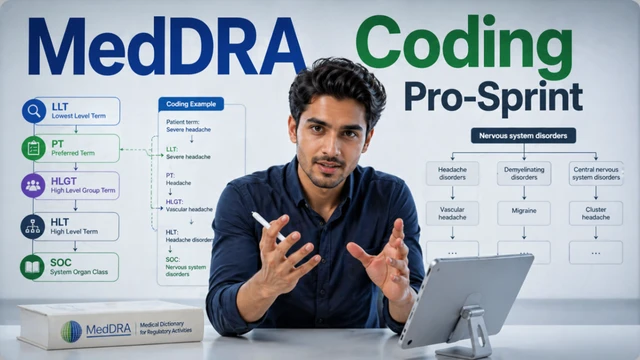
Our programs like the MedDRA Medical Coding Certification are designed to build this practical intelligence. While MedDRA is specialized for pharmacovigilance, the core principles of precise coding are the same. It teaches you the 'why' behind the 'what'. This skill is also vital in related fields like drug safety, making our End-to-End Pharmacovigilance Certification a valuable addition for those looking to build a broad skill set. You can learn more about that career path here: Pharmacovigilance jobs for freshers in India.
At ZANE ProEd, we don't just provide courses; we provide a system. A system that transforms your academic knowledge into the practical, job-ready skills that employers in the Indian market are desperately seeking.
Are You Ready for a Career in Healthcare Data?
Your life science degree is a powerful foundation. Now it's time to build on it with the right skills. Stop wondering what to do next and start building a clear path toward a rewarding career.
See how your skills compare to what top healthcare companies are looking for. Take the first step towards your new career in medical coding today.
Build These Skills Now
Programs from ZANE ProEd Academy that directly address the skill gaps discussed above.
Follow Zane ProEd on Google
Preferred SourceAdd our publication as a preferred source to get the latest clinical research guides, industry updates, and career intel directly in your Google Top Stories & AI Overviews.