How to Get Pharmacovigilance Case Processing Jobs for Freshers (Chemistry Guide)

Pharmacovigilance Case Processing jobs for freshers involve collecting and documenting patient data on drug side effects (adverse events). As a Case Processor, you will enter this data into a safety database, code medical terms, and prepare reports for regulatory authorities, ensuring drug safety compliance.
Are you a BSc or MSc Chemistry graduate feeling stuck? You see openings for pharmacovigilance case processing jobs for freshers, but your interview confidence is low. Recruiters ask about MedDRA, ICSR, and safety databases, and suddenly your degree feels irrelevant. It's a common and frustrating feeling.
You are not alone in this. Many science graduates feel this gap between their academic knowledge and the practical skills required in the pharmacovigilance (PV) industry. The good news is that there is a clear, direct path to bridge this gap.
Build These Skills Now
Programs from ZANE ProEd Academy that directly address the skill gaps discussed above.
This guide is your step-by-step playbook. It will show you exactly what employers want and how you can become a top candidate for PV case processing roles, even with a non-medical background.
What does a Pharmacovigilance Case Processor do?
A Pharmacovigilance Case Processor is like a detective for drug safety. Their main job is to handle reports of side effects, also known as adverse events. They ensure every detail is captured accurately and follows global rules.
Think of it as the first step in the entire drug safety process. Without accurate case processing, companies cannot make informed decisions about a medicine's safety profile. This role is a cornerstone of the industry and a great entry point for an ICSR processing career.
The typical pharmacovigilance case processor job description includes these daily tasks:
- Triage: Receiving and sorting incoming adverse event reports from doctors, patients, and other sources.
- Data Entry: Entering detailed information from the reports into a special safety database (like Argus or ArisG).
- Case Narrative Writing: Writing a clear, concise summary of the adverse event in a specific format.
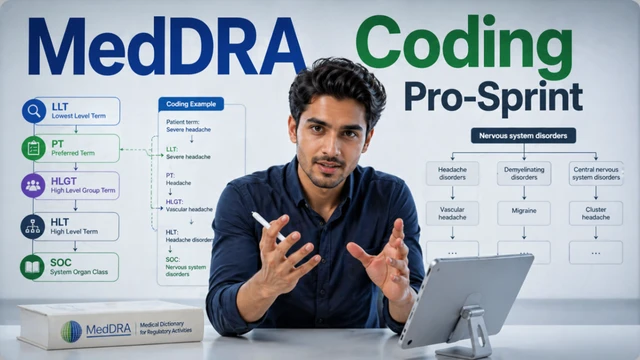
- Medical Coding: Using dictionaries like MedDRA to code patient medical history, event terms, and drug names. We will discuss MedDRA coding for freshers more below.
- Quality Check: Reviewing cases for accuracy, completeness, and consistency before they are submitted.
This is a detail-oriented job that combines science with process. Your chemistry background gives you a strong foundation in analytical thinking, which is highly valuable here.
What is the salary of a PV Case Processor in India?
Salary is a key factor when starting a new career. The PV case processor salary in India is competitive, especially considering the growth potential in the industry.
For a fresher just starting out, the salary range is typically:
- Starting Salary: ₹2.8 Lakhs to ₹4.5 Lakhs per year.
This figure can vary based on the company (MNC vs. a smaller CRO), the city (e.g., Bangalore, Mumbai, Hyderabad), and your specific skills. Candidates with practical certification in tools like MedDRA and safety databases often secure salaries at the higher end of this range.
With 1-3 years of experience, your salary can see a significant jump:
- Experienced Professional (1-3 years): ₹4.5 Lakhs to ₹7.0 Lakhs per year.
As you gain experience in case processing, you can move into more senior roles like Quality Reviewer, Safety Scientist, or Team Lead, which come with even higher earning potential.
How to get a PV case processing job as a fresher?
As a Chemistry graduate, you need a smart strategy to stand out. Recruiters look for candidates who understand the job's practical demands, not just theory. Companies need people who can be productive from day one.
Here is a simple plan to follow:
- Learn the Fundamentals: Understand the basics of pharmacovigilance, including key terms (AE, SAE, ADR) and the lifecycle of a drug. You must know the regulations set by bodies like the ICH and local authorities like the CDSCO.
- Master ICSR Processing: This is the core skill. You need to know how a case flows from receipt to submission. Read our complete guide on PV case processing jobs for a deeper dive.
- Get Certified in MedDRA: MedDRA coding is a non-negotiable skill. Recruiters specifically search for this on resumes. A certification proves you have this practical ability.
- Build a Skills-Based CV: Don't just list your degree. Highlight your knowledge of PV processes, MedDRA, and any relevant software. Frame your academic projects to show analytical and research skills.
- Prepare for Interviews: Practice explaining concepts like causality assessment and narrative writing. Be ready to answer questions about how your chemistry background is an asset.
What is ICSR processing in pharmacovigilance?
ICSR stands for Individual Case Safety Report. It is the single most important document in pharmacovigilance. Think of it as a standardized file that contains all the information about a single patient's adverse event with a specific drug.
ICSR processing is the step-by-step procedure of creating and managing this report. It's the core of all adverse event reporting jobs. The goal is to make the data structured, complete, and ready for analysis and submission to regulatory authorities like the FDA or the EMA.
The process generally includes:
- Case Booking: Logging the initial report and assigning it a unique ID.
- Data Entry: Inputting the 'four minimum criteria' (an identifiable patient, an identifiable reporter, a suspect drug, and an adverse event).
- Coding: Assigning standardized MedDRA codes to the medical information.
- Narrative Writing: Creating the medical story of the case.
- Quality Review & Submission: Checking the case for errors and submitting it electronically to health authorities.
A career in ICSR processing is stable and in high demand because it is a legally required function for all pharmaceutical companies.
What is MedDRA coding and how is it used in PV?
MedDRA stands for Medical Dictionary for Regulatory Activities. It is a massive, standardized dictionary of medical terms. Its purpose is to ensure everyone—companies, doctors, regulators—uses the exact same terminology to describe the same medical concept.
Imagine one person reports 'feeling sick to their stomach' and another reports 'nausea'. MedDRA allows a Case Processor to code both of these to the same standardized term, 'Nausea'. This makes data analysis possible on a global scale.
In case processing, you will use MedDRA to code:
- The patient's past medical history.
- The adverse events they experienced.
- Test results and diagnoses.
For freshers, learning MedDRA coding for freshers is crucial. It is a practical skill that immediately tells a recruiter you understand how PV data works. Without it, you cannot process a case correctly. For a Chemistry graduate, this is one of the fastest ways to show you are serious about a career in pharmacovigilance. Check out our detailed blog on PV jobs for Chemistry freshers to learn more.
The Gap: What Your Chemistry Degree Taught You vs. What PV Recruiters Expect
Your BSc or MSc in Chemistry gave you excellent analytical skills. You understand molecules, reactions, and scientific principles. You are trained to be precise and methodical in a lab.
However, recruiters for PV jobs are looking for a different set of practical skills:
- Your Degree Taught You: Organic chemistry, physical chemistry, analytical techniques, lab reporting.
- Employers Expect: Knowledge of GVP modules, ICSR processing workflow, MedDRA and WHO-DD coding, experience with safety databases, and regulatory submission timelines.
This is the skill gap that causes low confidence in interviews. You have the intelligence, but you lack the specific, job-ready knowledge that companies need right now.
Your 4-Step Roadmap to Become a Job-Ready Case Processor
Feeling overwhelmed? Don't be. Here is a simple, actionable plan to bridge that gap and walk into interviews with confidence.
- Build Foundational Knowledge: Dedicate time to learn the language of PV. Understand what an AE, SAE, and SUSAR are. Learn about the key regulatory bodies and their expectations.
- Master the Core Process (ICSR): Focus on the end-to-end ICSR workflow. Know each step, from triage to submission. This is the 'what you do' of the job.
- Learn the Essential Tools (MedDRA): Gain hands-on skill in medical coding. This is the 'how you do it'. This skill alone makes your CV 10x more attractive.
- Practice with Real-World Scenarios: Theory is not enough. You need to apply your knowledge to realistic case studies. This is what separates a certified candidate from a truly job-ready one.
The Fastest Way to Gain Practical Experience
How do you get experience without having a job? This is the classic problem freshers face. The answer is simulation. You need a system that lets you practice the job before you get the job.
Learning from videos and PDFs is passive. True confidence comes from doing. When you've processed simulated cases, written narratives, and coded them using MedDRA, you are no longer just a fresher with a degree. You are a candidate with demonstrable skills.
This is where a structured, simulation-based training system becomes critical. It's not just about getting a certificate; it's about building real-world muscle memory.
Build These Skills Now
Programs from ZANE ProEd Academy that directly address the skill gaps discussed above.
ZANE ProEd: Your System for Building Job-Ready Skills
At ZANE ProEd, we don't just offer courses. We provide a system designed to turn science graduates into skilled professionals. Our training is built on a 'Work-Alike-Experience' model, where you learn by performing the exact tasks you will do on the job.
Our ICSR Case Processing & Triage program teaches you the end-to-end workflow on simulated platforms. Our MedDRA Medical Coding Certification gives you the hands-on coding practice that recruiters demand.
This approach transforms your learning. You move from 'I know what ICSR is' to 'I have processed ICSRs'. That shift is what gives you unshakable confidence in interviews.
Are Your Skills Aligned with Industry Demands?
Stop guessing what recruiters want. It's time to know for sure. Take a moment to compare your current knowledge against the skills listed in this guide.
See how your skills compare to what top pharmaceutical companies are looking for right now. Understanding where you stand is the first step toward building a successful career in pharmacovigilance.
Build These Skills Now
Programs from ZANE ProEd Academy that directly address the skill gaps discussed above.
Follow Zane ProEd on Google
Preferred SourceAdd our publication as a preferred source to get the latest clinical research guides, industry updates, and career intel directly in your Google Top Stories & AI Overviews.