Pharmacovigilance Jobs for Freshers in India: A Guide for Chemistry Graduates

Pharmacovigilance jobs for freshers in India are an excellent career path for science graduates. As a Drug Safety Associate, you will monitor and report adverse effects of drugs. The role requires strong analytical skills, making it a great fit for BSc/MSc Chemistry graduates looking for a stable, high-growth career.
If you have finished your BSc or MSc in Chemistry, you might feel confused. You have a good degree, but the path forward isn't clear. Many students wonder where their chemistry knowledge fits in the corporate world outside of a lab. If this sounds like you, you are in the right place. This guide will show you a clear path to finding stable, high-paying pharmacovigilance jobs for freshers in India.
Pharmacovigilance (PV) is a fast-growing field within the pharmaceutical industry. It's not just for pharmacy graduates. Companies are actively hiring chemistry graduates for their strong analytical and scientific skills. Your degree has prepared you more than you think.
Build These Skills Now
Programs from ZANE ProEd Academy that directly address the skill gaps discussed above.
This is not just another job option; it's a structured career path where you play a critical role in public health. Let’s break down exactly what this career looks like and how you can get started, even with no prior experience.
What is pharmacovigilance and why is it important?
Pharmacovigilance, often called PV or drug safety, is the science of monitoring the effects of medicines. Its main job is to detect, assess, understand, and prevent adverse effects or any other drug-related problem. Think of it as the 'watchdog' for medicines after they are launched in the market.
Once a new drug is approved, it is used by millions of people. In such a large population, rare side effects can appear that were not seen in smaller clinical trials. Pharmacovigilance professionals collect and analyze data on these side effects to ensure the medicine is safe for everyone.
This process is critical for patient safety. Without it, harmful drugs could remain on the market, causing serious health issues. Regulatory bodies like the CDSCO in India and the FDA in the USA have strict rules for drug safety monitoring. This makes PV a vital and mandatory function for every pharmaceutical company.
What is the salary of a Drug Safety Associate in India?
Salary is a key factor when choosing a career. The good news is that the pharmacovigilance salary in India is competitive, even for freshers. As a fresher entering a role like Drug Safety Associate, you can expect a starting salary between ₹3.5 Lakhs to ₹5.5 Lakhs per annum.
This figure can vary based on the company (MNC vs. Indian pharma), your location (cities like Mumbai, Bangalore, and Hyderabad often pay more), and any specialized certifications you may have.
The real advantage is the career growth. Your salary can increase significantly with experience. Within 3-5 years, you can move into senior roles and see your salary double. The PV career path is well-defined, moving from Associate to Senior Associate, Team Lead, and Managerial positions.
How to start a career in pharmacovigilance?
Starting a career in PV as a chemistry graduate is a clear, step-by-step process. Your degree is the foundation, but you need to add specific industry skills. Here is how you can begin:
- Understand the Basics: Learn the fundamentals of pharmacovigilance, including key terms like Adverse Event (AE), Serious Adverse Event (SAE), and the drug development lifecycle.
- Gain Practical Skills: Theoretical knowledge is not enough. You need to learn practical skills like ICSR (Individual Case Safety Report) processing, which is the core activity in PV. You can learn more about this in our guide to case processing jobs.
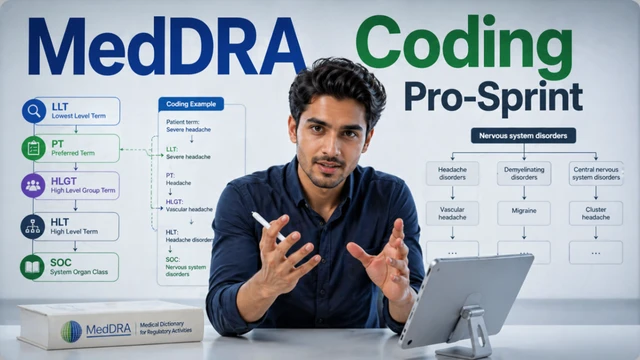
- Learn Medical Coding: Pharmacovigilance uses a standardized medical dictionary called MedDRA for coding adverse events. Proficiency in MedDRA is a non-negotiable skill for employers.
- Build a Strong Resume: Highlight your analytical skills from your chemistry degree. More importantly, mention any PV certifications or practical skills you have acquired.
- Apply to the Right Companies: Look for entry-level Drug Safety Associate or PV Associate roles in pharmaceutical companies (like Pfizer, Novartis) and Contract Research Organizations (CROs) like IQVIA, Syneos Health, and Parexel.
What are the job responsibilities of a PV Associate?
The drug safety associate job description is focused on ensuring patient safety by processing data accurately. While it might sound complex, the day-to-day tasks are very structured. Here are the common drug safety associate roles and responsibilities:
- Case Triage: Receiving and sorting incoming reports of adverse events from patients, doctors, and other sources.
- Data Entry: Entering all relevant information from the reports into a safety database (like Argus Safety or ArisG).
- Case Processing: Writing a clear medical narrative summarizing the case, checking for completeness and accuracy.
- Medical Coding: Coding the adverse events, patient history, and drug names using standardized dictionaries like MedDRA and WHO-DD.
- Following Up: Contacting the person who reported the event to gather any missing information.
- Regulatory Submissions: Ensuring serious and unexpected cases are reported to regulatory authorities like the EMA within strict timelines.
Your job is to ensure every piece of data is captured correctly, as this data helps scientists make important decisions about a drug's safety profile, including advanced topics like signal detection.
Is pharmacovigilance a good career for science graduates?
Yes, absolutely. Pharmacovigilance is an excellent career for BSc and MSc Chemistry graduates. Here’s why your background gives you a unique advantage:
- Strong Analytical Skills: Your degree trained you to analyze data, identify patterns, and pay close attention to detail. These skills are essential for reviewing safety cases.
- Scientific Foundation: You have a solid understanding of scientific principles, which helps you grasp the medical and chemical aspects of drug safety.
- Process-Oriented Mindset: Lab work in chemistry involves following strict protocols (SOPs). The PV industry is also highly regulated and process-driven, making it a natural fit.
- Career Stability: As long as there are medicines, there will be a need for drug safety monitoring. This makes PV a recession-proof and stable career choice.
The Gap: What Your Chemistry Degree Didn't Teach You
Your BSc or MSc in Chemistry gave you a strong scientific foundation. You understand molecules, reactions, and analytical methods. But companies hiring for PV roles are not looking for a chemist. They are looking for a drug safety professional.
Employers expect you to know:
- GVP Guidelines: Good Pharmacovigilance Practices, the rules that govern drug safety.
- ICSR Case Processing: The end-to-end workflow of handling a safety report.
- MedDRA and WHO-DD: How to code medical terms and drugs accurately.
- Safety Databases: Practical experience with tools like Oracle Argus.
- Regulatory Timelines: Knowing when and how to report cases to authorities.
Your degree alone doesn't cover these practical, job-specific skills. This is the gap that prevents many bright graduates from getting hired.
Your Step-by-Step Roadmap to a PV Career
Don't worry, bridging this gap is straightforward if you follow a clear plan. Here is your roadmap from a confused chemistry graduate to a confident PV professional.
- Step 1: Build Foundational PV Knowledge. Forget trying to memorize everything. Focus on understanding the 'why' behind drug safety and the lifecycle of a safety report.
- Step 2: Master ICSR Case Processing. This is the single most important skill for a fresher. It's what you will do every day in your first job. You must know how to handle a case from start to finish.
- Step 3: Become Proficient in MedDRA Coding. You cannot get a PV job without knowing MedDRA. Learn its structure (SOC, HLGT, HLT, PT, LLT) and how to select the right codes.
- Step 4: Get Hands-On with a Safety Database. Reading about a safety database is not enough. You need to practice data entry, case processing, and report generation in a simulated environment.
- Step 5: Create a Skill-First Resume. Update your resume to lead with these new PV skills. Instead of just listing your degree, list 'ICSR Case Processing' and 'MedDRA Coding' as your core competencies.
How to Gain Real Skills That Impress Employers
The biggest challenge for a fresher is getting practical experience. How can you learn ICSR processing or use a safety database without a job? The answer is simulation-based learning.
Instead of just watching videos, you need a system where you can practice on real-world case studies. This is the fastest way to build the confidence and skills employers are looking for. It proves you can do the job from day one.
Build These Skills Now
Programs from ZANE ProEd Academy that directly address the skill gaps discussed above.
At ZANE ProEd, we have built a complete system designed for this. We don't just give you courses; we give you a simulated work environment. Our training programs in ICSR Case Processing & Triage and MedDRA Medical Coding are built on this principle. You work on hundreds of real-world case scenarios, just like you would in a top pharma company.
This approach moves you from a 'fresher' to a skilled candidate. You learn the exact processes and tools used in the industry, making you job-ready. Our focus is on building a system for your career success, not just selling a certificate. We believe in providing a clear path from confusion to clarity, as explained on our about page.
You have the right foundation with your chemistry degree. Now it's time to build the specific skills that will unlock a rewarding career in pharmacovigilance.
Ready to see how your skills match up to the industry's demands? Take the first step and see where you stand.
Build These Skills Now
Programs from ZANE ProEd Academy that directly address the skill gaps discussed above.
Follow Zane ProEd on Google
Preferred SourceAdd our publication as a preferred source to get the latest clinical research guides, industry updates, and career intel directly in your Google Top Stories & AI Overviews.