A Simple Guide to Pharmacovigilance Case Processing Jobs for Freshers

Pharmacovigilance Case Processing Jobs for Freshers involve collecting, processing, and documenting adverse event data from drugs and medical devices. Key tasks include data entry into safety databases, MedDRA coding of medical terms, and preparing Individual Case Safety Reports (ICSRs) for regulatory submission. It is a data-driven role ensuring patient safety.
If you have recently graduated with a BDS, BHMS, BAMS, or Nursing degree, you might feel a little lost. Your clinical knowledge is strong, but the path to a corporate job isn't clear. This is a common feeling. You are looking for stable, high-growth pharmacovigilance case processing jobs for freshers, but don't know where to start.
The truth is, your medical degree is a powerful asset, but it's not the complete package for a career in pharmacovigilance (PV). The industry needs specific technical skills that colleges don't teach. This guide is your step-by-step roadmap from confusion to clarity.
Build These Skills Now
Programs from ZANE ProEd Academy that directly address the skill gaps discussed above.
We will break down what a Case Processor does, what you can earn, and exactly how to get your first job in this exciting field. This is the practical advice you need for the competitive Indian job market.
What does a Pharmacovigilance Case Processor do?
A Pharmacovigilance Case Processor is like a detective for drug safety. Their main job is to handle reports of side effects (adverse events) that patients experience. The pharmacovigilance case processor job description focuses on accuracy and detail.
Think of it this way: when someone reports a side effect, a detailed file or 'case' is created. The Case Processor manages this file from start to finish. Their daily tasks include:
- Triage: Receiving and sorting incoming adverse event reports from doctors, patients, and other sources.
- Data Entry: Accurately entering all patient and event details into a special safety database like Argus or ArisG.
- Case Narrative Writing: Writing a clear, simple summary of what happened to the patient in medical terms.
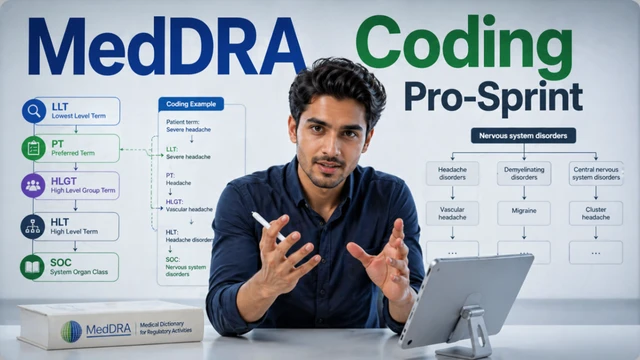
- Medical Coding: Using standard medical dictionaries like MedDRA to classify the reported medical events and patient history. This is a key part of adverse event reporting jobs.
- Quality Check: Reviewing the case for any errors or missing information to ensure it is complete and accurate.
They ensure that every piece of safety data is perfectly recorded according to global rules set by bodies like the ICH.
What is the salary of a PV Case Processor in India?
The salary is a major attraction for many medical graduates moving into PV. For a fresher, the starting PV case processor salary in India typically ranges from ₹3.0 Lakhs to ₹4.5 Lakhs per annum.
This starting salary can vary based on a few factors:
- Company Type: Large multinational corporations (MNCs) and top Contract Research Organizations (CROs) usually offer higher packages.
- Location: Jobs in major pharma hubs like Mumbai, Bengaluru, Hyderabad, and Pune may offer slightly more to cover the cost of living.
- Skills: A fresher with certified skills in ICSR processing and MedDRA coding has a stronger negotiating position than someone with just a degree.
With 2-3 years of experience, your salary can grow significantly, often reaching ₹6 to ₹8 Lakhs per annum. It's a field where your skills directly impact your earning potential, making it a rewarding ICSR processing career path.
How to get a PV case processing job as a fresher?
Getting your first PV job requires a targeted approach. Your degree gets you to the interview, but specific skills get you the job offer. For more details, you can also check our complete guide on PV jobs for freshers.
Here is a clear plan:
- Understand the Basics: Learn the fundamentals of pharmacovigilance, drug development cycles, and global safety regulations from authorities like the CDSCO in India.
- Master ICSR Processing: This is the core skill. You must know how to handle a case from receipt to submission. This includes triage, data entry, and narrative writing.
- Learn Medical Coding: Get trained in MedDRA coding for freshers. This is a non-negotiable skill. You need to know how to accurately code adverse event terms.
- Build a Skills-Based Resume: Don't just list your degree. Highlight your PV skills. Mention any projects, certifications, or training you have completed in ICSR, MedDRA, and safety databases.
- Prepare for the Interview: Be ready to answer questions about PV regulations, the ICSR lifecycle, and how you would handle a sample case.
What is ICSR processing in pharmacovigilance?
ICSR stands for 'Individual Case Safety Report'. It is the foundation of all pharmacovigilance work. An ICSR is a detailed report of a single patient's adverse event suspected to be caused by a drug.
ICSR processing is the step-by-step workflow of managing these reports. The goal is to create a complete, accurate, and standardized report that can be submitted to regulatory authorities like the FDA or EMA. This process ensures that regulators have high-quality data to monitor a drug's safety.
The key stages of an ICSR processing career involve:
- Case Receipt: Getting the initial information.
- Case Validation: Checking if it has the four minimum criteria (an identifiable patient, a suspect drug, an adverse event, and an identifiable reporter).
- Data Entry & Coding: Entering the data into the safety system and coding it with MedDRA.
- Medical Review & Submission: A medical professional reviews the case, and then it is submitted to health authorities.
What is MedDRA coding and how is it used in PV?
MedDRA stands for Medical Dictionary for Regulatory Activities. It is a globally recognized, standardized medical dictionary. Think of it as a 'Google Translate' for medical terms.
In pharmacovigilance, different people might describe the same side effect using different words. For example, a patient might say 'feeling sick,' a doctor might write 'nausea,' and another report might say 'upset stomach.' MedDRA allows a Case Processor to code all these different terms to one single, standard term: 'Nausea'.
This standardization is critical. It allows companies and regulators to analyze safety data from millions of patients around the world consistently. Knowing how to use MedDRA is one of the most important technical skills for any adverse event reporting jobs, and it is essential for freshers to learn.
The Gap: What Your Medical Degree Didn't Teach You
As a BDS, BAMS, BHMS, or Nursing graduate, your education focused on diagnosing and treating patients. You are an expert in anatomy, physiology, and pathology. But companies hiring for PV roles need something different.
Employers expect you to know regulatory guidelines, data management processes, and specific software tools from day one. They need you to understand the difference between seriousness criteria, how to write a clinical narrative for a regulator, and how to code an event in MedDRA. This is the skill gap that holds many freshers back.
Your Step-by-Step Roadmap to a PV Career
Feeling overwhelmed? Don't be. Here is a simple, actionable path to follow:
- Build Your Foundation: Start by learning the core principles of pharmacovigilance. Forget complex theory; focus on the practical workflow of drug safety monitoring.
- Master ICSR Case Processing: This is your primary job function. You need to learn the end-to-end process, from receiving a case to preparing it for submission.
- Become Proficient in MedDRA Coding: This skill makes you immediately valuable. Learn the structure of MedDRA and practice coding real-world medical terms.
- Get Familiar with Safety Databases: Understand the layout and function of databases like Oracle Argus Safety. You don't need to be an expert, but you should know what they are for.
- Practice with Real-World Scenarios: The best way to learn is by doing. Work on simulated case studies that mimic the challenges you will face on the job.
The Bridge from Theory to On-the-Job Performance
How do you gain practical skills without having a job? Reading textbooks is not enough. The answer is simulation-based learning. You need to work in a system that feels like a real job, processing realistic cases and using the same tools as the professionals.
This approach builds muscle memory and confidence. When you face a complex case in an interview or on your first day, you will know exactly what to do because you have done it before.
Build These Skills Now
Programs from ZANE ProEd Academy that directly address the skill gaps discussed above.
A System Designed for Your Success
At ZANE ProEd, we don't just offer courses; we provide a complete system to make you job-ready. Our programs are built to bridge the exact skill gap that medical graduates face.
Our ICSR Case Processing & Triage program uses job simulations to teach you the practical workflow of managing safety cases. You will learn to think like a Case Processor. Our MedDRA Medical Coding program gives you hands-on practice, turning a complex dictionary into a simple, powerful tool you can use with confidence. Learn more about our approach on our about page.
This system is your roadmap. It takes your existing medical knowledge and adds the specific technical skills that employers are searching for right now. For a deeper dive, read our ultimate guide to PV case processing.
Are You Ready for a Career in Pharmacovigilance?
Moving from a clinical background to a corporate role in pharmacovigilance is a big step, but it is achievable with the right preparation. The demand for skilled Case Processors is high, and your medical degree gives you a significant advantage.
Instead of just sending out your resume and hoping for the best, take control. Build the skills that companies are desperate for. See how your current skills compare to what the industry demands.
Build These Skills Now
Programs from ZANE ProEd Academy that directly address the skill gaps discussed above.
Follow Zane ProEd on Google
Preferred SourceAdd our publication as a preferred source to get the latest clinical research guides, industry updates, and career intel directly in your Google Top Stories & AI Overviews.