Pharmacovigilance Case Processing Jobs for Freshers: Complete Career Guide

Pharmacovigilance Case Processor for freshers: BDS, BHMS, BAMS, and Nursing graduates can start in pharmacovigilance case processing jobs freshers by learning ICSR processing, MedDRA coding, and adverse event reporting. No prior experience is needed if you build practical skills in safety database tools.
You completed BDS, BHMS, BAMS, or Nursing. You know patient care, anatomy, and medicines. But after graduation, you sit at home with no job offers. The market is crowded. Hospitals demand experience. Clinics pay too little.
Here is the truth: pharmacovigilance case processing jobs freshers are growing fast in India. Companies need people who can process safety reports. They do not ask for years of experience. They ask for specific skills. Skills you can learn in a few months.
Build These Skills Now
Programs from ZANE ProEd Academy that directly address the skill gaps discussed above.
This guide shows you the exact roadmap to enter pharmacovigilance as a fresh graduate. No mystery. No fluff. Just clear steps.
What does a Pharmacovigilance Case Processor do?
If you are looking at pharmacovigilance case processing jobs freshers, you need to know the daily work. A PV Case Processor handles individual case safety reports (ICSRs). These reports come from patients, doctors, or clinical trials.
Your job is to take raw safety information and turn it into a clean, coded record. You work in a safety database. You follow global guidelines from ICH and WHO.
Key responsibilities in the pharmacovigilance case processor job description:
- Receive and triage adverse event reports (AERs) from various sources.
- Enter data into safety databases like Argus, ArisG, or Veeva Vault.
- Perform MedDRA coding for medical terms.
- Check for duplicate cases and request follow-up information.
- Assess seriousness, causality, and expectedness of adverse events.
- Ensure data quality and compliance with regulatory timelines.
You do not diagnose patients. You do not prescribe treatment. You are the data gatekeeper for drug safety. That is why clinical knowledge from BDS, BHMS, BAMS, or Nursing is a strong advantage.
What is the salary of a PV Case Processor in India?
The PV case processor salary India depends on location, company, and your skill level. For freshers with no experience, here are typical monthly figures:
- Small CROs or BPOs: ₹18,000 – ₹25,000 per month.
- Mid-size pharmaceutical companies: ₹22,000 – ₹32,000 per month.
- Top global CROs (IQVIA, Parexel, Syneos): ₹25,000 – ₹40,000 per month.
After 2-3 years as a case processor, you can earn ₹40,000 – ₹60,000 per month. Senior case processors or team leads earn more. You can also move into quality control, medical writing, or signal detection.
Remember: salary is not just about the degree. It is about your ability to process ICSRs correctly and meet quality standards.
How to get a PV case processing job as a fresher?
Getting into pharmacovigilance case processing jobs freshers does not happen by chance. You need a clear plan. Here are the exact steps you should follow:
- Learn the basics of pharmacovigilance. Understand what adverse event reporting is. Read guidelines from FDA and CDSCO. Know the difference between serious and non-serious events.
- Master ICSR processing. ICSR stands for Individual Case Safety Report. You must know how to triage, data entry, follow-up, and quality check. This is the core skill for any case processor job.
- Learn MedDRA coding. MedDRA is the Medical Dictionary for Regulatory Activities. It is the standard coding system for adverse events. You must know how to code medical terms accurately. Many freshers lose jobs because of poor coding skills.
- Practice on real case scenarios. Do not just read theory. Practice entering cases in a mock safety database. Use sample ICSR forms. Time yourself. Employers test your speed and accuracy.
- Build a project portfolio. Show employers that you can process a case from start to finish. Include a sample ICSR you processed, your MedDRA coding choices, and a quality check report. This proves you are job-ready.
Also check our detailed guide on pharmacovigilance jobs for BPharm freshers for more insights.
What is ICSR processing in pharmacovigilance?
ICSR stands for Individual Case Safety Report. It is a report of a single patient who experienced an adverse event after taking a medicine. ICSR processing career means handling these reports from start to finish.
The EMA and ICH define strict standards for ICSR. A case processor must follow these standards to ensure data is accurate and complete.
The four stages of ICSR processing:
- Triage: Receive the report and check if it is valid. Determine if it meets minimum criteria for reporting.
- Data entry: Enter all available information into the safety database. This includes patient details, drug details, reaction details, and reporter information.
- Medical coding: Code the adverse event terms using MedDRA. Code the drug names using WHO Drug Dictionary.
- Quality review and submission: Check for errors, missing data, or duplicate cases. Then submit the case to regulatory authorities within required timelines.
ICSR processing is the foundation of all pharmacovigilance work. If you master this, you can move to advanced roles like aggregate reporting or signal detection.
What is MedDRA coding and how is it used in PV?
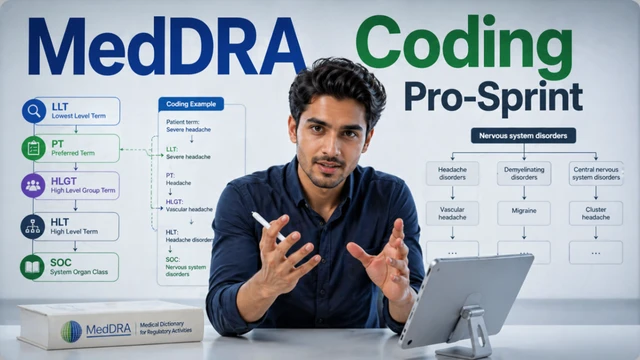
MedDRA is the Medical Dictionary for Regulatory Activities. It is a standardized medical terminology used worldwide in pharmacovigilance. MedDRA coding for freshers is a must-have skill.
When a patient reports 'liver damage,' you cannot just type that into a database. You must code it to a specific MedDRA term, like 'Hepatic failure' or 'Hepatitis.' MedDRA has five levels of hierarchy, from very specific (Lowest Level Term) to very broad (System Organ Class).
Example: A patient says 'I had a bad rash all over my body.' You would code it as 'Rash generalized' under the System Organ Class 'Skin and subcutaneous tissue disorders.'
Why MedDRA coding matters for freshers:
- Employers test your coding accuracy during interviews.
- Wrong coding can lead to delayed submissions and regulatory fines.
- Coding skills show that you understand medical terminology in a structured way.
- BDS, BHMS, BAMS, and Nursing graduates already know medical terms, which gives you an edge.
If you want to see how medical coding applies to other roles, read our article on medical coding jobs for freshers.
What is the skill gap for BDS, BHMS, BAMS, and Nursing graduates in PV?
Your college taught you anatomy, pharmacology, and patient care. But employers expect something different. Here is the gap:
- What colleges teach: Theoretical knowledge of drugs and diseases.
- What employers expect: Practical ability to process safety data in a software.
- What colleges teach: Writing patient case sheets.
- What employers expect: Using MedDRA and WHO Drug dictionaries.
- What colleges teach: Clinical diagnosis skills.
- What employers expect: Regulatory compliance and ICH guidelines.
- What colleges teach: Manual record keeping.
- What employers expect: Working in safety databases like Argus or ArisG.
This is why many allied health graduates struggle in interviews. They have the medical knowledge, but not the operational PV skills. The good news: you can bridge this gap with focused training and simulation.
How to become a PV Case Processor in 2026: A Step-by-Step Roadmap
Follow this roadmap to get your first pharmacovigilance case processing job as a fresher:
- Step 1: Build baseline PV knowledge. Spend 2 weeks learning the fundamentals: what is pharmacovigilance, why it matters, key terms like AE, SAE, SUSAR, ICSR. Read free guidelines from WHO and CDSCO.
- Step 2: Master ICSR process flow. Spend 3-4 weeks on ICSR triage, data entry, follow-up, and quality check. Practice with sample cases.
- Step 3: Learn MedDRA coding. Spend 2-3 weeks on MedDRA structure, coding conventions, and error correction. Use the free MedDRA browser to explore terms.
- Step 4: Practice on simulated databases. This is critical. Use a training environment that mimics real safety software. Process at least 10-20 mock cases end-to-end.
- Step 5: Create a portfolio and apply. Build a case processing portfolio. Then apply to entry-level PV jobs at CROs, pharma companies, and BPOs.
This roadmap takes 8-12 weeks if you are consistent. It does not require quitting your studies or paying huge fees.
What is the fastest way to bridge the skill gap? Simulation-Based Learning
Reading books will not get you a job. Employers want proof that you can do the work. That is where simulation-based learning comes in.
At ZANE ProEd, we built a system that replicates real pharmacovigilance workflows. You practice on realistic ICSR cases. You use MedDRA coding tools. You get instant feedback on your errors. It is like doing the job before you get the job.
No boring lectures. No outdated theories. Just hands-on practice that mirrors what you will do in a company.
Build These Skills Now
Programs from ZANE ProEd Academy that directly address the skill gaps discussed above.
How does ZANE ProEd help you master ICSR and MedDRA coding?
ZANE ProEd is not a typical course provider. It is a system designed to make you job-ready. It includes two focused programs that align with the skills employers demand.
ICSR Case Processing Triage
This program covers the complete ICSR lifecycle. You learn how to receive, triage, enter, and quality-check safety reports. You practice on simulated cases with varying complexity. By the end, you can process a case from start to finish without supervision.
MedDRA Medical Coding Certification
This program focuses on MedDRA coding accuracy. You learn the hierarchy, coding rules, and common pitfalls. You code dozens of real-world adverse event scenarios. You build a coding portfolio that proves your skill.
Together, these two programs form the core of pharmacovigilance case processing jobs freshers preparation. You do not just learn concepts; you demonstrate capability.
Ready to check your PV job readiness?
Take a free self-assessment. See how your current skills compare to what employers expect for an entry-level PV case processor. Identify your gaps. Then build a plan to close them.
Your degree is a foundation. But only practical skills will get you hired. Start your journey today.
Build These Skills Now
Programs from ZANE ProEd Academy that directly address the skill gaps discussed above.
Follow Zane ProEd on Google
Preferred SourceAdd our publication as a preferred source to get the latest clinical research guides, industry updates, and career intel directly in your Google Top Stories & AI Overviews.