Pharmacovigilance Case Processing Jobs for Freshers: A Recruiter's Guide

Pharmacovigilance Case Processor jobs for freshers involve receiving, triaging, and entering adverse event reports into safety databases. You also code medical terms using MedDRA and support drug safety monitoring. Life science graduates can get these roles by learning ICSR processing and MedDRA coding, which are the core skills employers test.
If you are a BSc or MSc Biotechnology, Microbiology, or Biochemistry graduate with no experience, pharmacovigilance case processing jobs for freshers are not out of reach. Recruiters tell us they hire freshers every month, but only if you have the right practical skills.
\nYour degree taught you biology, but not how to handle a real adverse event report. Employers do not expect you to know everything. They expect you to know ICSR processing and MedDRA coding. The good news? You can learn these in 3-6 months.
Build These Skills Now
Programs from ZANE ProEd Academy that directly address the skill gaps discussed above.
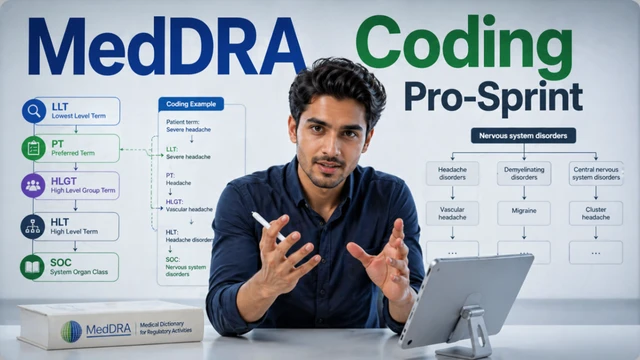
In this guide, we break down exactly what recruiters look for, what you will do daily, and how to build a job-ready profile fast.
\nWhat does a Pharmacovigilance Case Processor do?
\nA Pharmacovigilance Case Processor reviews and enters safety data from clinical trials and post-marketing reports. This is the most common entry-level role in drug safety.
\nHere is the pharmacovigilance case processor job description in simple terms:
\n- \n
- Receive adverse event reports from patients, doctors, or clinical trials. \n
- Check each report for completeness and validity (triage). \n
- Enter data into safety databases like Argus or ArisG. \n
- Code medical terms using MedDRA. \n
- Write case narratives that summarize the event clearly. \n
- Send completed cases to medical reviewers or regulatory authorities. \n
You do not need to be a doctor. You need to be accurate, detail-oriented, and comfortable with software.
\nWhat is the salary of a PV Case Processor in India?
\nSalaries vary by company, city, and your skills. Here is what you can expect in India:
\n- \n
- Fresher (0-1 year): ₹2.5 to ₹4 LPA \n
- 1-3 years: ₹4 to ₹6 LPA \n
- 3-5 years: ₹6 to ₹9 LPA \n
- Senior/Team Lead: ₹10 LPA and above \n
Cities like Hyderabad, Bangalore, Pune, and Mumbai pay higher. CROs and global pharma companies typically offer better packages than small BPOs.
\nYour PV case processor salary India depends heavily on your MedDRA coding speed and accuracy. Freshers who complete simulation-based training often negotiate 10-15% more.
\nHow to get a PV case processing job as a fresher?
\nMany life science freshers apply to hundreds of jobs with no response. The reason? Their resume shows theory, not skill. Here is a recruiter-approved path:
\n- \n
- Learn ICSR processing: Understand the full case lifecycle from intake to submission. Use free resources from ICH and practice with sample cases. \n
- Master MedDRA coding: Learn how to code adverse events to the correct preferred terms. This is tested in almost every interview. \n
- Build simulated experience: Use case processing software or simulation platforms to practice on realistic cases. Recruiters love this on a resume. \n
- Create a skills-based resume: List ICSR, MedDRA, safety database knowledge, and any practical projects. Do not just list degrees. \n
- Apply to entry-level roles: Target job titles like Pharmacovigilance Case Processor, Drug Safety Associate, or ICSR Processor. Check our detailed jobs guide and this fresher roadmap for more tips. \n
What is ICSR processing in pharmacovigilance?
\nICSR stands for Individual Case Safety Report. It is the core document in pharmacovigilance. Every time a patient or doctor reports a side effect, an ICSR is created.
\nICSR processing career means handling these reports end-to-end. The steps are:
\n- \n
- Receipt: Get the report via email, phone, or database. \n
- Triage: Check if it has the four minimum elements: identifiable patient, reporter, suspect drug, and adverse event. \n
- Data entry: Enter all details into a safety database. \n
- Coding: Code the adverse event and medical history using MedDRA. \n
- Narrative writing: Write a clear, chronological summary of the case. \n
- Medical review: A physician or safety scientist reviews the case. \n
- Submission: Send the case to regulators if required (within strict timelines). \n
Regulatory bodies like CDSCO in India and FDA in the US require accurate and timely ICSR submissions. That is why companies need skilled processors.
\nWhat is MedDRA coding and how is it used in PV?
\nMedDRA stands for Medical Dictionary for Regulatory Activities. It is the global standard for coding medical terms in pharmacovigilance. Developed by ICH, it is maintained by the WHO and used by regulators worldwide.
\nIn PV, you code adverse events (like 'headache') to a precise MedDRA term. MedDRA has five levels: System Organ Class, High Level Group Term, High Level Term, Preferred Term, and Lowest Level Term.
\nMedDRA coding for freshers is challenging because the same symptom can have many similar terms. You need to choose the most accurate one based on the case details.
\nFor example, 'heart attack' should be coded to 'Myocardial infarction' (Preferred Term), not just 'chest pain'. Employers test this skill heavily in interviews.
\nLink to our fresher guide to see common MedDRA coding questions.
\nWhat Colleges Don't Teach: The PV Skill Gap for Life Science Graduates
\nYour BSc or MSc in Biotechnology, Microbiology, or Biochemistry gives you strong science fundamentals. But recruiters say less than 10% of freshers are job-ready for pharmacovigilance case processing jobs.
\nHere is the gap:
\n- \n
- Colleges teach: Drug mechanisms, lab techniques, basic pharmacology. \n
- Employers need: ICSR data entry, MedDRA coding, safety database navigation, regulatory timelines, attention to detail under pressure. \n
The result? Freshers fail technical interviews or lack confidence on day one. You can close this gap with targeted, practical training—not by reading another textbook.
\nYour 6-Month Roadmap to a PV Case Processing Job
\nFollow this step-by-step plan. It works for absolute beginners.
\n- \n
- Month 1-2: Learn the basics. Study ICH guidelines, pharmacovigilance fundamentals, and MedDRA structure. Use free resources and short online modules. \n
- Month 3: Practice ICSR processing. Work on sample cases. Learn triage, data entry, and narrative writing. Use simulation tools if possible. \n
- Month 4: Master MedDRA coding. Code at least 50 practice cases. Focus on common adverse events and medical history terms. \n
- Month 5: Build your resume and LinkedIn. Highlight practical skills, not just degrees. List any simulation projects or certifications. \n
- Month 6: Apply and interview. Target 20-30 entry-level roles per week. Prepare for case scenario questions and MedDRA coding tests. \n
Why Simulation-Based Learning Gets You Hired Faster
\nReading about PV is like reading about swimming. You need to practice in real conditions. Employers want proof you can handle a case from start to finish.
\nSimulation-based learning gives you that proof. You work on realistic ICSRs, code with MedDRA, and get feedback on your accuracy. This is exactly what ZANE ProEd provides—a system that builds job-ready skills in weeks, not years.
\nBuild These Skills Now
Programs from ZANE ProEd Academy that directly address the skill gaps discussed above.
How ZANE ProEd Prepares You for ICSR and MedDRA Roles
\nZANE ProEd offers two targeted programs that map directly to these roles.
\nThe ICSR Case Processing Triage program teaches you how to receive, validate, and enter cases. You learn narrative writing and database basics. The MedDRA Medical Coding Certification program drills you on coding accuracy and speed. Both are built with recruiter input, so they match real job tasks.
\nThese are not just video courses. They include hands-on case simulations, quizzes, and feedback loops. You finish with a portfolio of processed cases to show employers.
\nCheck Your Job Readiness for PV Case Processing
\nNot sure where you stand? Take a quick self-assessment. Compare your current skills against the recruiter checklist: ICSR processing, MedDRA coding, database familiarity, and case narrative writing.
\nIf you are missing two or more, it is time to build them. Explore our learning system and see how you can be interview-ready in 3-6 months.
Build These Skills Now
Programs from ZANE ProEd Academy that directly address the skill gaps discussed above.
Follow Zane ProEd on Google
Preferred SourceAdd our publication as a preferred source to get the latest clinical research guides, industry updates, and career intel directly in your Google Top Stories & AI Overviews.