Pharmacovigilance Case Processing Jobs for Freshers: Complete Career Guide

Pharmacovigilance Case Processor Pharmacovigilance case processing jobs for freshers involve receiving, triaging, and entering adverse event reports into safety databases. Life sciences graduates can start as PV Case Processors after learning ICSR workflows and MedDRA coding. No prior experience is needed, but practical training helps.
If you are a BSc or MSc graduate in Biotechnology, Microbiology, or Biochemistry, you probably know the theory behind drug safety. But pharmacovigilance case processing jobs freshers often seem out of reach because colleges rarely teach the actual workflow.
The gap between your degree and the industry is real. You memorized definitions but never touched a real adverse event report. Employers want people who can process a case from start to finish, not just pass a written exam.
Build These Skills Now
Programs from ZANE ProEd Academy that directly address the skill gaps discussed above.
This playbook breaks down exactly what a PV Case Processor does, how much you can earn, and the practical steps to get hired without fake promises.
What does a Pharmacovigilance Case Processor do?
Pharmacovigilance case processing jobs freshers focus on handling individual safety reports from patients, doctors, or clinical trials. You are the first line of defense to ensure drug safety data is accurate and complete.
A typical day includes:
- Receiving adverse event reports through email, phone, or database.
- Entering case details into safety systems like Argus, ArisG, or Veeva.
- Coding medical terms using MedDRA.
- Checking seriousness, causality, and expectedness.
- Writing clear case narratives for regulators.
- Performing quality control before submission to health authorities.
The job description often says 'no experience required,' but employers still expect you to understand ICH guidelines. You can review them on the ICH website.
What is the salary of a PV Case Processor in India?
The PV case processor salary India varies by city, company, and your practical skill level. Here are realistic ranges for full-time roles:
- Freshers (0–1 year): ₹2.5 – ₹4 LPA
- 1–3 years: ₹4 – ₹6 LPA
- 3–5 years: ₹6 – ₹9 LPA
- Senior/Team Lead: ₹9 – ₹15 LPA
Bangalore, Hyderabad, Pune, and Chennai pay slightly higher than other cities. International BPOs often add night shift allowances. For India-specific regulations, check CDSCO.
How to get a PV case processing job as a fresher?
Most freshers struggle because they only have theoretical knowledge. Follow this practical path to stand out:
- Learn the ICSR workflow end-to-end. Understand intake, triage, data entry, coding, and submission.
- Practice MedDRA coding on real examples. Start with common adverse events like 'headache' or 'rash.'
- Use free resources. Review WHO and FDA guidelines on adverse event reporting.
- Get simulation-based training. Work on mock cases that mimic actual industry software.
- Build a skills-focused resume. List tools (Argus, ArisG), coding skills, and case narratives you have written.
For more guidance, read our detailed article on pharmacovigilance case processing jobs for freshers and PV jobs for freshers in India.
What is ICSR processing in pharmacovigilance?
ICSR processing means handling Individual Case Safety Reports. This is the core of any ICSR processing career. Every time a patient has an adverse reaction to a drug, that event becomes an ICSR. This is why adverse event reporting jobs always mention ICSR processing as a core skill.
The workflow usually has five steps:
- Intake: Receive the report and check if it is valid.
- Triage: Assign priority based on seriousness.
- Data entry: Enter all patient, drug, and event details.
- Medical coding: Convert free text to MedDRA codes.
- Submission: Send the case to regulators within a deadline.
The World Health Organization runs the global pharmacovigilance programme.
What is MedDRA coding and how is it used in PV?
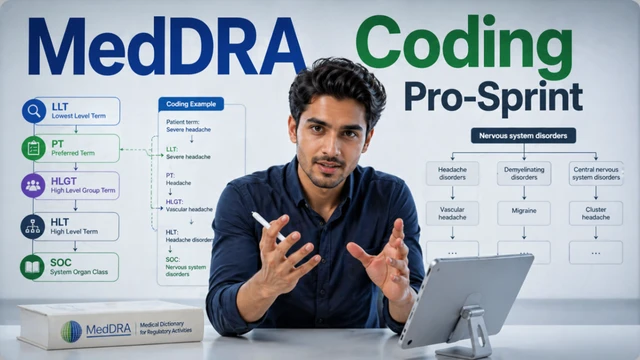
MedDRA coding for freshers is often the most confusing part. MedDRA stands for Medical Dictionary for Regulatory Activities. It is a standardized set of medical terms used to describe adverse events. Many adverse event reporting jobs test this skill during interviews.
You need to know the five-level hierarchy:
- System Organ Class (SOC)
- High Level Group Term (HLGT)
- High Level Term (HLT)
- Preferred Term (PT)
- Lowest Level Term (LLT)
For example, a report says 'heart attack.' You code it as 'Myocardial infarction' under 'Cardiac disorders.' The US FDA also publishes adverse event reporting guidance.
What is the skill gap between college and PV jobs?
Colleges teach you the science of drugs. Employers want you to apply it to real cases. The biggest gaps are:
- No hands-on experience with safety databases.
- No clue how to write a case narrative.
- No practice with MedDRA coding on real reports.
- No understanding of regulatory timelines (e.g., 7-day or 15-day reports).
This is why many BSc/MSc Biotechnology and Microbiology graduates are rejected despite good marks.
A step-by-step pathway to become a PV Case Processor
- Week 1: Study ICH E2D guidelines and basic pharmacovigilance terms.
- Week 2: Learn the ICSR workflow and practice triage on sample cases.
- Week 3: Master MedDRA coding with at least 50 common adverse events.
- Week 4: Write three full case narratives based on mock reports.
- Week 5: Build a project portfolio with your mock cases and apply to entry-level roles.
This is the exact path that turns a theory-only graduate into a job-ready candidate.
How can you bridge the gap without a job?
You don't need to be hired first to get practical experience. Simulation-based learning lets you work on realistic ICSR cases, use MedDRA coding tools, and receive feedback exactly like an industry trainer would.
This is not certification for the sake of a certificate. It is about building the muscle memory to process a case correctly on day one.
Build These Skills Now
Programs from ZANE ProEd Academy that directly address the skill gaps discussed above.
How ZANE ProEd builds job-ready PV Case Processors
ZANE ProEd uses a system, not just video lectures. The ICSR Case Processing Triage course covers the exact intake and triage steps used in companies. The MedDRA Medical Coding Certification course takes you from zero to coding confidence with practical exercises.
You work on simulated cases, get personalized feedback, and build a portfolio that proves your skill. This is how you close the gap between college and industry. Learn more about our approach on the ZANE ProEd About page.
Are you ready to start your PV career?
Don't wait for a company to train you. Check your job readiness today. See how your current skills compare to what employers actually expect in pharmacovigilance case processing.
You have the science background. Now add the workflow skills and become the fresher who gets hired.
Build These Skills Now
Programs from ZANE ProEd Academy that directly address the skill gaps discussed above.
Follow Zane ProEd on Google
Preferred SourceAdd our publication as a preferred source to get the latest clinical research guides, industry updates, and career intel directly in your Google Top Stories & AI Overviews.