Pharmacovigilance Case Processing Jobs for Freshers: A Step-by-Step Career Guide

Pharmacovigilance Case Processor is an entry-level role where freshers review, code, and process reports of medicine side effects (adverse events). BPharm and MPharm graduates can start with no industry connections by learning ICSR processing and MedDRA coding, with salaries starting from ₹2.5–4 LPA.
You just finished your BPharm or MPharm. Everyone said pharmacy has “good scope.” But now you look around and see limited hospital or sales jobs. You want a stable, growing career. But you have no industry connections. The good news? Pharmacovigilance case processing jobs for freshers are ready for you—if you know what skills to build.
I was in your place. I remember the confusion. Colleges teach theory: pharmacology, therapeutics, but not the exact tools used in the PV industry. Here’s the truth: companies need case processors who can work from day one. They don’t expect you to know everything, but they expect you to understand ICSR processing, MedDRA coding, and adverse event reporting. This guide gives you a clear, step-by-step path to your first PV job in 3–6 months, even with no connections.
Build These Skills Now
Programs from ZANE ProEd Academy that directly address the skill gaps discussed above.
What does a Pharmacovigilance Case Processor do?
A Pharmacovigilance Case Processor works at the heart of drug safety. Your daily tasks include:
- Receiving and reviewing adverse event (AE) reports from healthcare professionals, patients, or clinical trials.
- Entering data into safety databases like Argus or ArisG.
- Performing MedDRA coding to standardize medical terms.
- Assessing seriousness, expectedness, and causality of the adverse event.
- Ensuring reports meet global regulatory timelines (like 15-day expedited reports).
- Following ICH guidelines and ICH standards for consistency.
This role is perfect for BPharm and MPharm freshers because it uses your medical knowledge without needing sales experience. You become an expert in case processing, building a foundation for future roles like Drug Safety Associate or PV Scientist.
What is the salary of a PV Case Processor in India?
For freshers, the PV case processor salary India starts around ₹2.5 LPA in small CROs to ₹4 LPA in top MNCs. With 1–2 years of experience, salaries can jump to ₹5–7 LPA. The demand is high, and companies value specialized skills.
Here’s a quick breakdown:
- Fresher (0–1 year): ₹2.5–4 LPA
- Junior (1–3 years): ₹4–7 LPA
- Senior (3–5 years): ₹7–12 LPA
Cities like Hyderabad, Bangalore, Mumbai, and Pune offer the most jobs. Multinationals like Novartis, Pfizer, and global CROs often pay higher. Even without industry connections, your salary can grow fast once you gain hands-on skills.
How to get a PV case processing job as a fresher?
The market is competitive, but there’s a proven way. Stop relying on college placements alone. Here’s what works:
- Learn the core tools: Understand safety databases, MedDRA coding, and regulatory timelines. Many freshers skip this step and get rejected.
- Get practical exposure: Simulation-based training can make you job-ready. See our complete career guide for insights.
- Optimize your resume: Highlight keywords like “ICSR processing,” “MedDRA coding,” and “adverse event reporting” even if you learned them through courses.
- Network smartly: Join LinkedIn groups, attend free webinars by FDA and EMA, and connect with PV professionals. Mention your simulation experience.
- Apply to CROs and MNCs: Target companies like IQVIA, Syneos, Labcorp, and local pharmacovigilance centers. Many hire freshers in batches.
With a structured approach, you can start in 3–6 months.
What is ICSR processing in pharmacovigilance?
ICSR stands for Individual Case Safety Report. It’s the core document in adverse event reporting jobs. When a patient or doctor reports a side effect, every detail goes into an ICSR. Your job as a case processor is to:
- Review the report for completeness.
- Enter it into the safety database.
- Code adverse events using MedDRA.
- Assess if the report needs expedited submission to regulators like CDSCO (India) or FDA (US).
An ICSR processing career is stable and detail-oriented. You follow strict guidelines from ICH, ICH, and WHO. Freshers often find this role the easiest entry into the pharma industry.
What is MedDRA coding and how is it used in PV?
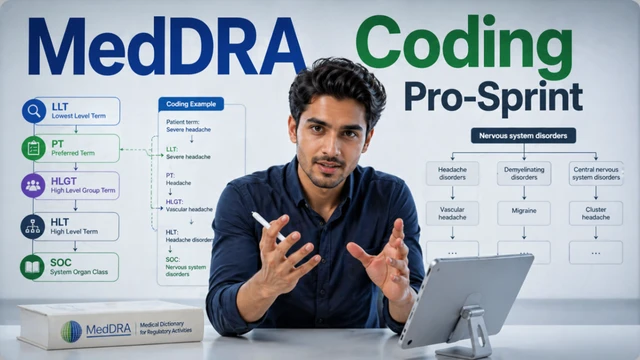
MedDRA (Medical Dictionary for Regulatory Activities) is the standard language for medical terms in drug safety. It has five levels: System Organ Class (SOC), High Level Group Term (HLGT), High Level Term (HLT), Preferred Term (PT), and Lowest Level Term (LLT). For example, a patient’s report of “stomach pain” might be coded to the PT “Abdominal pain.”
MedDRA coding for freshers is critical because it ensures that adverse events are uniformly reported worldwide. Companies look for candidates who can:
- Select the correct PT from a verbatim.
- Understand the hierarchy and medical logic.
- Stay updated with MedDRA version changes (released biannually).
Most colleges never teach this. But with the right simulation training, you can master it quickly.
What colleges don’t teach you about PV jobs
Your BPharm or MPharm gives you a strong foundation in pharmacology. But employers expect immediate productivity. Here’s the gap:
- College teaches: Drug mechanisms, dispensing, hospital pharmacy.
Employer wants: Knowledge of safety databases, regulatory guidelines (ICH E2B), and MedDRA coding. - College teaches: Theory of adverse reactions.
Employer wants: Practical ICSR processing: how to triage, enter data, and assess causality.
This is why many freshers struggle. The solution? Close the gap with hands-on practice before your interview.
Your 5-step roadmap to a PV case processing job
Follow these steps to get hired:
- Step 1: Understand the role. Read the pharmacovigilance case processor job description on job portals. Note the keywords.
- Step 2: Learn the tools. Take a simulation-based course in ICSR triage and MedDRA coding. Don’t just watch videos—practice on a mock platform.
- Step 3: Build a resume. List your simulation experience as projects. Use exact terms: “Processed 50 mock ICSRs,” “Performed MedDRA coding with 95% accuracy.”
- Step 4: Apply strategically. Use Naukri, LinkedIn, and company websites. Set alerts for “adverse event reporting jobs” and “PV case processing.”
- Step 5: Prepare for interviews. Expect scenario-based questions: “How do you handle an incomplete AE report?” Practice with real-time cases.
Learn by doing: simulation-based training
Reading theory won’t get you hired. You need muscle memory. Simulation platforms replicate a real safety database. You receive mock ICSRs, code them with MedDRA, and meet deadlines—just like on the job.
ZANE ProEd builds your confidence through practical application, not passive lectures. When you simulate the work, recruiters see you as a low-risk hire.
Build These Skills Now
Programs from ZANE ProEd Academy that directly address the skill gaps discussed above.
Mastering ICSR triage and MedDRA coding with ZANE ProEd
Two specific systems prepare you fully: ICSR case processing and triage and MedDRA medical coding certification. In ICSR triage, you learn to filter valid reports, assess seriousness, and prioritize. In MedDRA coding, you practice selecting preferred terms and coding hundreds of real-world verbatims.
These are not theory courses. They are simulated workflows that match the exact expectations of top CROs and pharma companies. When you complete them, you can confidently say, “I am ready to process cases from day one.”
Check your job readiness
Still unsure? Think about this: Can you code a simple adverse event like “headache” to its MedDRA PT? Do you know the 15-day expedited reporting rule? If not, you aren’t ready yet—but you can be.
Learn more about our approach and take a free self-assessment to see where your skills stand. Your future in pharmacovigilance starts with the right preparation.
Build These Skills Now
Programs from ZANE ProEd Academy that directly address the skill gaps discussed above.
Follow Zane ProEd on Google
Preferred SourceAdd our publication as a preferred source to get the latest clinical research guides, industry updates, and career intel directly in your Google Top Stories & AI Overviews.