Pharmacovigilance Case Processing Jobs for Freshers: Complete Guide

Pharmacovigilance Case Processor Pharmacovigilance case processing jobs for freshers involve handling adverse event reports, entering safety data, coding with MedDRA, and supporting drug safety monitoring. Freshers with BPharm, BSc, or life science degrees can enter this field with focused training in ICSR processing and medical coding.
If you just finished BPharm, BSc, or any life science degree and are searching for pharmacovigilance case processing jobs freshers, you already know the gap is massive.
College gave you theory. Employers want speed, accuracy, and tool knowledge. This blog gives you the recruiter's eye view on how to break in.
Build These Skills Now
Programs from ZANE ProEd Academy that directly address the skill gaps discussed above.
You do not need 5 years of experience. You need the right signals.
For a deeper dive, read our complete guide on PV case processing for freshers. If you are switching from IT or BPO, check this career-switcher roadmap.
What does a Pharmacovigilance Case Processor do? (Pharmacovigilance Case Processing Jobs for Freshers)
A pharmacovigilance case processor is the first line of defense in drug safety. You receive reports of adverse events from patients, doctors, or clinical trials. Your job is to turn raw information into clean, coded safety data.
This is the pharmacovigilance case processor job description in simple terms: intake, triage, data entry, coding, and submission. No lab work. No patient contact. Just you, a computer, and a global safety database.
Typical daily tasks include:
- Receive and log adverse event reports from emails, calls, or portals.
- Perform initial triage to check if the report is valid and complete.
- Enter case details into safety databases like Argus, ArisG, or Veeva Vault.
- Assign MedDRA codes for medical terms.
- Assess seriousness, expectedness, and causality.
- Prepare follow-up requests for missing information.
- Support ICSR submission to regulatory authorities.
Freshers with BPharm, BSc, or life science backgrounds are hired for these roles. Companies like Accenture, Cognizant, TCS, and IQVIA run large PV teams. Many BPO units specifically hire for adverse event reporting jobs.
What is the salary of a PV Case Processor in India?
The PV case processor salary India range is simple and realistic.
- Fresher (0-1 year): ₹2.2 to ₹3.5 LPA
- 1-3 years: ₹3.5 to ₹5.5 LPA
- 3-5 years: ₹5.5 to ₹8 LPA
- Senior/Team Lead: ₹8 to ₹14 LPA
In metro cities like Bengaluru, Hyderabad, and Pune, fresher salaries start around ₹2.8 LPA. Night shifts for global teams can add 10-15% shift allowance.
Do not expect high pay on day one. The real value is the career ladder. Most people move to drug safety associate, aggregate reporting, or pharmacovigilance scientist roles within 3-5 years.
How to get a PV case processing job as a fresher?
You can get pharmacovigilance case processing jobs freshers without a master's degree. But you need to show three things: basic medical knowledge, tool awareness, and proof of accuracy.
Here is the shortest route:
- Learn ICSR processing fundamentals. Understand what a valid case looks like.
- Get hands-on with MedDRA coding. Practice coding real examples.
- Build a small portfolio. Show sample case narratives and coded entries.
- Apply to BPO and CRO entry-level roles. Use keywords like 'drug safety associate' or 'case processor'.
- Clear the interview test. Many companies give a written case processing test.
Most freshers fail at step 5 because they have never seen a real ICSR form. Simulation practice fixes that.
What is ICSR processing in pharmacovigilance?
ICSR processing career starts with understanding ICSR. ICSR stands for Individual Case Safety Report. It is the single most important document in pharmacovigilance.
When a patient takes a drug and has a side effect, that event becomes an ICSR. Your job is to process that report from raw text to a structured database entry.
The core steps of ICSR processing are:
- Triage: Check if the report is valid and if the minimum criteria are met.
- Data entry: Fill all fields in the safety database.
- Coding: Assign MedDRA terms for adverse events.
- Assessment: Determine seriousness, expectedness, and causality.
- Narrative writing: Summarize the case story in a clear narrative.
- Submission: Send the ICSR to regulators within timelines.
Global standards come from ICH and WHO. National regulators like FDA, CDSCO, and EMA enforce them.
What is MedDRA coding and how is it used in PV?
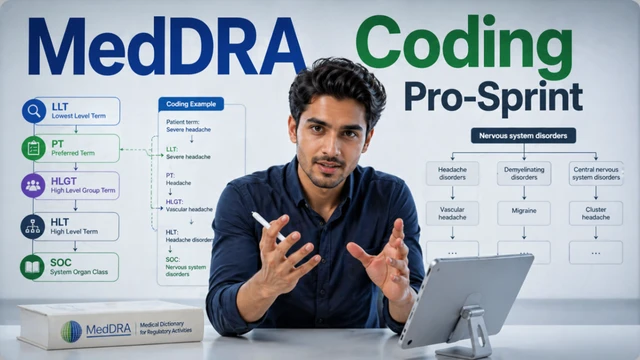
MedDRA stands for Medical Dictionary for Regulatory Activities. It is the standard language for coding medical terms in PV. MedDRA coding for freshers is a must-have skill.
When a doctor writes 'heart attack', you cannot just type that. You must find the correct MedDRA term, usually 'Myocardial infarction'. The system has five levels:
- System Organ Class (SOC)
- High Level Group Term (HLGT)
- High Level Term (HLT)
- Preferred Term (PT)
- Lowest Level Term (LLT)
Case processors use the Preferred Term for coding. You need to know how to search, pick the right term, and avoid common coding errors.
Most employers test MedDRA coding in interviews. Without practice, you will fail. With a simulation tool, you can master it in 2 weeks.
What Do Employers Expect That Colleges Don't Teach? (The Real Skill Gap)
Colleges teach pharmacology, anatomy, and maybe regulatory affairs. Employers want job-ready skills.
Here is the reality check for BSc / BCA / BTech / Non-Healthcare switchers:
- Colleges teach: drug classification and mechanisms.
- Employers expect: you can process an ICSR in 20 minutes with zero errors.
- Colleges teach: theory of adverse drug reactions.
- Employers expect: you can code 50 MedDRA terms without help.
- Colleges teach: how to write lab reports.
- Employers expect: you can write a clear case narrative that passes QA.
If you are from IT or BPO, the gap is even bigger. You know software but not medical terms. You need to bridge both.
Your Step-by-Step Roadmap to Your First PV Job (3-6 Months)
- Month 1: Learn the PV lifecycle. Understand ICSR, MedDRA, and safety databases.
- Month 2: Practice case processing on simulated cases. Do at least 50 mock ICSRs.
- Month 3: Master MedDRA coding. Practice 200+ terms.
- Month 4: Build a portfolio. Include case narratives and coded examples.
- Month 5: Apply to 20+ entry-level PV roles. Use your portfolio as proof.
- Month 6: Clear the interview. Show your simulation practice.
This roadmap works if you practice daily. The hardest part is getting real case data to practice on. That is where simulation-based learning changes everything.
How Simulation-Based Learning Closes the Gap
You cannot get a job by reading theory. You need to do the work. But no company will let you practice on live safety data.
Simulation-based learning gives you a safe environment to practice ICSR processing, MedDRA coding, and narrative writing. You make mistakes, learn, and improve without risk.
Build These Skills Now
Programs from ZANE ProEd Academy that directly address the skill gaps discussed above.
The ZANE ProEd System: Two Courses That Matter
ZANE ProEd built a system, not just courses. The system focuses on two skills that recruiters actually test.
The icsr-case-processing-triage course teaches you how to handle a case from intake to submission. You practice triage, data entry, and narrative writing on real-world scenarios.
The meddra-medical-coding-certification course trains you to code correctly and fast. You work through hundreds of coding exercises until it becomes automatic.
These are not theory videos. They are simulation labs. You learn by doing.
Check Your Job Readiness Now
Ask yourself these three questions:
- Can I process a basic ICSR in under 30 minutes without errors?
- Can I code 20 MedDRA terms correctly on the first try?
- Can I write a case narrative that passes a QA review?
If you answered 'no' to any of them, you are not ready yet. See how your skills compare to what employers expect.
Take a free readiness check. Find the gaps. Then close them with focused practice.
Build These Skills Now
Programs from ZANE ProEd Academy that directly address the skill gaps discussed above.
Follow Zane ProEd on Google
Preferred SourceAdd our publication as a preferred source to get the latest clinical research guides, industry updates, and career intel directly in your Google Top Stories & AI Overviews.