Pharmacovigilance Case Processing Jobs Freshers: Step-by-Step Roadmap for Chemistry Graduates

Pharmacovigilance Case Processor is a role where you review and process adverse drug reaction reports. Freshers from BSc/MSc Chemistry can start in pharmacovigilance case processing jobs freshers by learning ICSR processing and MedDRA coding. Entry-level salaries range from ₹2.5 to ₹4.5 LPA in India.
If you feel stuck with a Chemistry degree and no job offers in hand, you’re not alone. BSc and MSc Chemistry graduates often discover that academic knowledge alone isn’t enough to land a stable industry role. The good news is that pharmacovigilance case processing jobs freshers are a hidden pathway—one where your analytical skills can translate directly into a healthcare career.
But why pharmacovigilance? Because every drug company, CRO (Contract Research Organization), and regulatory body needs people to monitor drug safety. As a case processor, you become the first line of defense for patient safety. And here’s the secret: you don’t need a pharmacy degree. Your background in chemical sciences is already a strong foundation.
Build These Skills Now
Programs from ZANE ProEd Academy that directly address the skill gaps discussed above.
What does a Pharmacovigilance Case Processor do?
A pharmacovigilance case processor reviews reports of adverse drug reactions (ADRs) from patients, doctors, or clinical trials. Their main job is to enter the data accurately into a safety database, code medical terms using MedDRA, and assess the case’s seriousness and causality. They ensure the report complies with regulatory timelines. This role is also called ICSR processing (Individual Case Safety Report processing). It’s detail-oriented work that directly impacts public health.
Daily tasks include:
- Triaging incoming ADR reports from various sources (emails, phone calls, literature).
- Checking if minimum information is present (identifiable patient, reporter, suspect drug, adverse event).
- Entering data into systems like Argus, ArisG, or Veeva Vault.
- Coding medical history, events, and drugs using MedDRA and WHO Drug dictionaries.
- Writing the narrative: a short clinical story of what happened.
- Submitting reports to regulatory authorities (CDSCO, FDA, EMA) within deadlines.
Typical qualification required: A Bachelor’s or Master’s degree in Life Sciences, Pharmacy, or Chemical Sciences. Companies often train freshers on the job, but having prior knowledge of regulatory guidelines (ICH E2B) and hands-on practice is a huge advantage.
What is the salary of a PV Case Processor in India?
The PV case processor salary India varies based on location, company type, and skills. For a fresher (0–1 year experience), the typical CTC is between ₹2.5 LPA and ₹4.5 LPA. In metropolitan cities like Bengaluru, Mumbai, Hyderabad, or Delhi NCR, salaries can be higher.
Breakdown:
- Small pharmacovigilance service providers or CROs: ₹2.2 – ₹3.0 LPA
- Mid-size IT/BPO companies with PV arms: ₹2.8 – ₹3.8 LPA
- Large multinational CROs or pharma companies: ₹3.5 – ₹4.5 LPA
- With just 1–2 years of experience, you can negotiate ₹4.5 – ₹6 LPA.
Remember, what decides your salary beyond the degree is your hands-on tool knowledge and understanding of regulatory guidelines. A fresher who can show case processing simulation experience and MedDRA coding speed often gets a higher offer.
How to get a PV case processing job as a fresher?
Landing pharmacovigilance case processing jobs freshers requires three things: the right knowledge, practical skills, and a strategic approach. Here’s a step-by-step plan:
- Understand the regulatory backbone: Study ICH E2B(R3) guidelines, which define the data elements for ICSR. Learn about expedited reporting timelines (7 days and 15 days from the regulatory body’s perspective).
- Learn MedDRA coding: MedDRA (Medical Dictionary for Regulatory Activities) is the global standard for coding adverse events. Check this pharmacovigilance case processing jobs roadmap for guidance on MedDRA certification.
- Practice ICSR processing: You can’t learn this from textbooks alone. Use simulation-based platforms that mirror real safety databases. This builds speed and accuracy.
- Tailor your resume: Highlight any project or internship where you handled data, used databases, or applied chemical knowledge to biological systems. Use keywords like ICSR processing, adverse event reporting, MedDRA coding, pharmacovigilance.
- Apply to the right companies: Target CROs (Parexel, IQVIA, Syneos Health), BPOs with PV units (TCS, Accenture, Infosys), and pharma companies (Dr. Reddy’s, Cipla, Sun Pharma). Look for titles like Pharmacovigilance Associate, Drug Safety Associate, Case Processor, or Safety Data Specialist.
- Ace the interview: Prepare to answer scenario-based questions: “How would you handle an incomplete case? What is the difference between seriousness and severity? Code this event using MedDRA.” A pharmacovigilance jobs for freshers guide can give you common interview questions.
What is ICSR processing in pharmacovigilance?
ICSR processing (Individual Case Safety Report processing) is the core activity of a case processor. An ICSR is a report about a single patient who experienced an adverse event after taking a drug. The processor:
- Receives the report (source: spontaneous, clinical trial, literature).
- Validates the report: checks if it meets the four minimum criteria (identifiable patient, reporter, suspect drug, adverse event).
- Enters data into a safety database according to ICH E2B specifications.
- Codes the adverse event using MedDRA and the drug(s) using WHO Drug Dictionary.
- Assesses seriousness and expectedness.
- Writes a clinical narrative summarizing the case.
- Submits the case to regulatory agencies within strict timelines.
A strong ICSR processing career can lead to roles like Safety Reviewer, Case Manager, or Drug Safety Physician. Automation is changing how cases are processed, but human judgment is still essential for medical assessment.
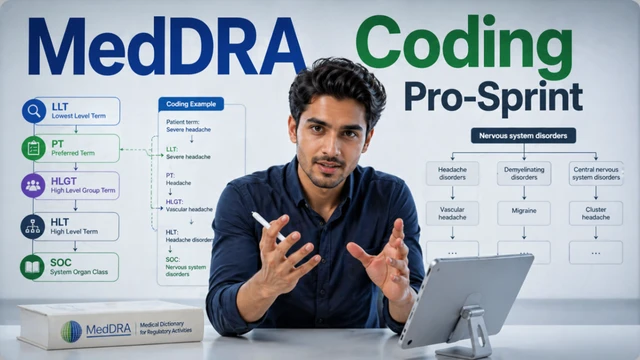
What is MedDRA coding and how is it used in PV?
MedDRA (Medical Dictionary for Regulatory Activities) is a standardized medical terminology developed by the International Council for Harmonisation (ICH). In pharmacovigilance, every adverse event report must be coded using MedDRA to ensure consistent analysis and reporting across products and countries.
For a fresher, learning MedDRA coding for freshers means understanding:
- Five levels of hierarchy: System Organ Class (SOC), High Level Group Term (HLGT), High Level Term (HLT), Preferred Term (PT), and Lowest Level Term (LLT).
- How to search for the correct term using a browser and digital dictionary.
- That you generally code to the most specific PT/LLT level that represents the reported event.
- Common mistakes: coding symptoms when a diagnosis is available, or using an LLT without checking the PT.
Many pharmacovigilance teams test your MedDRA skills during the interview. You can practice using official MedDRA browsers available on the WHO or other regulatory sites.
The Chemistry Graduate Skill Gap: What Employers Want vs. What You Learned
Your BSc or MSc Chemistry degree gave you strong analytical thinking, knowledge of molecular interactions, and lab precision. But pharmacovigilance recruiters look for a different toolset:
- College taught: Organic reactions, spectroscopy, thermodynamics.
- Employers want: ICSR workflow, MedDRA coding, safety database navigation, regulatory writing.
The gap is real. You might never have heard of ICH guidelines or an “expedited report.” The good news is this gap can be closed in a few weeks with focused training. Simulation-based learning lets you practice on platforms identical to those used in industry—so you can confidently say, “I have processed 50 mock cases” instead of just “I have a degree.”
Your 6-Step Roadmap to a Pharmacovigilance Case Processor Job
Follow this action plan to go from zero to job-ready:
- Learn the terminology: Understand ADR, AE, SAE, SUSAR, ICSR, MedDRA, E2B, and timelines. Watch free webinars or read FDA and CDSCO guidelines.
- Get certified in ICSR processing: Enroll in a practical course like ICSR Case Processing & Triage Simulation at ZANE ProEd. This covers end-to-end case handling, from intake to submission.
- Master MedDRA coding: Take a dedicated certification like MedDRA Medical Coding Certification. Practice coding 100+ fictional cases to build speed and accuracy.
- Build a portfolio: Document your simulated cases, coding exercises, and narrative writing samples. Create a LinkedIn project section highlighting your PV skills.
- Apply with precision: Use job portals and company careers pages. Write a cover letter that mentions your hands-on training in ICSR and MedDRA.
- Practice interviews: Be ready to explain how you would process a case, how you use MedDRA, and what you know about regulatory guidelines. A career mentor can help you prepare.
Bridging the Experience Gap with Simulation
The biggest hurdle for any fresher is the “no experience” label. But you can create experience. Simulation-based learning platforms replicate the exact software used by global pharma companies. You’ll work on real-time case scenarios, make mistakes in a safe environment, and learn the workflow end-to-end. By the time you interview, you’ll have the confidence of someone who has already done the job.
Build These Skills Now
Programs from ZANE ProEd Academy that directly address the skill gaps discussed above.
At ZANE ProEd, the ICSR Case Processing & Triage Simulation course is designed specifically for life science and chemistry graduates. You’ll learn:
- ICSR validation and data entry
- Narrative writing and medical coding
- Regulatory submission processes
The MedDRA Medical Coding Certification helps you build speed and accuracy in coding adverse events. These programs don’t just teach theory—you’ll work on a simulated safety database with thousands of cases. That’s the difference between “I studied” and “I can do.”
Check your job readiness now. See how your current skills compare to what employers demand—and take the first step toward a pharmacovigilance career that actually uses your chemistry background.
Build These Skills Now
Programs from ZANE ProEd Academy that directly address the skill gaps discussed above.
Follow Zane ProEd on Google
Preferred SourceAdd our publication as a preferred source to get the latest clinical research guides, industry updates, and career intel directly in your Google Top Stories & AI Overviews.