A Recruiter's Audit: 90% of Hospital QA/QC Candidates Fail the Interview. Here's Why.

Why 90% of QA/QC Executive (Hospital / NABH) Candidates Are Rejected in 10 Minutes
As a recruiter who screens hundreds of candidates for leading NABH-accredited hospitals, I’ll share a brutal truth. Nine out of ten interviews for a QA/QC Executive (Hospital / NABH) are over before they truly begin. It’s not about your degree, your marks, or even the name on your basic quality management certificate. It’s about a fundamental gap between what you learned and what we need.
Candidates walk in ready to recite definitions from a textbook. They can explain what a CAPA is, but they freeze when asked to design one for a real-world medication error. They've memorized the standards but have never been trained to think in workflows. The interview isn't a test of your memory; it's a simulation of the job. And most candidates fail the simulation.
This isn't just an inconvenience; it's a critical breakdown. Hospitals are high-risk environments where quality isn't a department; it's a lifeline. We need practitioners, not theorists. The tension in the room becomes palpable when a candidate’s theoretical knowledge collides with a practical problem they are completely unprepared to solve.
Build These Skills Now
Programs from ZANE ProEd Academy that directly address the skill gaps discussed above.
The Great Disruption: Your Certificate is Not Your Shield
You believe your M.Sc. in a relevant field and a certification in quality management make you a strong candidate. In reality, they are just the minimum entry fee to get the interview. The real evaluation—and where most rejections happen—begins when we probe for operational readiness.
Recruiters reject candidates because of demonstrated skill gaps, not missing credentials. I can see it the moment I ask a scenario-based question: "Describe the process you would follow if you discovered a sudden spike in surgical site infections in a specific orthopedic ward." The textbook answer is, "I would initiate a Root Cause Analysis." The job-winning answer is, "First, I'd verify the data with the Infection Control Nurse. Second, I'd perform a preliminary observation of the ward's sterilization and patient prep protocols. Third, I'd assemble a cross-functional team including the head surgeon and nursing supervisor to map the end-to-end process and identify potential deviation points." See the difference? One is a definition; the other is a plan of action.
An Insider's View: What Hospital Directors Actually Want
Let me be clear. My job isn't to check if you know the ten chapters of the NABH 5th Edition standards. My job is to find someone who can protect the hospital from clinical risk, financial penalties, and reputational damage. We don't need 'quality police' who walk around with clipboards. We need quality architects who can proactively identify systemic weaknesses and build robust processes that clinicians will actually adopt.
We need you to understand that quality assurance in a hospital setting is about patient safety, first and foremost. This aligns with global initiatives outlined by organizations like the World Health Organization (WHO). Your role is to translate regulatory requirements into practical, on-the-floor workflows that prevent adverse events before they happen.
The Skill Gap Exposed: College Theory vs. Hospital Reality
The disconnect between academic training and industry demand is vast. It's the primary source of interview failure. Here's a direct comparison of what we see versus what we need:
- On Root Cause Analysis (RCA):
College Output: Can define RCA and list the '5 Whys' method.
Industry Expectation: Can take a real scenario (e.g., a patient data breach from the HIS system) and facilitate a live RCA during the interview, identifying potential failures in software security, user access protocols, and staff training—not just blaming an individual. - On Key Performance Indicators (KPIs):
College Output: Knows the definition of a KPI.
Industry Expectation: Can design three meaningful clinical quality KPIs for an emergency department (e.g., Door-to-Needle time for stroke patients, patient wait times, rate of return within 72 hours), explain the data collection method, and outline the actions triggered by a negative trend. - On Audits:
College Output: Can list the types of audits (internal, external).
Industry Expectation: Can explain how they would prepare a department for an external audit, including conducting mock audits, training staff on common questions, and organizing documentation for easy retrieval. They must demonstrate an understanding of what auditors from bodies like the Joint Commission International (JCI) look for.
The ZANE Framework: Workflow Fluency vs. Textbook Fluency
To simplify this, we use a model called 'Workflow Fluency vs. Textbook Fluency'. It’s the single biggest differentiator between candidates who get offers and those who get rejected.
- Textbook Fluency is knowing what a standard says. You can recite clauses and definitions. This is the baseline, and frankly, it's what 90% of candidates possess. It's the result of traditional, passive learning. As other recruiters have noted in related fields, simply memorizing rules isn't enough.
- Workflow Fluency is knowing how that standard is applied in the chaotic, dynamic environment of a hospital floor. It's the ability to see a process, connect it to a standard, anticipate failure points, and communicate solutions to a diverse team of doctors, nurses, and administrators. This is what the top 10% have. It’s what we hire for.
A Recruiter's Mistake Audit: 3 Interview-Killing Errors
To build Workflow Fluency, you must first stop making these common mistakes. Here is my audit of the top three interview failures:
- The 'Standard Reciter': When asked how they'd manage a sentinel event, they quote the standard definition. This tells me nothing. The Correction: You must articulate a sequence of actions. For example: "My immediate priority is patient safety and containment. I would then trigger the hospital's incident management protocol, notify leadership, and secure all relevant records and equipment for the investigation, ensuring compliance with reporting timelines to regulatory bodies like the CDSCO where applicable."
- The 'Tool Namer': The candidate proudly says they would use a "Fishbone Diagram" or "Pareto Chart" to solve a problem, but cannot apply it. It’s like a carpenter showing you a hammer but not knowing how to build a chair. The Correction: Apply the tool directly. "For the issue of rising patient complaints about discharge delays, I'd use a Fishbone Diagram. The 'bones' would be People, Process, Technology, and Policy, allowing us to brainstorm root causes in each area—from insufficient staff training to issues with the electronic health record system."
- The 'Silo Thinker': They talk about the QA department as an isolated island. This is a massive red flag. The Correction: Demonstrate collaborative thinking. "To implement a new infection control protocol, I would work directly with the Infection Control Committee, Head of Nursing, and even the biomedical engineering team to ensure equipment is properly sterilized. I'd then develop training materials and conduct sessions with floor staff to ensure buy-in and effective implementation." As other recruiters confess, showing you can work in a team is non-negotiable.
Micro-Scenario: Your 15-Minute Test
Let's run a quick simulation. A nurse from the ICU calls you, panicked. The new infusion pump—Model XYZ—has malfunctioned, delivering an incorrect dosage to a patient. The patient is stable but the event was critical. What are your first three actions in the next 15 minutes? Your career could hinge on this answer.
The expected response isn't complex, it's procedural: 1. Instruct the nurse to immediately remove the specific device and all other Model XYZ pumps from service and tag them for investigation. 2. Ensure the adverse event is documented in the patient's record and reported through the hospital's internal incident system. 3. Escalate to the Chief Medical Officer and Biomedical Head immediately. This demonstrates an immediate focus on risk containment and adherence to protocol, which is the essence of Workflow Fluency.
The Bridge from Theory to Practice
That 15-minute response is the gap. You can't learn that level of instinctual, procedural thinking from a book or a one-way lecture. It comes from practice, from being put in the hot seat and forced to make decisions.
This is precisely why the most forward-thinking healthcare organizations are now prioritizing candidates who have been trained using high-fidelity simulations. They want people who have already faced dozens of these micro-scenarios in a controlled training environment. This builds the 'muscle memory' needed for high-stakes roles in quality and patient safety.
Build These Skills Now
Programs from ZANE ProEd Academy that directly address the skill gaps discussed above.
Integrating into a System of Readiness
This is the philosophy behind the ZANE ProEd system. It is engineered to close the gap between Textbook Fluency and the Workflow Fluency that gets you hired. We don't sell courses; we provide access to a system that builds operational readiness.
The Hospital Quality Management Certification is a prime example. It moves beyond theory by immersing you in a system where you must build quality dashboards, conduct simulated audits of hospital processes, and apply NABH standards to practical case studies. You aren't just reading about quality management; you are performing the functions of a quality manager.
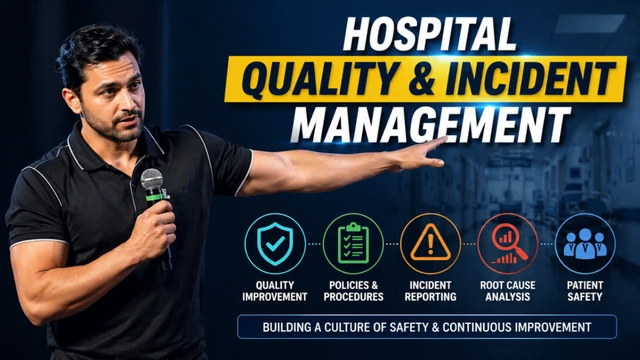
Similarly, the Hospital Quality & Incident Management program is a deep-dive simulation. It places you directly into the role of a QA Executive facing scenarios like the infusion pump failure. You will manage incidents, conduct root cause analyses, and develop CAPAs within the system, learning by doing in a way that a textbook could never replicate. This is how you transition from a candidate who knows the terms to a professional who can execute the tasks.
Your Next Move: Stop Memorizing, Start Simulating
The definition of insanity is doing the same thing and expecting a different result. If you keep preparing for interviews by simply reading standards, you will continue to struggle.
Audit your own fluency. Could you confidently navigate the micro-scenario I presented? Could you answer the follow-up questions from a hiring manager? If there is any hesitation, it's a sign that you have a fluency gap.
It's time to change your preparation strategy. Explore the systems designed to build the operational skills and workflow fluency that hospital recruiters are desperately searching for. Your next interview, and your career as a QA/QC Executive, depends on it.
Build These Skills Now
Programs from ZANE ProEd Academy that directly address the skill gaps discussed above.
Follow Zane ProEd on Google
Preferred SourceAdd our publication as a preferred source to get the latest clinical research guides, industry updates, and career intel directly in your Google Top Stories & AI Overviews.