Regulatory Affairs Career Path India: A Guide for Chemistry Graduates

Regulatory Affairs Career Path India: For Chemistry graduates, the path starts as a Trainee or Associate, focusing on documentation and dossier preparation. With 2-5 years of experience, you can become a Senior Associate or Assistant Manager, leading submissions to agencies like CDSCO, before advancing to managerial roles.
Finishing your BSc or MSc in Chemistry feels great, but the job market can be tough. You have a strong degree, but maybe you're finding that it's not enough to land the job you want. If you're looking for a stable and growing field, the regulatory affairs career path India offers a fantastic opportunity for chemistry graduates like you.
Many freshers feel stuck. You see job postings asking for experience you don't have. It feels like a cycle you can't break. This guide is your way out. It’s a simple, step-by-step roadmap to show you how to enter the world of Regulatory Affairs (RA), even with no prior experience.
Build These Skills Now
Programs from ZANE ProEd Academy that directly address the skill gaps discussed above.
We will break down the exact steps, skills, and knowledge you need. This isn't about theory; it's about getting you job-ready for the competitive Indian pharmaceutical and biotech market.
What does a Regulatory Affairs Associate do?
A Regulatory Affairs (RA) Associate is like a bridge between a pharmaceutical company and government health authorities. Their main job is to ensure that a company's products (like medicines or medical devices) meet all legal and scientific requirements.
Think of them as navigators. They guide the product through the complex approval process. The regulatory affairs job description for a fresher usually includes these key tasks:
- Preparing Dossiers: They collect and organize all the data about a new drug—clinical trial results, manufacturing details, quality reports—into a special file called a dossier.
- Submissions to Authorities: They submit these dossiers to regulatory bodies like the CDSCO in India or the FDA in the USA. This is a critical part of the CDSCO registration process.
- Checking for Compliance: They make sure all company activities, from research to marketing, follow the government's rules and regulations.
- Answering Queries: If a regulatory agency has questions about a submission, the RA associate helps prepare the answers.
- Keeping Records: They maintain detailed records of all communications and submissions with health authorities.
Essentially, they ensure every 'i' is dotted and every 't' is crossed so that safe and effective medicines can reach the market legally.
What is the salary of a Regulatory Affairs Associate in India?
Salary is a major factor when choosing a career. The good news is that Regulatory Affairs is a well-paying field that rewards expertise. The regulatory affairs associate salary in India for a fresher can vary based on the city and the size of the company (MNC vs. local Indian pharma).
Here is a realistic breakdown:
- Entry-Level (0-1 year experience): As a Trainee or Junior Associate, you can expect a starting salary between ₹3.0 Lakhs to ₹4.5 Lakhs per year. Companies look for candidates with strong foundational knowledge.
- Associate (1-3 years experience): Once you have some experience, your salary can increase significantly to ₹4.5 Lakhs to ₹7.0 Lakhs per year. You'll be handling more complex submissions and responsibilities.
- Senior Associate / Assistant Manager (4-7 years experience): With solid experience, you can earn between ₹7.0 Lakhs to ₹12.0 Lakhs per year or more. At this stage, you might specialize in specific markets (like US, Europe) or product types.
Your salary growth depends on your ability to learn quickly, understand complex regulations, and manage projects effectively. It’s a career where your knowledge directly impacts your value.
How to get into regulatory affairs without experience?
This is the most common question for freshers. It seems impossible, but it's not. You need to build a bridge between your academic knowledge and the industry's practical needs. Here's how to do it:
- Understand the Core Regulations: Your chemistry degree is a great foundation, but you must learn the rules of the pharma world. Start by reading about the Drugs and Cosmetics Act (India), ICH Guidelines, and basics of Good Manufacturing Practices (GMP).
- Learn the Documentation Language: The industry runs on specific document formats. You need to know what CTD eCTD submissions are. This knowledge immediately sets you apart from other freshers.
- Get Certified in Specific Skills: A generic degree is not enough. A targeted regulatory affairs course for freshers can give you the practical skills employers are looking for. Certifications show you are serious and have invested in learning the job.
- Tailor Your CV: Don't just list your college projects. Highlight any knowledge of regulatory guidelines, documentation, or quality standards. Even a project on analytical method validation can be framed from a regulatory perspective.
- Network Intelligently: Connect with people working in RA on LinkedIn. Ask them about their work. Don't ask for a job directly. Instead, ask for advice. This builds relationships and provides valuable insights.
Many roles in pharma are interconnected. Understanding roles in Quality Assurance and Quality Control (QA/QC) or Pharmacovigilance can also be a stepping stone into Regulatory Affairs.
What is CTD/eCTD in drug registration?
CTD and eCTD are terms you will see in almost every Regulatory Affairs job description. Understanding them is non-negotiable.
The Common Technical Document (CTD) is a standard format for organizing the application or dossier that a pharmaceutical company submits to regulatory authorities. It was created by the International Council for Harmonisation (ICH) to be used across Europe, Japan, and the United States. Many other countries, including India, have adopted it.
The CTD is structured like a pyramid with five modules:
- Module 1: Administrative Information (Specific to each region).
- Module 2: Summaries (Overviews of the entire dossier).
- Module 3: Quality (Chemistry, Manufacturing, and Controls - CMC data). This is where your chemistry knowledge is most valuable!
- Module 4: Non-clinical Study Reports (Animal studies).
- Module 5: Clinical Study Reports (Human trials).
The eCTD (electronic Common Technical Document) is simply the electronic version of the CTD. Instead of submitting piles of paper, companies submit the dossier as a set of digital files. Mastering CTD eCTD submissions is a core skill for any modern RA professional.
What skills are required for regulatory affairs?
To succeed in the regulatory affairs career path India, you need a mix of technical knowledge and soft skills. Your chemistry degree gives you a good start on the technical side, but you need to build the rest.
Technical Skills:
- Knowledge of Regulations: Understanding of Indian (Schedule Y, Drugs & Cosmetics Act) and international guidelines (ICH, FDA, EMA).
- Dossier Preparation: Familiarity with the CTD/eCTD format and how to compile information for each module.
- Scientific Writing: Ability to write clearly and precisely about complex scientific data.
- Quality Management Systems: Basic knowledge of GMP, GLP (Good Laboratory Practices), and GCP (Good Clinical Practices).
Soft Skills:
- Attention to Detail: A small mistake in a dossier can cause major delays and cost millions. Accuracy is everything.
- Communication Skills: You need to communicate clearly with scientists, managers, and regulatory agencies.
- Organizational Skills: Managing multiple submissions and deadlines requires excellent planning.
- Problem-Solving: When a regulator asks a tough question, you need to be able to find a logical and compliant solution.
The Skill Gap: What Your MSc Chemistry Taught You vs. What RA Needs
Your degree taught you the 'what' of chemistry—reaction mechanisms, analytical techniques, and organic synthesis. An RA job needs you to apply this to the 'why' of regulations.
- College Teaches: Theoretical knowledge of analytical instruments like HPLC and GC.
- Industry Expects: How to document HPLC validation reports for a Module 3 submission in a CTD format.
- College Teaches: Complex chemical structures and theories.
- Industry Expects: How to assess if a change in a chemical's manufacturing process will impact its regulatory approval status.
This gap is the main reason why freshers struggle. You need to translate your academic knowledge into the practical language of the industry.
Your 4-Step Roadmap to a Career in Regulatory Affairs
Here is a clear, actionable plan to get you from a chemistry fresher to a job-ready RA professional.
Step 1: Build Your Foundational Knowledge (First 30 Days)
Don't just apply for jobs. Spend this time learning. Read the basics of ICH guidelines. Understand the structure of the CDSCO. Watch videos explaining the drug approval process. This makes you a knowledgeable candidate in interviews.
Step 2: Acquire Practical, Job-Specific Skills (Next 60 Days)
This is the most critical step. You must learn the 'how'. Learn how to read a regulatory submission, how dossiers are assembled (CTD/eCTD), and how Standard Operating Procedures (SOPs) are written. This is where a targeted certification becomes essential.
Step 3: Rebuild Your CV and LinkedIn Profile (Next 15 Days)
Remove generic phrases. Add keywords like 'Regulatory Affairs', 'CTD', 'eCTD', 'ICH Guidelines', and 'Dossier Preparation'. List the specific skills and software you learned in your certification. Make your LinkedIn headline 'MSc Chemistry | Aspiring Regulatory Affairs Professional'.
Step 4: Apply Strategically and Network (Ongoing)
Don't just apply to large MNCs. Look for opportunities in smaller pharma companies, contract research organizations (CROs), and consultancies. They are often more willing to hire and train freshers. Connect with RA professionals and ask for informational interviews.
Bridging the Gap with Real-World Simulation
Reading about regulatory affairs is one thing. Doing it is another. The fastest way to become job-ready is to work on tasks that mimic what an RA Associate does every day. This is where simulation-based learning changes everything. It takes you from a student with theoretical knowledge to a candidate with practical, demonstrable skills.
Build These Skills Now
Programs from ZANE ProEd Academy that directly address the skill gaps discussed above.
The ZANE ProEd System: More Than Just a Course
We built a system designed to solve the 'no experience' problem. It's not about watching videos; it's about building skills through practice.
Our Clinical Research, Ethics & Regulatory Affairs Certification is designed to build your core domain knowledge. You won't just learn about regulations; you'll learn how they are applied in real-world scenarios, from dossier preparation to responding to regulatory queries. This gives you the context that employers are desperately looking for.
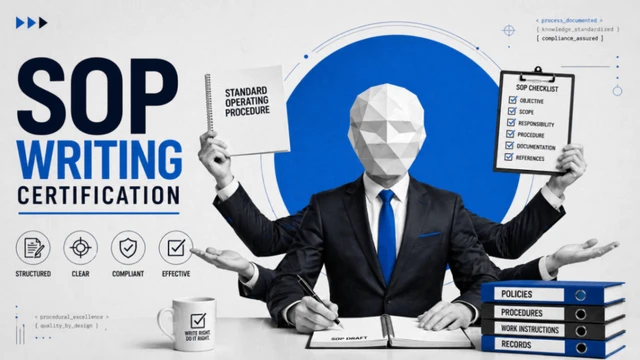
Additionally, a skill like documentation is universal. The SOP Writing Certification teaches you how to create clear, compliant, and easy-to-follow documents—a fundamental skill in any regulated industry, especially RA where precision is key.
This system equips you with the proof of skill that gets your CV noticed and helps you confidently answer technical questions in an interview.
Are You Ready for a Career in Regulatory Affairs?
The regulatory affairs career path in India is waiting for skilled professionals. Your chemistry degree is the entry ticket, but practical skills are what will get you the job and help you grow.
Instead of hoping your degree is enough, take control. Start building the practical skills that companies are willing to pay for.
See how your current skills compare to what hiring managers are looking for. Check your job readiness for a role in Regulatory Affairs today.
Build These Skills Now
Programs from ZANE ProEd Academy that directly address the skill gaps discussed above.
Follow Zane ProEd on Google
Preferred SourceAdd our publication as a preferred source to get the latest clinical research guides, industry updates, and career intel directly in your Google Top Stories & AI Overviews.