Signal Detection Pharmacovigilance Career: Complete Guide for Chemistry Graduates

Signal Detection Specialist A signal detection pharmacovigilance career involves analyzing drug safety data to spot new risks. It's ideal for chemistry graduates as it needs analytical skills, not medical training. Freshers can earn ₹4–8 LPA, with quick growth in the pharma industry.
You did your MSc Chemistry. You finished two pharma internships. Yet job offers don't come. You feel stuck. Here's the thing: most companies don't think internships gave you enough real skills for a signal detection pharmacovigilance career. But that gap is fixable. And we'll show you exactly how.
Signal detection is not just for doctors. Companies now hire science graduates who can think critically with data. If you understand patterns and safety rules, you can build a high-paying career faster than you imagine.
Build These Skills Now
Programs from ZANE ProEd Academy that directly address the skill gaps discussed above.
What is signal detection in pharmacovigilance?
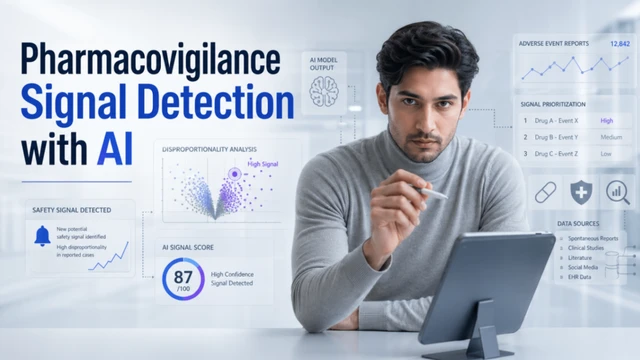
Signal detection means scanning safety data to find new possible side effects of medicines. After a drug is sold, millions use it. Some report problems. Your job is to connect the dots and decide if there is a real reason to worry. This is the heart of pharmacovigilance signal management.
Regulators like WHO and FDA require companies to do this constantly. So every pharma company needs signal detection teams.
What is the salary of a Signal Detection Specialist in India?
The signal detection specialist salary in India varies by experience and location. Here are typical numbers:
- Fresher (0–1 year): ₹3.5–5 LPA
- 1–3 years: ₹5–8 LPA
- Senior (5+ years): ₹10–18 LPA or more
In major pharma hubs like Hyderabad, Bengaluru, or Mumbai, salaries can be higher. With demand rising, jumping to a signal detection pharmacovigilance career early gives you a head start.
How to become a Signal Detection Specialist?
The signal detection job description looks scary but is learnable. Here's a simple path to become a specialist even with a chemistry background:
- Understand core pharmacovigilance concepts - safety databases, case processing.
- Learn signal detection methods: quantitative and qualitative.
- Get hands-on practice with real data sets and tools like Signal Management Systems.
- Build a project portfolio showing you can spot safety signals.
- Apply for entry-level signal detection or drug safety associate roles.
Many freshers skip step 3 and 4 because colleges don't teach them. That's why internships feel empty. More on how to fix that later.
What tools are used for signal detection?
This is where you can really stand out. Companies use specific signal detection tools and methods that are rarely taught in class:
- Oracle Argus / ArisGlobal LifeSphere - safety databases for case entry and retrieval.
- Empirica Signal - used for quantitative signal detection and disproportionality analysis.
- PV Signal - a newer tool for end-to-end signal management.
- Statistical methods: PRR (Proportional Reporting Ratio), ROR (Reporting Odds Ratio), Bayesian methods.
Knowing even one tool deeply makes your CV pop. But reading about them isn't enough - you need to practice on simulated platforms.
What qualifications are needed for signal detection roles?
Good news: you don't need a medical degree. A BSc or MSc in Chemistry, Life Sciences, or Pharmacy is accepted. Companies look for:
- Strong analytical thinking - which chemistry graduates already have.
- Basic knowledge of medical terms and drug actions.
- Attention to detail and data accuracy.
- Certification in pharmacovigilance (like from ICH guidelines training).
- Familiarity with regulatory guidelines (ICH E2E, GVP Module IX).
Most freshers have the degree but not the practical know-how. That's the bottleneck.
Why internships didn't get you a job
Many chemistry graduates feel betrayed after internships. You were told real experience matters. But most internships give you only observation or data entry tasks. Employers know that. What they actually want is someone who can independently run a signal check using a tool like Empirica Signal. Colleges focus on theory; employers demand application. This skill gap is why you're still searching.
Your 4-step plan to land a signal detection role in 6 months
We built this roadmap from talking to hiring managers in top pharma and CROs. Here's exactly what to do:
- Month 1: Build foundations. Study ICH E2E guidelines, basic pharmacovigilance, and case processing. Check our guide on pharmacovigilance case processing jobs to understand related roles.
- Month 2-3: Master signal detection tools. Get hands-on with a simulation platform. Practice running disproportionality analyses and writing signal detection reports.
- Month 4: Create a mini-project. Take a public safety database (like FDA FAERS) and do a sample signal detection exercise. Document your method and findings.
- Months 5-6: Apply smartly. Target entry-level roles like Drug Safety Associate or Signal Management Associate. Highlight your tool skills and project in your resume.
This approach is different because it mirrors real work, not textbook chapters. And it's how you convert a signal detection pharmacovigilance career from dream to reality.
Bridge the skill gap with simulation-based learning
The missing piece for most freshers is a safe place to practice. Reading theory isn't enough. You need a system where you can work with dummy safety data, use tools, and get feedback. This simulation method is used by top medical schools now. It builds muscle memory for signal detection.
Build These Skills Now
Programs from ZANE ProEd Academy that directly address the skill gaps discussed above.
How ZANE ProEd prepares you for signal detection roles
ZANE ProEd built a learning system that mimics a real pharmacovigilance department. Their Signal Detection with AI course lets you practice on industry-used platforms through simulations. You won't just learn definitions; you'll perform actual signal detection cycles. Many students from non-medical backgrounds have used this to land jobs. It's not about buying a course - it's about getting the skill simulation that colleges missed. Check more about pharma careers in our complete guide to pharmacovigilance jobs for freshers.
Ready to test your current signal detection knowledge? See how your skills compare to job requirements.
Build These Skills Now
Programs from ZANE ProEd Academy that directly address the skill gaps discussed above.
Follow Zane ProEd on Google
Preferred SourceAdd our publication as a preferred source to get the latest clinical research guides, industry updates, and career intel directly in your Google Top Stories & AI Overviews.