Signal Detection Pharmacovigilance Career: A Complete Guide for Freshers

Signal Detection Specialist is a career in pharmacovigilance focused on analyzing drug safety data to identify new risks. It requires a science background, training in signal management, and skills in tools like Oracle Argus. Freshers from chemistry can enter with the right upskilling.
As a BSc or MSc Chemistry graduate in India, you might feel the pharmaceutical industry doors are closed unless you have a pharmacy degree. But from a recruiter's perspective, a signal detection pharmacovigilance career is an open opportunity for analytical minds like yours. Companies urgently need specialists who can find hidden safety patterns in drug data—and your chemistry background gives you a head start in data analysis.
Even without industry connections, you can build job-ready skills through the right training. This guide answers the most common questions to help you break into signal detection.
Build These Skills Now
Programs from ZANE ProEd Academy that directly address the skill gaps discussed above.
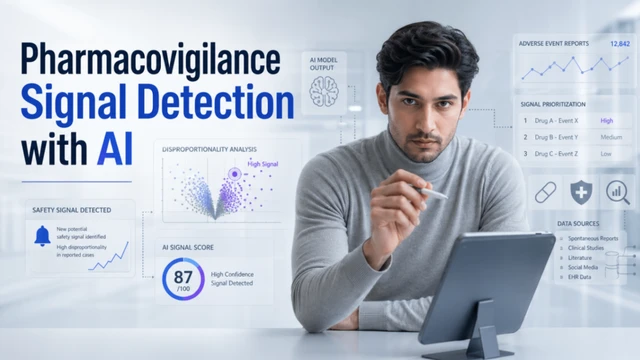
What is signal detection in pharmacovigilance?
Signal detection is the process of finding new, changing, or previously unknown safety issues related to a medicine. It is a core part of pharmacovigilance signal management. Specialists review data from clinical trials, patient reports, and global databases to spot patterns. This job is critical because it helps prevent harm to patients.
The daily tasks of a Signal Detection Specialist include:
- Monitoring adverse event reports in tools like Oracle Argus or ArisGlobal LifeSphere.
- Using statistical methods and algorithms to detect safety signals.
- Preparing signal evaluation reports for regulatory bodies like FDA and CDSCO.
- Collaborating with medical reviewers and pharmacovigilance scientists.
In short, a signal detection job description revolves around protecting public health by identifying risks early.
What is the salary of a Signal Detection Specialist in India?
The signal detection specialist salary in India varies by experience and company. Here are the typical ranges:
- Entry-level (0-2 years): ₹3,00,000 to ₹5,00,000 per annum.
- Mid-level (3-5 years): ₹6,00,000 to ₹10,00,000 per annum.
- Senior/Lead (6+ years): ₹12,00,000 and above.
These figures are based on recruiter insights and job market reports. Large CROs and MNCs often pay higher. Skills in AI-based tools can increase your package by 15-20%.
How to become a Signal Detection Specialist?
If you are a BSc or MSc Chemistry graduate, here is a clear roadmap on how to become a signal detection specialist:
- Build a strong foundation: Learn the basics of pharmacovigilance, ICH guidelines (especially E2E), and drug safety regulations. Refer to ICH and WHO resources.
- Take a specialized course: Enroll in a program that covers signal detection tools and methods, case processing, and real-world projects. Look for simulation-based learning that mimics industry workflows.
- Master the tools: Gain hands-on practice with Oracle Argus, Empirica Signal, or VigiLyze. Many employers expect tool proficiency even from freshers.
- Work on a portfolio: Create sample signal detection reports or contribute to open-source safety data analysis. This proves your practical skills.
- Apply strategically: Highlight your chemistry analytics background and PV training. Network on LinkedIn with recruiters hiring for PV roles. Check our detailed guide for pharmacovigilance jobs for freshers in India.
What tools are used for signal detection?
Modern signal detection relies on both traditional and AI-driven signal detection tools and methods. The most common ones include:
- Oracle Argus Safety: Market leader for case processing and signal management.
- ArisGlobal LifeSphere: Cloud-based platform for end-to-end pharmacovigilance.
- Empirica Signal: Advanced statistical signal detection software.
- VigiLyze: WHO's global database for exploring suspected adverse reactions.
- AI and machine learning tools: Companies now use AI to scan large datasets faster. For example, our career roadmap explains how AI is changing signal detection.
As a fresher, you need at least basic familiarity with one of these tools. Practical training can bridge this gap.
What qualifications are needed for signal detection roles?
Employers typically look for:
- Educational background: BSc, MSc, or B.Pharm in Life Sciences, Chemistry, Biotechnology, or related fields. A chemistry degree is highly relevant because of the strong analytical and data interpretation skills it provides.
- Certification: A recognized certificate in pharmacovigilance and signal detection adds weight. Courses that include hands-on tool training are preferred.
- Technical skills: Knowledge of ICH GxP guidelines, medical terminology, and database querying.
- Soft skills: Attention to detail, critical thinking, and communication.
Many chemistry graduates have successfully transitioned into these roles by acquiring just 3-4 months of targeted upskilling.
The Reality Gap: College vs. Industry
Your chemistry program taught you reaction mechanisms and chromatography. But a signal detection hiring manager expects you to know MedDRA coding, safety database workflows, and signal prioritization algorithms. This skill gap is why many graduates struggle to get hired.
In today's AI-driven healthcare industry, the gap has widened. Companies now use intelligent automation to handle routine case processing. The demand is for specialists who can interpret AI-generated signals and make regulatory decisions. This is not taught in colleges.
Your 5-Step Roadmap to Become Industry-Ready
- Learn PV Fundamentals Online: Start with free resources from ICH and FDA. Understand what a case is, how safety databases work, and the signal detection cycle.
- Enroll in a Simulation-Based Program: Choose a course that gives you a sandbox environment with real drug safety data. This is where you move from theory to practice.
- Get Tool Certified: Obtain proficiency in at least one industry tool like Oracle Argus. Many online platforms offer mock projects.
- Build a Portfolio on GitHub: Create a few sample signal detection reports using public datasets. Share these with your LinkedIn network.
- Apply for Associate/Entry-Level Roles: Target job titles like "Drug Safety Associate - Signal Management" or "Junior Pharmacovigilance Scientist". Customize your resume with keywords like "case processing", "signal detection", and "Argus certified".
How Simulation Helps You Close the Gap
At ZANE ProEd, we understand that reading about signal detection is not enough. That's why our pharmacovigilance-signal-detection-with-ai course uses a simulated industry environment. You work on real-world scenarios, use AI tools, and prepare reports just like you would on the job. This approach builds recruiter-trusted skills without needing industry connections.
By the end, you have a portfolio that proves you can handle the job from day one.
Build These Skills Now
Programs from ZANE ProEd Academy that directly address the skill gaps discussed above.
Take the next step: see how your current skills match up for a signal detection pharmacovigilance career.
Build These Skills Now
Programs from ZANE ProEd Academy that directly address the skill gaps discussed above.
Follow Zane ProEd on Google
Preferred SourceAdd our publication as a preferred source to get the latest clinical research guides, industry updates, and career intel directly in your Google Top Stories & AI Overviews.