Signal Detection Pharmacovigilance Career: Step-by-Step Roadmap for Chemistry Graduates

Signal Detection Specialist A signal detection pharmacovigilance career focuses on finding hidden safety patterns in drug data to protect patients. Specialists review reports, use databases and AI tools to spot potential risks before they become bigger problems. This role blends science, data, and vigilance.
If you feel stuck after your BSc or MSc Chemistry, unsure which career path to choose, you are not alone. The gap between what you study and what industry needs is huge. Many graduates like you search for a signal detection pharmacovigilance career because it offers a way into the growing healthcare industry without a medical degree.
You might wonder: Can a chemistry graduate work in drug safety? Absolutely. Companies need people who understand chemical compounds and can spot unusual patterns. This step-by-step guide will show you exactly how to move from confusion to a clear, high-paying role as a Signal Detection Specialist.
Build These Skills Now
Programs from ZANE ProEd Academy that directly address the skill gaps discussed above.
What is signal detection in pharmacovigilance?
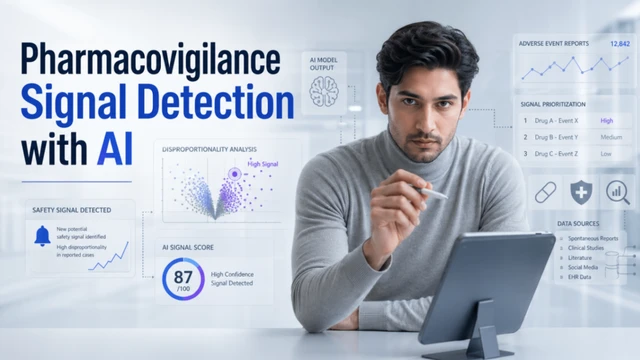
Signal detection in pharmacovigilance is the process of identifying new or changing risks linked to medicines. It involves analyzing large volumes of data from adverse event reports, clinical trials, and medical literature. The goal is to find 'signals' – early warnings that a drug might cause a side effect not seen before. This helps regulators and companies take action to protect patients. For a BSc/MSc Chemistry grad, your background in data analysis and understanding of molecular interactions can be very useful here.
The World Health Organization and ICH have set global guidelines for pharmacovigilance signal management. As a specialist, you work with global safety databases and collaborate with medical reviewers to confirm signals.
What is the salary of a Signal Detection Specialist in India?
For freshers, starting salary ranges from ₹3.5 to ₹6 lakhs per annum. With 2-4 years of experience, you can earn ₹6-10 lakhs. Senior specialists with 5+ years may get ₹12-18 lakhs. These numbers vary by company, location, and skills. Learning AI-based signal detection tools can boost your pay. Many pharma hubs in Pune, Hyderabad, and Bangalore offer competitive packages.
Check our detailed guide on pharmacovigilance jobs for freshers in India to see current trends.
How to become a Signal Detection Specialist?
Follow these steps:
- Build foundational knowledge: Learn the basics of pharmacovigilance and drug safety. Free resources from FDA and CDSCO can help.
- Understand regulations: Study ICH E2E guidelines and GVP modules. This is the backbone of signal detection work.
- Get tool practice: Use simulations to learn Oracle Argus, ArisG, or VigiBase. Hands-on experience is what recruiters value.
- Develop data skills: Learn basic SQL and Excel for analyzing large datasets.
- Apply for internships: Start as a drug safety associate or pharmacovigilance trainee. See our article on pharmacovigilance case processing for freshers for entry points.
What tools are used for signal detection?
Common tools include:
- Oracle Argus – widely used for case processing and signal detection.
- ArisG – a safety database with built-in signal detection modules.
- VigiBase – WHO's global database of adverse event reports.
- EudraVigilance – European Union's system managed by EMA.
- Empirica Signal – advanced AI-driven tool for statistical signal detection.
Additionally, you use disproportionality analysis methods like PRR (Proportional Reporting Ratio) and ROR (Reporting Odds Ratio). Today, AI and machine learning are changing how signals are detected, making the field more exciting.
What qualifications are needed for signal detection roles?
A typical signal detection job description asks for:
- A degree in BPharm, MSc Chemistry, or related life sciences.
- 0–2 years of experience in pharmacovigilance (freshers can apply with relevant internships).
- Knowledge of MedDRA coding and regulatory guidelines.
- Proficiency in safety databases and MS Excel.
- Strong attention to detail and analytical thinking.
Chemistry graduates are often preferred because they can understand drug structures and impurities. But the biggest gap is hands-on experience with tools. That's where simulation-based training comes in.
The Reality Gap: College vs. Employer Expectations
In college, you learn about chemical equations and lab techniques. But in a signal detection role, you deal with safety cases, medical codes, and regulatory timelines. Employers expect you to know how to navigate a safety database on day one. Most freshers lack this practical exposure, leading to rejection despite good grades.
For a BSc/MSc Chemistry graduate, the shift from lab glassware to global pharmacovigilance systems is huge. You need a bridge that connects your scientific mind to industry workflows.
A Step-by-Step Roadmap to Start Your Career
Here is a clear path to become a Signal Detection Specialist:
- Learn the basics (1 week): Watch introductory videos on drug safety and read overviews of signal detection.
- Study key regulations (2 weeks): Go through ICH E2E and E2B. Use the official ICH website.
- Get simulation access (4 weeks): Practice on platforms that mirror industry tools. Focus on creating and reviewing cases, generating reports, and spotting signals.
- Build a mini project (1 week): Take a sample dataset and perform a disproportionality analysis. Document your findings.
- Polish your resume and apply: Highlight hands-on experience and your chemistry background. Target companies in Hyderabad, Pune, and Bangalore.
How Simulation-Based Learning Accelerates Your Entry
Instead of just reading theory, simulation-based systems let you 'learn by doing'. You get to work with dummy safety data, generate signals, and use the same interfaces as top pharma companies. This practical approach builds muscle memory and confidence. It's the fastest way to show recruiters you are job-ready.
Build These Skills Now
Programs from ZANE ProEd Academy that directly address the skill gaps discussed above.
The Right System for Chemistry Graduates
ZANE ProEd's system, 'Pharmacovigilance Signal Detection with AI', is built exactly for this transition. It uses interactive case studies and real-world data sets. You don't just memorize facts – you work on signal detection just like a specialist would. The program integrates AI tools that are now used by major global firms. This isn't a typical course; it's a career launchpad tailored for chemistry graduates who want to enter the pharmacovigilance field with confidence. Explore how this system can help you master signal detection tools and methods without any prior experience.
By now, you have a clear picture of the signal detection pharmacovigilance career path. The next step is to test your readiness. ZANE ProEd offers a quick self-assessment to see where you stand.
Check your job readiness today – the industry is waiting for skilled chemistry graduates like you.
Build These Skills Now
Programs from ZANE ProEd Academy that directly address the skill gaps discussed above.
Follow Zane ProEd on Google
Preferred SourceAdd our publication as a preferred source to get the latest clinical research guides, industry updates, and career intel directly in your Google Top Stories & AI Overviews.