Signal Detection Pharmacovigilance Career: A Step-by-Step Guide for Non-Medical Graduates

Signal detection pharmacovigilance career involves using statistical tools and clinical judgment to identify new safety signals from drug safety databases. It's a high-demand role open to graduates from non-medical backgrounds like BSc, BCA, and BTech if you acquire the right skills in pharmacovigilance signal management.
Are you from a tier-2 or tier-3 college with a degree in BSc, BCA, or BTech, and wondering if a stable, high-growth career is possible? A signal detection pharmacovigilance career might be your perfect entry into the life sciences industry. Many freshers like you have successfully switched from IT or BPO roles into this specialized domain.
The best part? You don't need a medical background. What you need is a clear roadmap and practical knowledge of the tools and workflows. This guide breaks down everything step by step, so you can land a job in the next hiring cycle.
Build These Skills Now
Programs from ZANE ProEd Academy that directly address the skill gaps discussed above.
What is signal detection in pharmacovigilance?
In simple terms, signal detection is the process of finding new or changing safety issues related to a medicine. It is a key part of pharmacovigilance signal management. After a drug is on the market, companies must continuously monitor reports of side effects. A signal emerges when there is a possibility that a drug is linked to a particular adverse event more than expected.
As a signal detection specialist, you will review large databases of case reports, apply statistical methods, and prepare reports for medical reviewers. The goal is to catch potential risks early to protect patients. This work is guided by international standards from organizations like the ICH and WHO.
What is the salary of a Signal Detection Specialist in India?
The signal detection specialist salary in India varies based on experience and company. Here's a realistic breakdown for freshers:
- Entry-level (0-2 years): ₹3.5 to ₹5.5 LPA
- Mid-level (2-5 years): ₹6 to ₹10 LPA
- Senior (5+ years): ₹12 to ₹20+ LPA
Salaries are often higher in multinational companies and consulting firms. Even starting from a tier-2 city, remote roles and hybrid setups are becoming common. The investment in learning pays off quickly.
How to become a Signal Detection Specialist?
Wondering how to become a signal detection specialist? Follow this practical action plan:
- Understand the basics: Start with a foundation in pharmacovigilance. Read free resources on CDSCO and FDA websites to learn about adverse event reporting.
- Learn signal detection tools: Master industry-standard software like Oracle Argus, ArisG, or Empirica Signal. Even a basic hands-on practice gives you an edge.
- Get trained in methodologies: Study quantitative methods like PRR, ROR, and Bayesian methods. Understand how to write a signal validation report.
- Build a practical portfolio: Use simulation-based platforms to work on real-world case processing and signal detection scenarios. This is crucial because employers want to see you can do the job from day one.
- Apply strategically: Target entry-level roles like Drug Safety Associate or Signal Detection Analyst. Customize your resume with the right keywords: signal detection, pharmacovigilance, ICSR, case processing, Argus safety.
What tools are used for signal detection?
The signal detection tools and methods are the heart of this role. Hiring managers expect you to know at least a few of these:
- Safety databases: Oracle Argus, ArisG (ArisGlobal), or Empirica Signal. These are used for case processing and signal management.
- Statistical tools: Methods like Proportional Reporting Ratio (PRR), Reporting Odds Ratio (ROR), and Bayesian Confidence Propagation Neural Network (BCPNN) are applied to calculate signal scores.
- Visualization: Tools like Spotfire or Tableau help in creating trend charts and dashboards for signal review meetings.
- Documentation: You will work with documents like PSURs, DSURs, and RMPs, so familiarity with templates is a plus.
If you come from an IT or data background, these tools will feel natural. With guided practice, you can quickly become proficient.
What qualifications are needed for signal detection roles?
The signal detection job description often lists a degree in life sciences, pharmacy, or medicine, but companies are increasingly open to non-traditional profiles. Here's what matters most:
- Educational background: A BSc (any stream), BCA, BTech, or even a B.Com can work if you have the right certification and skills.
- Technical skills: Proficiency in MS Excel for data manipulation and a basic understanding of statistics is essential.
- Certification: A recognized certification in pharmacovigilance or signal detection bridges the gap. Look for programs that offer hands-on tool training, not just theory.
- Soft skills: Attention to detail, analytical thinking, and clear communication are highly valued.
Also, read our detailed guide on signal detection for medical graduates to see how you can adapt even without a medical degree.
What Your College Didn't Teach You
If you're from a tier-2 or tier-3 college, let's be honest: your curriculum probably focused on theory—concepts of drug action, maybe some basic pharmacology. But here's the reality: employers expect you to know how to navigate a safety database, triage an ICSR, and run a disproportionality analysis on day one. This gap is why many graduates struggle in interviews.
You need to build workflow knowledge—the step-by-step process of case intake, duplicate check, seriousness coding, narrative writing, and signal detection. Without practice, these sound like buzzwords. With simulation-based training, they become your daily tasks.
Your Step-by-Step Roadmap to a Signal Detection Career
- Step 1: Immerse in the terminology (Week 1-2)
Spend a few hours daily learning key terms: ICSR, MedDRA, causality assessment, labeling. Free videos and articles can get you started. Bookmark the EMA guidelines for reference. - Step 2: Get hands-on with a safety database (Week 3-6)
This is non-negotiable. Use a simulation environment to practice data entry, duplicate search, and case processing. Check our guide on case processing jobs for freshers to understand the entry-level work. - Step 3: Master signal detection methods (Week 7-10)
Learn how to calculate PRR, interpret a data mining result, and draft a signal detection report. Apply these on practice datasets. - Step 4: Build your application portfolio (Week 11-12)
Prepare a resume that highlights your tool skills and practical projects. Create a sample signal validation report to attach with applications. - Step 5: Ace the interview (Ongoing)
Practice common questions: 'What is a signal?', 'How do you handle a duplicate case?', 'What is the difference between a signal and a risk?'
The Missing Piece: Simulation-Based Learning
Most online courses give you theory but leave you blank when the interviewer asks, 'Have you worked on Argus?' That's where simulation-based platforms come in. You work on realistic cases, get instant feedback, and build confidence without fear of real-world mistakes. It's like a flight simulator for your career. By the time you face a real database, you already know the buttons to click.
Build These Skills Now
Programs from ZANE ProEd Academy that directly address the skill gaps discussed above.
How ZANE ProEd's Signal Detection Program Fits In
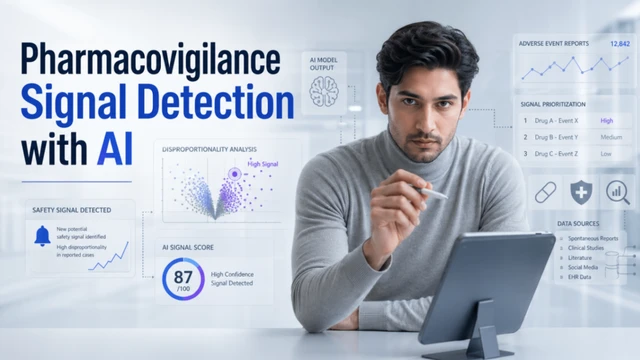
The Pharmacovigilance Signal Detection with AI program is built for beginners from non-medical backgrounds. It doesn't just teach definitions; it puts you in a live environment where you practice end-to-end signal management—from case processing to signal analysis using AI-assisted tools. You'll learn the exact workflows demanded by top employers. This program has helped graduates from small towns secure roles in Bengaluru, Hyderabad, and even remotely. Check the ZANE ProEd approach to see why our method works.
Ready to Test Your Signal Detection Skills?
Don't wait for the next hiring cycle to catch you unprepared. Take our free readiness quiz to see where you stand. Compare your skills against real job requirements and discover exactly what you need to work on to land your dream role.
Build These Skills Now
Programs from ZANE ProEd Academy that directly address the skill gaps discussed above.
Follow Zane ProEd on Google
Preferred SourceAdd our publication as a preferred source to get the latest clinical research guides, industry updates, and career intel directly in your Google Top Stories & AI Overviews.