Beyond Theory: A Signal Detection Specialist's Real Workflow in an AI World
The Signal Detection Myth Your University Taught You
Let’s pull back the curtain. You’ve finished your Life Sciences degree. You’ve memorized the definition of 'signal detection' and can probably recite the basics of pharmacovigilance from a textbook. You believe you're ready. But the industry sees something different. They see theory without application, a list of definitions without the muscle memory of execution.
The truth is, the neat, linear process you learned in a classroom is a phantom in today's AI-driven healthcare industry. The real world of a Signal Detection Specialist isn't about answering multiple-choice questions; it’s about navigating a chaotic, high-stakes environment where data from millions of patients pours in daily. It's about finding a needle of true risk in a haystack of digital noise, and the haystack is growing exponentially every second.
Reality Disruption: Your Degree is Not a Work Permit
This is the conversation hiring managers have behind closed doors. Your degree got you past the initial HR filter. Your certification proves you can study. But neither proves you can do the job. The brutal reality is that industry expects you to walk in with practical knowledge of their tools and, more importantly, their workflows. They don’t have six months to teach you what you should have learned to make yourself job-ready.
Build These Skills Now
Programs from ZANE ProEd Academy that directly address the skill gaps discussed above.
They expect you to understand the difference between data from the FDA's FAERS database versus real-world evidence from a clinical study. They assume you know how to interpret the outputs of statistical algorithms and, increasingly, AI-powered pattern recognition systems. Your theoretical knowledge is the starting line, not the finish line. The race is won by those who can demonstrate workflow proficiency from day one.
The Industry Insider's View: What We Actually Look For
As someone who has seen countless resumes and interviewed dozens of candidates, I can tell you this: we don't hire encyclopedias. We hire problem-solvers. We need specialists who can function within the rigorous, regulated frameworks set by bodies like the European Medicines Agency (EMA) and the Central Drugs Standard Control Organisation (CDSCO) in India.
We need you to understand not just what a Signal Workup Report is, but how to draft one under pressure. We need you to know the principles of ICH guidelines, not just as a concept, but as a set of rules that govern every action you take. Your ability to speak the language of workflows, data queries, and risk assessment is what separates you from the stack of other applicants with the exact same degree.
The Skill Gap Exposed: Academic Theory vs. Operational Reality
The gap between what universities produce and what the industry demands is wider than ever. It's not a knowledge gap; it's a performance gap.
- Academic Output: Knows the definition of disproportionality analysis. Can list methods like PRR and ROR.
- Industry Expectation: Can run a disproportionality analysis on a messy, real-world dataset from a safety database, interpret the results in a clinical context, and justify the choice of one statistical method over another.
- Academic Output: Can define 'adverse event of special interest' (AESI).
- Industry Expectation: Can help develop an AESI list for a new compound based on its mechanism of action and then build the surveillance strategy to monitor for it post-launch.
- Academic Output: Understands that AI is used in pharmacovigilance.
- Industry Expectation: Can interpret the output of an AI-driven anomaly detection system, validate its findings with traditional methods, and explain its implications to a non-technical Safety Management Team.
Introducing The Workflow Simulation Gap™
This disconnect has a name: The Workflow Simulation Gap™. It’s the chasm between knowing the steps and having executed them. Academic learning gives you a map, but it doesn't teach you how to drive in traffic, navigate unexpected detours, or handle the vehicle under pressure. The industry doesn't need more map readers; it needs skilled drivers.
The Workflow Simulation Gap™ is why bright graduates with perfect GPAs often fail technical interviews. They can describe the 'what' but freeze when asked to detail the 'how'. Closing this gap is the single most critical step in your transition from student to a high-value Signal Detection Specialist.
The Real AI-Integrated Signal Detection Workflow
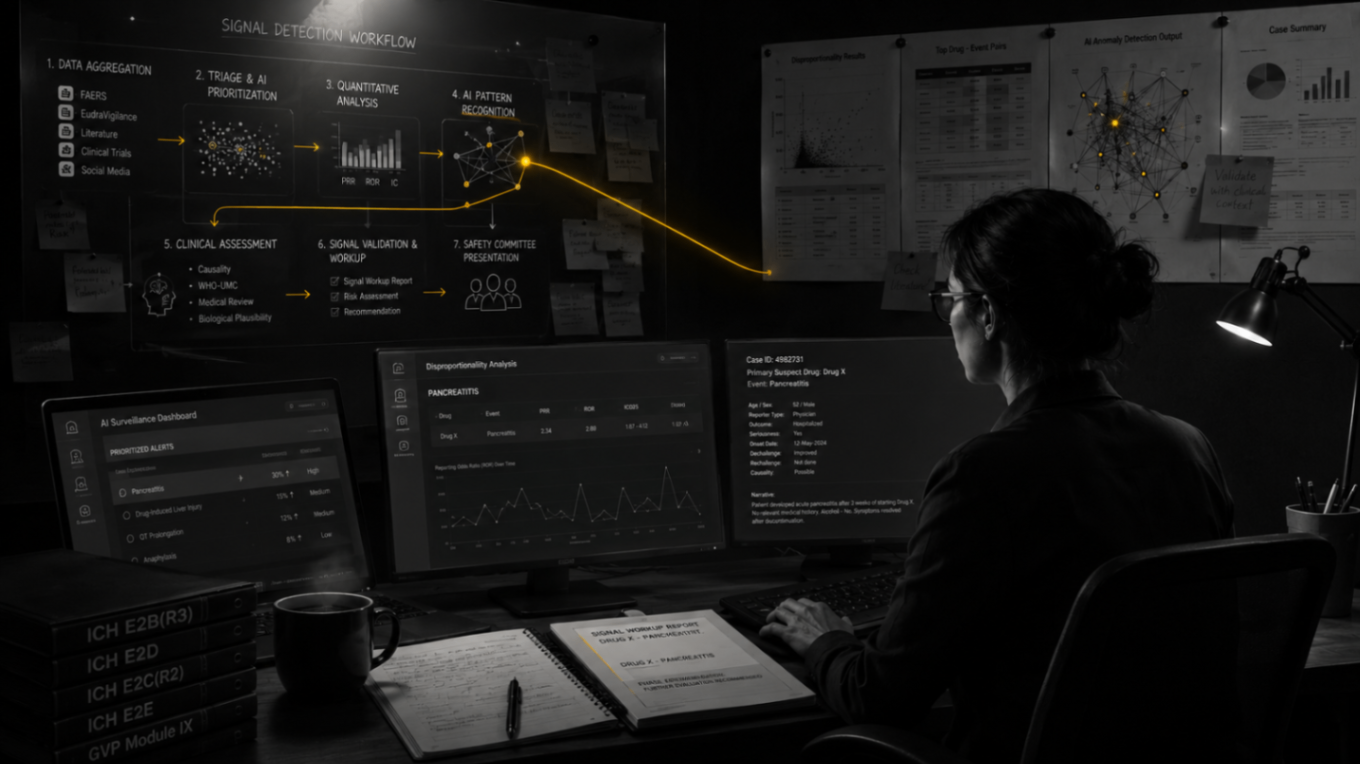
So, how do you close the gap? By mastering the real workflow. Forget the textbook chapters. This is the operational sequence from data to decision:
- Data Aggregation & Triage: The process begins with raw data from multiple sources – spontaneous reports (FAERS, EudraVigilance), clinical trial data, and literature. An initial AI-powered triage often flags duplicate reports and prioritizes cases based on severity and listedness.
- Quantitative Signal Detection: This is where you run the numbers. Using statistical software, you perform disproportionality analyses (e.g., PRR, ROR, IC) to identify drug-event combinations that are reported more frequently than expected. This is a core competency.
- AI-Enhanced Pattern Recognition: This is the modern layer. Sophisticated algorithms now scan the entire database for complex patterns that traditional statistics might miss—for example, a cluster of events in a specific demographic or a time-to-onset trend. Your job is to validate and interpret these AI-generated hypotheses.
- Clinical & Qualitative Assessment: Data is nothing without context. You must dive into individual case reports, assess causality (e.g., using the WHO-UMC causality assessment scale), review the medical literature, and consider biological plausibility. Is there a scientific reason this drug could cause this event?
- Signal Validation & Workup: You synthesize all your findings into a formal Signal Workup Report. This document presents the evidence, your analysis, and a recommendation on whether the signal is validated and requires further action (e.g., a label change, a Dear Doctor letter).
- Safety Committee Presentation: Finally, you present your findings to the company's Safety Management Team. You must defend your analysis, answer challenging questions from clinicians and executives, and clearly communicate the potential risk.
A Micro-Scenario: Your First Real Task
It's Tuesday morning. The AI surveillance system flags a 30% increase in reports of 'pancreatitis' for a drug that's been on the market for two years. The alert is on your desk. The system provides the raw case numbers and a preliminary statistical score. Your manager wants a one-page summary of the potential signal by 4 PM. What do you do? Where do you even begin? This isn't a test. This is the job.
Bridging the Gap: From Passive Learning to Active Simulation
Reading about that workflow is one thing. Executing it under pressure is another. The only way to gain the confidence and competence the industry demands is through hands-on simulation. You need a controlled environment—a digital sandbox—where you can work with real (anonymized) data, use industry-standard tools and AI outputs, and run through the entire workflow from data aggregation to a mock safety committee presentation. This is how you build the 'muscle memory' of a professional.
This is where you stop being a student and start becoming a specialist. You move from simply knowing the terms to performing the tasks, making the decisions, and defending your conclusions. That is the bridge across the Workflow Simulation Gap™.
Build These Skills Now
Programs from ZANE ProEd Academy that directly address the skill gaps discussed above.
The ZANE ProEd System: An Industry Replication Engine
This is precisely why we built the ZANE ProEd training ecosystem. We don't sell courses; we provide access to a system that replicates the industry environment. Our programs are designed to immerse you in this exact workflow.
For instance, our Pharmacovigilance Signal Detection with AI program doesn't just teach you about AI; it places you in a simulated environment where you must use AI-generated outputs to conduct a real signal investigation. You’ll perform the quantitative analysis, the qualitative review, and draft the reports. Following that, the Post-Marketing Surveillance & Real-World Evidence program expands this view, showing you how signal detection fits into the larger lifecycle of a drug, integrating data from RWE studies to inform safety decisions long-term. Together, they form an integrated system for building a robust, modern skillset that hiring managers are desperate to find.
It’s about moving beyond passive learning and into a world of active, simulated practice. If this reality check resonates with you, it's time to stop collecting certificates and start building capabilities. The industry doesn't reward those who know the most; it rewards those who can do the most. Before you even update your resume, understand the fundamental shift discussed in The Pharmacovigilance Shock facing freshers.
Your Next Move: Stop Applying, Start Simulating
The path forward is clear. The cycle of applying for jobs with a purely academic profile leads to rejection. It's a frustrating and inefficient approach. The alternative is to build undeniable, demonstrable proof of your skills within a simulated industry environment. Before you send another application, we strongly recommend you read our strategic guide on why you must stop applying for pharmacovigilance jobs with your current approach.
Begin the process of transforming your theoretical knowledge into practical expertise. Start by mapping your current skills against the real industry workflow outlined above. Identify your gaps, and then take deliberate action to fill them not with more theory, but with simulated, hands-on experience.
Build These Skills Now
Programs from ZANE ProEd Academy that directly address the skill gaps discussed above.
Follow Zane ProEd on Google
Preferred SourceAdd our publication as a preferred source to get the latest clinical research guides, industry updates, and career intel directly in your Google Top Stories & AI Overviews.