Stop Memorizing MedDRA Codes: The Skill Your Medical Coder Certificate Didn't Teach You

The Useless Certification: Why Your Medical Coder Training is Already Obsolete
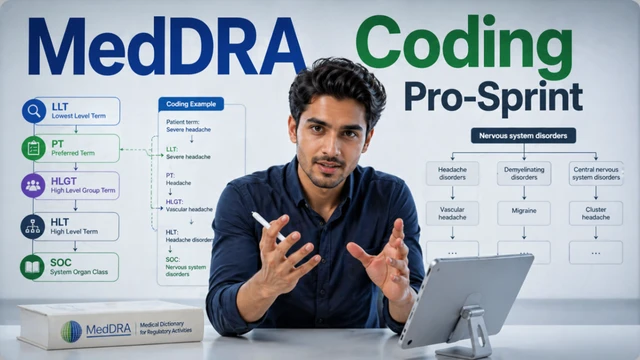
Stop memorizing MedDRA codes. Seriously. You’ve spent months cramming hierarchies, Preferred Terms (PTs), and Lower-Level Terms (LLTs), believing this intellectual brute force is your ticket to a Medical Coder job. But in today's AI-driven healthcare industry, that’s like learning to spell without knowing how to write a sentence. A machine can look up codes faster and more accurately than you ever will.
The hard truth fresh graduates refuse to accept is that your certification proves one thing: you can pass a multiple-choice test. It says nothing about your ability to function in a real-world pharmacovigilance department. The industry isn't hiring human search engines. It's desperate for clinical detectives—professionals who can interpret, contextualize, and apply judgment to ambiguous case narratives. What the machine can't do is apply that judgment. That’s the gap where careers are built… or broken.
Reality Disruption: The Hiring Manager’s Filter
That shiny certificate you framed? To a hiring manager, it’s just a baseline filter, not a guarantee. They know the difference between theoretical knowledge and operational readiness. They’ve seen hundreds of candidates who can define an adverse event but freeze when handed a one-paragraph email from a patient describing a complex series of symptoms.
Build These Skills Now
Programs from ZANE ProEd Academy that directly address the skill gaps discussed above.
The assumption that a certificate equals competence is the single biggest career killer for aspiring medical coders. Internships are often no better, relegating you to shadow-work and data entry, never allowing you to own a decision. The real work of a Medical Coder isn't finding a code; it's defending your choice of code based on medical context and regulatory guidelines like those from the International Council for Harmonisation (ICH).
The Industry Insider View: We Don't Test Your Memory, We Test Your Logic
As people who build and manage drug safety teams, we can tell you precisely what happens in an interview. We don't ask you to recite the System Organ Classes (SOCs). We give you a messy, anonymized case narrative and say, “Code this.”
The candidates who fail are the ones who immediately jump into a MedDRA browser and pull the first term that matches a keyword. The candidates who get the job offer are the ones who pause, think, and ask questions: “What was the temporal relationship between drug administration and event onset? Are there co-morbidities? What are the concomitant medications?” They are trying to understand the full clinical picture before ever touching the dictionary. This is the chasm between academia and industry. You can read more about this in our analysis titled The Pharmacovigilance Shock awaiting freshers.
Skill Gap Exposure: College Output vs. Industry Expectation
Let's get specific. Here is the fundamental gap:
- College Output: You know that MedDRA is a standardized medical terminology developed by ICH. You can list its five hierarchical levels. You can define a Preferred Term.
- Industry Expectation: You receive a narrative: “Patient felt woozy and sick to his stomach about an hour after the new pill. He also complained of a pounding in his head, which he gets sometimes.” You must apply the MedDRA Term Selection: Points to Consider document, decide if “woozy” is 'Dizziness' or 'Somnolence', determine if “sick to his stomach” is 'Nausea' or 'Vomiting', and assess if the 'Headache' is related or coincidental. Your choice directly impacts the drug's safety profile and what gets reported to regulatory authorities like the FDA.
The first is memory. The second is a high-stakes analytical skill. High-value professionals operate at the second level, which is why a skilled Clinical Data Manager's salary reflects this advanced capability.
The ZANE ProEd Framework: The Clinical-Contextual Coding Matrix™
To bridge this gap, we train professionals using the Clinical-Contextual Coding Matrix™. This proprietary framework forces you to move beyond simple keyword matching and evaluate every potential term against four critical pillars:
- Narrative Integrity: Does the code accurately represent the event as described by the reporter?
- Medical Plausibility: Does the code make sense within the patient’s overall clinical picture?
- Regulatory Intent: Does the code fulfill the reporting requirements of agencies like the European Medicines Agency (EMA) without over- or under-representing the risk?
- Data Consistency: Does the code align with how similar events have been coded previously for this product, ensuring clean data for signal detection?
Coders who use this matrix don't just pick terms; they build a defensible, logical case for each data point they create.
Your Structured Pathway to Real-World Proficiency
Forget cramming. Start applying. Here is the step-by-step process for developing real-world coding skills:
- Deconstruct the Narrative: Break down the source text into individual medical concepts, patient demographics, and temporal data points. Isolate symptoms from diagnoses.
- Apply Medical Logic First: Before opening any tool, group the concepts. Is 'chest tightness' and 'shortness of breath' part of a single cardiac event or two separate issues? This is a medical decision, not a coding one.
- Hypothesize and Verify: Form a hypothesis about the best PT to represent the concept. Then, use a MedDRA browser not to search, but to *verify* if your chosen PT and its corresponding LLTs are the best fit.
- Document Your Rationale: For any ambiguous case, add a note explaining *why* you chose one term over another. This is the most valuable skill you can develop. It demonstrates critical thinking and protects data integrity.
Micro Scenario: The Flight Simulator Test
Imagine you're given this case narrative:
“A 68-year-old female with a history of osteoarthritis taking ‘Drug Y’ reported that her hands felt ‘tingly and numb’ this morning. She mentioned she might have slept on her arm wrong.”
A novice coder sees ‘tingly and numb’ and immediately codes PT: Paraesthesia. An expert, using the Clinical-Contextual Coding Matrix, thinks differently:
- Narrative Integrity: The patient offered an alternative cause (“slept on her arm wrong”). This must be considered.
- Medical Plausibility: Could this be a peripheral neuropathy, a known side effect class? Or is it a simple positional issue?
- Regulatory Intent: Coding this as a simple ‘Paraesthesia’ without context could incorrectly contribute to a safety signal. The alternative cause is a critical piece of information.
- Decision: A skilled coder might still use PT: Paraesthesia, but would flag the case for medical review or add a detailed comment in the case notes about the alternative etiology. This nuance is everything.
The System Bridge: From Theory to Application
How do you build this level of judgment without having a job for 2 years? You can't learn it from a textbook, and you won't learn it by watching someone else work. You must be put in the hot seat.
The only effective way to forge these skills is through high-fidelity simulation. You need to process hundreds of varied, realistic case narratives, from the simple to the impossibly complex. You need to make coding decisions, see the consequences, and get expert feedback in a closed-loop system. This is the flight simulator for medical coders, building the muscle memory for clinical analysis before you ever touch a live, high-stakes project.
Build These Skills Now
Programs from ZANE ProEd Academy that directly address the skill gaps discussed above.
Integrating into the Academy System
This simulation-centric approach is the core of the ZANE ProEd system. It’s not about selling you another course; it’s about immersing you in an operational environment that mirrors the industry’s top pharmaceutical companies.
Our MedDRA Medical Coding Certification module isn't a vocabulary test. It’s a dynamic training ground where you apply the Clinical-Contextual Coding Matrix™ to a vast library of real-world case scenarios. You don't just learn the 'what'; you master the 'why'.
Furthermore, we place this skill within its proper context. The ICSR Case Processing & Triage program shows you exactly how your coding decisions impact the entire pharmacovigilance workflow. You'll understand that a medical coder is not an isolated functionary but the gatekeeper of data quality for patient safety. This systemic understanding is what makes you not just hirable, but invaluable.
Your Next Step: Stop Studying, Start Simulating
The path forward is clear. Stop collecting certificates that prove you can memorize. Start building the tangible, defensible skills that prove you can perform.
Your career as a Medical Coder won't be defined by the definitions you know, but by the judgments you can make under pressure. It's time to step out of the classroom and into the simulation. Deconstruct your first complex case narrative and feel the difference between knowing and doing.
Build These Skills Now
Programs from ZANE ProEd Academy that directly address the skill gaps discussed above.
Follow Zane ProEd on Google
Preferred SourceAdd our publication as a preferred source to get the latest clinical research guides, industry updates, and career intel directly in your Google Top Stories & AI Overviews.